MEPCO Peak Hours Timing 2026: Summer & Winter Schedule + Bill Saving Tips
If your electricity bill suddenly feels heavy, the time you use power may be part of the reason. MEPCO peak hours are the evening hours when demand on the grid is highest, and consumers with a Time of Use (TOU) meter pay a higher rate for every unit used in that window. This guide gives you the complete MEPCO peak hours timing for 2026, explains who is charged peak rates, shows the price difference, and shares simple tips to cut your bill.
MEPCO Peak Hours Timing 2026 (Season-Wise)
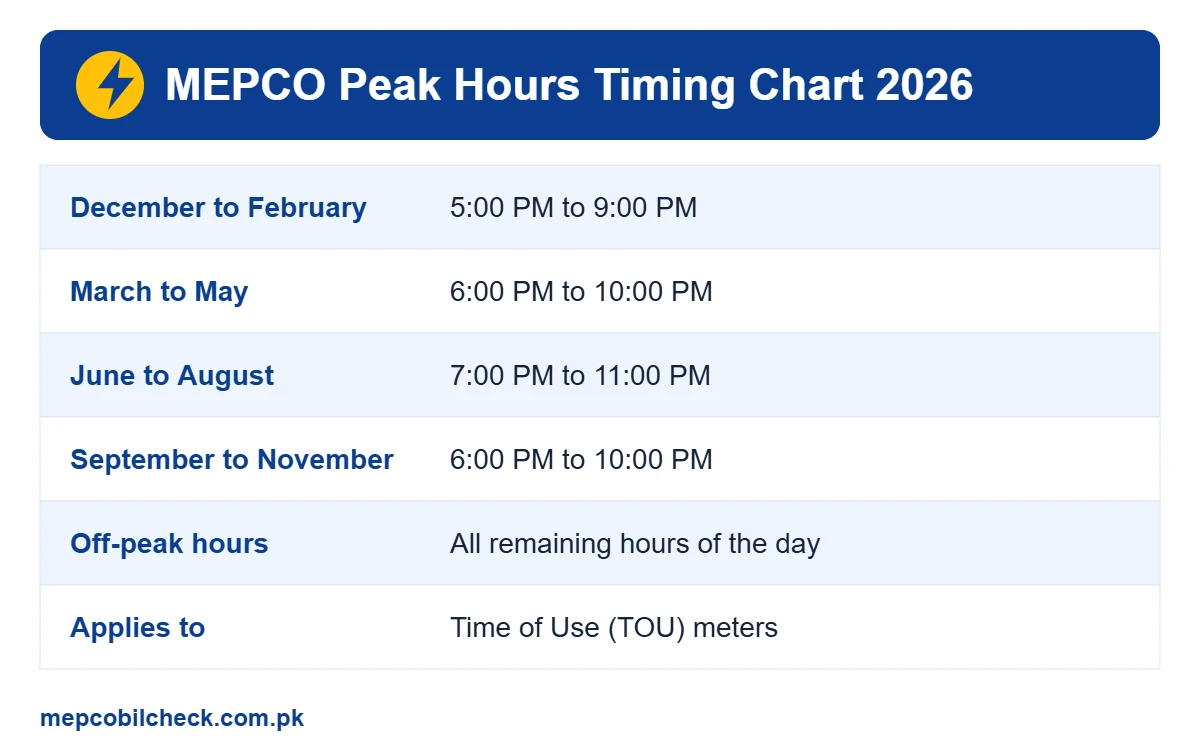
MEPCO follows the same seasonal peak hours schedule that applies to all former WAPDA distribution companies under NEPRA’s tariff. The peak block is four hours long in every season, but it moves with sunset time:
| Season | Months | Peak hours | Off-peak hours |
|---|---|---|---|
| Winter | December to February | 5:00 PM to 9:00 PM | Remaining 20 hours |
| Spring | March to May | 6:00 PM to 10:00 PM | Remaining 20 hours |
| Summer | June to August | 7:00 PM to 11:00 PM | Remaining 20 hours |
| Autumn | September to November | 6:00 PM to 10:00 PM | Remaining 20 hours |
Right now (October to November 2026), MEPCO peak hours are 6:00 PM to 10:00 PM. From 1 December, the window shifts to 5:00 PM to 9:00 PM for winter.
What Are Peak and Off-Peak Hours?
Peak hours are the part of the day when most homes, shops and offices use electricity at the same time. In Pakistan this happens in the evening, when lights, fans, air conditioners and kitchen appliances all run together. Producing electricity for this short burst of demand is expensive, so NEPRA sets a higher price for units used during MEPCO peak hours and a lower price for MEPCO off peak hours.
The idea is simple: if consumers move some of their usage to off-peak hours, the grid stays stable and everyone benefits from lower generation costs.
Who Pays Peak Hour Rates in MEPCO?
Not every consumer pays a different rate in peak hours. It depends on your meter and sanctioned load:
- TOU (Time of Use) meter consumers: Units are recorded separately for peak and off-peak hours, and each is charged at its own rate.
- Residential connections with a sanctioned load of 5 kW or more: TOU metering is compulsory, so peak hours MEPCO rates apply.
- Residential connections below 5 kW: These usually stay on normal slab billing, where every unit has the same rate regardless of time.
- Commercial and industrial connections: Many are on TOU tariffs, so their peak and off-peak units are billed separately.
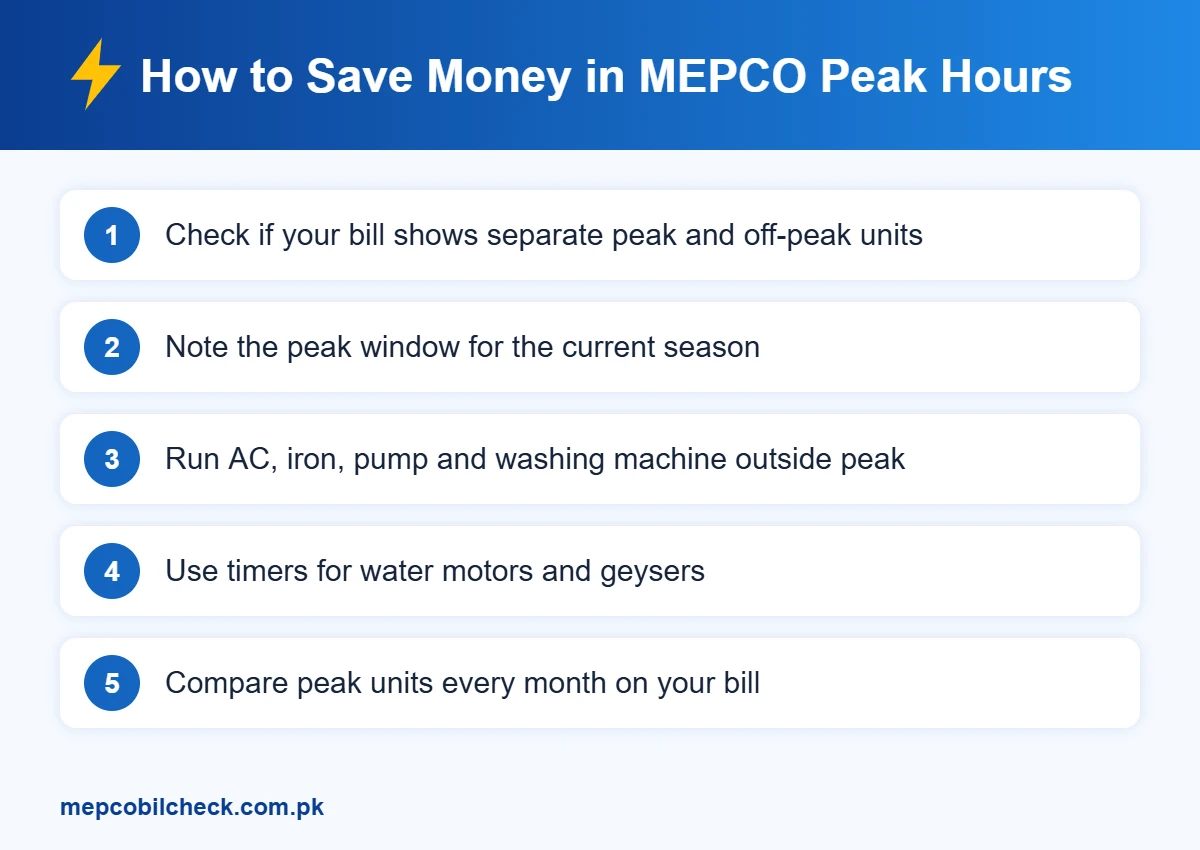
To check your type, look at the units section of your bill. If you see separate “Peak” and “Off-peak” readings, MEPCO peak hours timing directly affects your bill. You can view your latest bill on our MEPCO bill check online page.
MEPCO Peak vs Off-Peak Rates in 2026
Under NEPRA’s uniform tariff decision for calendar year 2026 (notified in February 2026), the base energy rates for residential TOU consumers of ex-WAPDA companies, including MEPCO, are:
| Residential TOU | Rate per unit (base) |
|---|---|
| Peak hours | Rs 46.85 |
| Off-peak hours | Rs 34.53 |
| Difference | Rs 12.32 per unit |
| Fixed charges (TOU) | Rs 675 per kW per month, on 50% of sanctioned load or MDI, whichever is higher |
These are base rates only. Your final bill also includes fuel price adjustment (FPA), quarterly adjustments and taxes, so the real per-unit cost is higher. Rates can change after a new NEPRA decision, so always check the latest notification on NEPRA’s website.
Example: How Peak Hours Change Your Bill
Imagine a TOU consumer who uses 300 units in a month:
- Case 1: 90 units in peak hours and 210 units off-peak. Energy cost = (90 x 46.85) + (210 x 34.53) = Rs 4,216.50 + Rs 7,251.30 = Rs 11,467.80
- Case 2: The same family shifts 50 units out of the peak window, so 40 peak and 260 off-peak. Energy cost = (40 x 46.85) + (260 x 34.53) = Rs 1,874 + Rs 8,977.80 = Rs 10,851.80
By moving just 50 units, the family saves about Rs 616 in base energy charges in one month, before taxes and adjustments. Over a full summer, the saving adds up quickly.
How to Check Your Peak Units on the MEPCO Bill
- Open your latest bill using your 14-digit reference number.
- Find the meter reading section near the units consumed.
- Look for two separate readings marked for peak and off-peak.
- Compare peak units with last month in the bill history table.
- If peak units look wrong, photograph your meter display and report it.
If you think the reading is incorrect, you can register a billing complaint through the MEPCO complaint number 118 or the PITC online complaint portal.
Smart Ways to Save Money During MEPCO Peak Hours
You do not need to sit in the dark. Small changes in timing make a big difference:
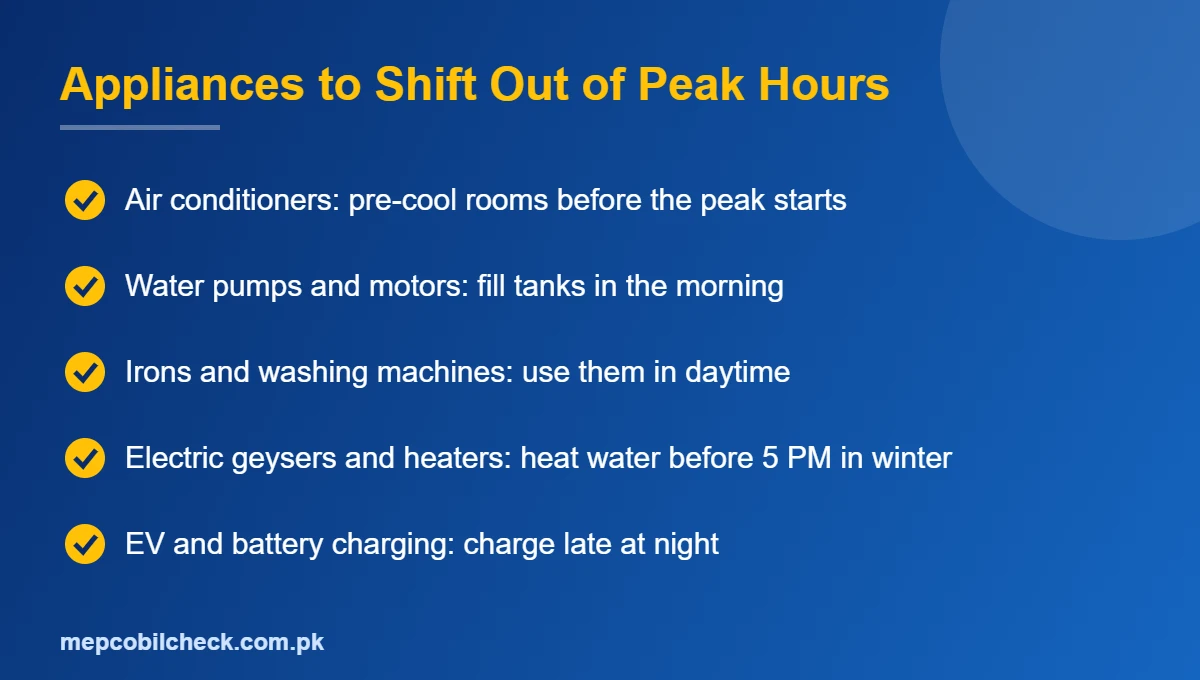
- Pre-cool your rooms: Run the AC on a lower temperature before the peak starts, then raise it to 26 degrees during peak hours.
- Use timers: Set water motors, geysers and washing machines to run in the morning or after 10 PM.
- Iron in daytime: An electric iron draws high power; ironing clothes for the week in one daytime session helps.
- Cook smart: Use electric ovens, air fryers and kettles before the evening peak.
- Switch to efficient appliances: Inverter ACs, LED lights and DC fans reduce load in every hour, including peak time.
- Solar users: Daytime solar output does not cover the evening peak, so batteries or careful evening usage help most.
MEPCO Peak Hours for Commercial and Industrial Users
Shops, offices and factories on TOU tariffs follow the same seasonal windows. For businesses, the saving is often larger because their monthly units are higher. Practical steps include closing heavy machinery before the peak window, scheduling production shifts outside peak hours, and running cold storage or pumps at night. Commercial and industrial rates differ from residential rates, so check your tariff code on the bill before planning.
Should You Switch to a TOU Meter?
If your sanctioned load is below 5 kW, you may still be able to request a TOU meter at your MEPCO sub-division office. Whether it helps depends on your habits:
- A TOU meter can help if most of your usage happens in the morning, afternoon or late night, for example a family that runs the AC mainly during the day or a home with a daytime water pump.
- A TOU meter may not help if your family uses most electricity between sunset and midnight, because those units would be charged at the higher MEPCO peak hours rate.
Before you apply, study your last 12 months of units and think about when you use your heavy appliances. Also remember that TOU connections carry fixed charges based on load. Ask your SDO office about the meter cost, the documents required and how long the change will take, and request the details in writing.
MEPCO Peak Hours vs Load Shedding: What Is the Difference?
Many people confuse peak hours with load shedding, but they are completely different:
| Point | MEPCO peak hours | Load shedding |
|---|---|---|
| What it is | A pricing window with higher per-unit rates | Planned power cuts on a feeder |
| Electricity supply | Supply continues normally | Supply is switched off |
| Who is affected | Mainly TOU meter consumers | Consumers on the affected feeder |
| Timing | Fixed by season (4 hours daily) | Depends on feeder losses and system demand |
| How to plan | Shift heavy appliances | Check the feeder schedule and use backup |
In short, peak hours affect how much you pay, while load shedding affects whether you have power at all. Both are worth tracking if you want lower bills and fewer surprises.
Common Mistakes Consumers Make
- Assuming all homes pay peak rates: Many small homes are on slab billing and are not charged different rates by time.
- Ignoring seasonal changes: The window moves every few months, so last season’s timing may not apply today.
- Running water pumps in the evening: This is one of the most common reasons for high peak units.
- Not checking the meter: A faulty TOU meter can record wrong peak units for months.
Why MEPCO Peak Hours Matter for the Grid
Evening demand in South Punjab rises sharply in summer, when air conditioners run in millions of homes. When too many consumers use power at the same time, feeders and transformers can overload, which leads to trips and outages. Shifting even a small part of evening usage helps keep the supply stable for everyone in your area. If you face frequent tripping in the evening, report it on 118 so the local team can check the transformer load.
Frequently Asked Questions
What are MEPCO peak hours today?
From September to November, MEPCO peak hours are 6:00 PM to 10:00 PM. In December to February they are 5:00 PM to 9:00 PM.
Do MEPCO peak hours apply on Sundays?
The seasonal peak window applies every day of the week. There is no separate weekend or holiday timing.
Does a normal single-phase meter pay peak rates?
Usually no. Residential connections below 5 kW sanctioned load are normally on slab billing, where all units have the same rate.
What is the MEPCO off peak hours rate?
The base off-peak rate for residential TOU consumers in 2026 is Rs 34.53 per unit, compared with Rs 46.85 in peak hours, before taxes and adjustments.
Where can I see my peak units?
Your MEPCO bill shows separate peak and off-peak readings if you have a TOU meter. You can download the bill online with your reference number.
Final Words
Knowing the MEPCO peak hours timing is one of the easiest ways to control your electricity bill. Keep the season-wise chart handy, move heavy appliances out of the evening window, and check your peak units every month. For your latest bill and usage history, use our free MEPCO bill check online tool, and read our MEPCO MIS guide to understand which MEPCO portals you really need.