FPA in Electricity Bill 2026: What It Means on Your MEPCO Bill
Have you seen a line called FPA or FCA on your electricity bill and wondered why it changes every month? This guide explains FPA in electricity bill terms in plain language: what the fuel price adjustment is, who decides it, how it is calculated on your MEPCO bill, the recent rates in 2026, and what you can and cannot do about it.
What Is FPA in Electricity Bill?
FPA stands for fuel price adjustment. NEPRA’s official term is fuel charges adjustment (FCA). Both mean the same thing: a per unit charge, or sometimes a refund, that adjusts your bill for the difference between the fuel cost assumed in the tariff and the actual fuel cost of producing electricity in a past month.
When the national tariff is set, NEPRA includes a reference fuel cost for each month. If power plants end up spending more on fuel than that reference, consumers pay the extra through a positive FPA. If they spend less, consumers get a negative FPA, which reduces the bill.
Who Decides the FPA?
The process works the same way every month for MEPCO and other former WAPDA companies:
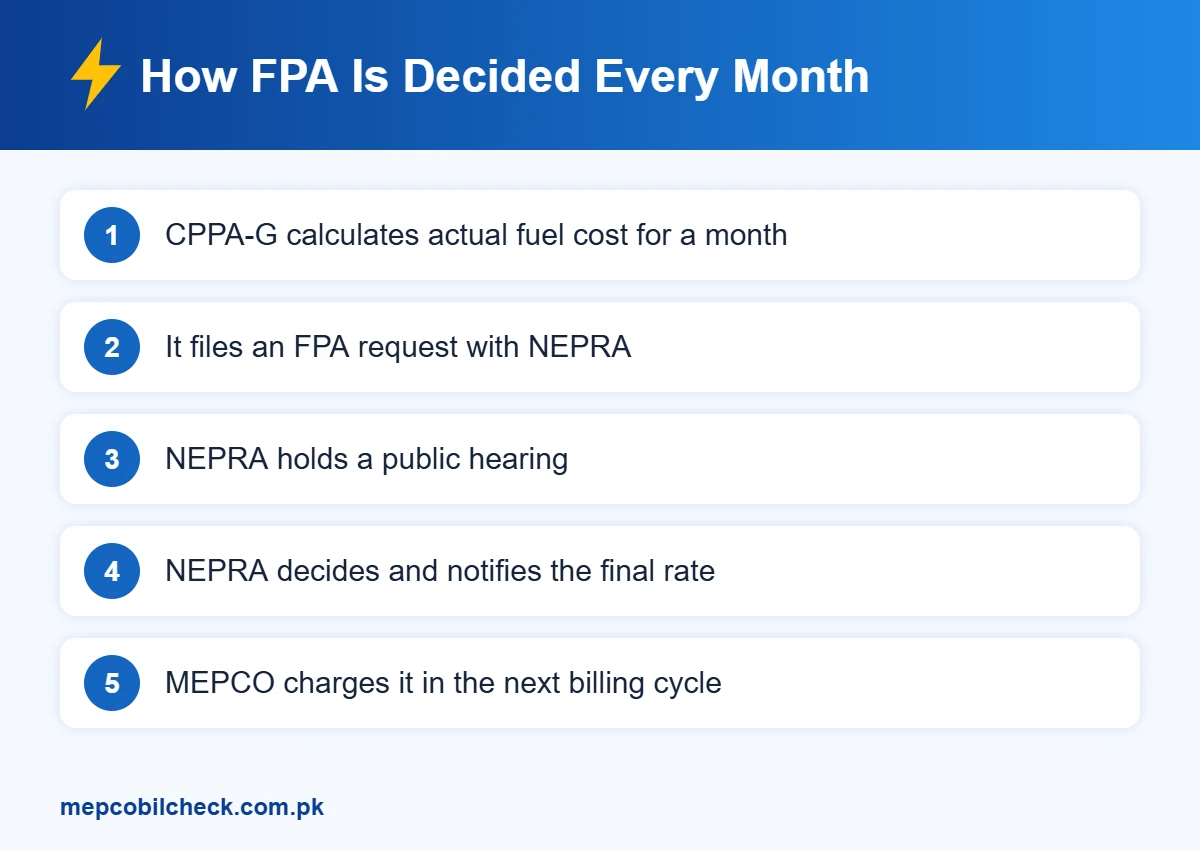
- The Central Power Purchasing Agency (CPPA-G) works out the actual fuel cost for a month.
- It files a request with NEPRA for a positive or negative adjustment.
- NEPRA holds a public hearing and reviews the data.
- NEPRA decides the final rate, often lower than the request, and notifies it.
- Distribution companies, including MEPCO, apply the rate in the next billing cycle.
Because of this process, the FPA in your bill usually relates to fuel costs from about two months earlier.
How FPA Is Calculated on Your MEPCO Bill
The calculation is simple: units consumed x FPA rate per unit. GST is then charged on the FPA amount as well. For example, if your bill shows 200 units and the FPA is Rs 1.11 per unit:
- FPA = 200 x Rs 1.11 = Rs 222
- GST on FPA = 18% of Rs 222 = about Rs 40
- Total effect = about Rs 262
You will find the FPA as a separate line in the charges section of your MEPCO bill. It is not part of the slab rate, so it does not change your protected or non-protected status.
FPA in Electricity Bill: 2026 Rates So Far
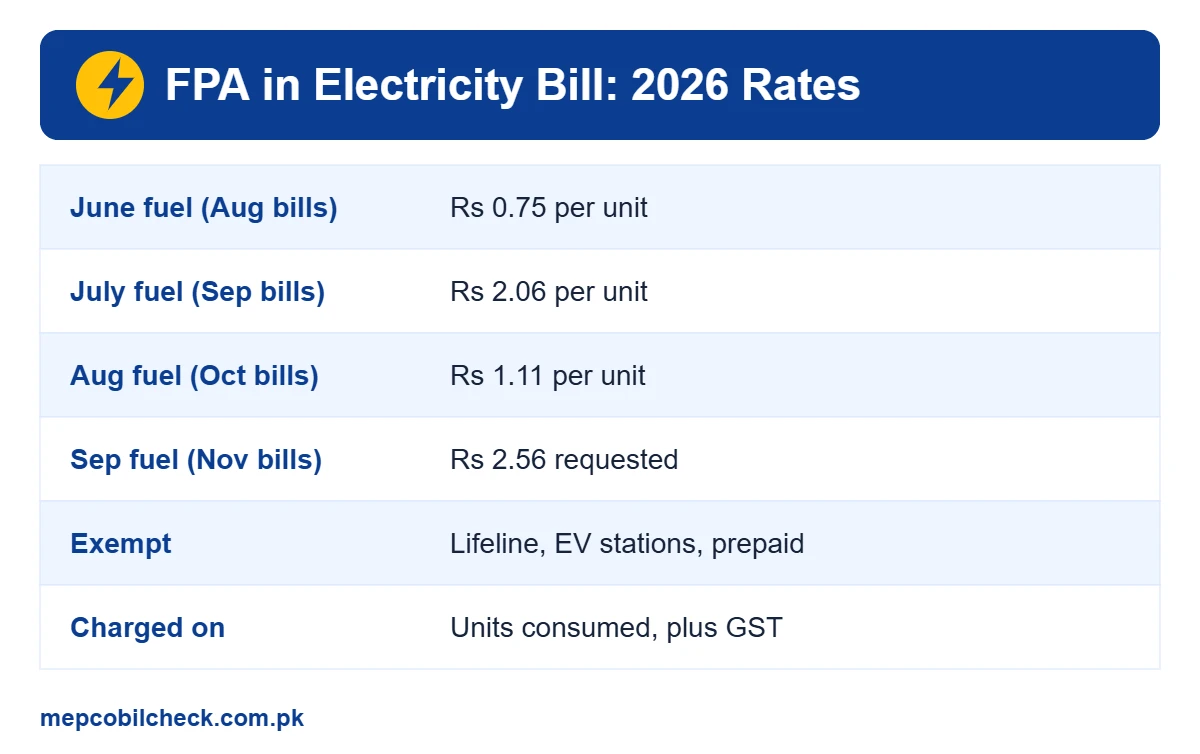
| Fuel month | Charged in | FPA per unit | Status |
|---|---|---|---|
| June 2026 | August 2026 bills | Rs 0.75 | Approved by NEPRA |
| July 2026 | September 2026 bills | Rs 2.06 | Approved (reported by Tribune) |
| August 2026 | October 2026 bills | Rs 1.11 | Approved and notified on 8 October 2026 |
| September 2026 | Expected in November 2026 bills | Rs 2.56 requested | NEPRA hearing on 29 October 2026 |
For August fuel costs, CPPA-G had asked for about Rs 1.73 per unit, but NEPRA allowed about Rs 1.11 per unit. This shows why the requested figure in the news is often higher than what finally appears on your bill. Our guides on the MEPCO bill October 2026 and MEPCO bill November 2026 explain the effect month by month.
Who Does Not Pay the FPA?
In its recent decisions, NEPRA excluded these consumers from the monthly fuel adjustment:
- Lifeline consumers
- Electric vehicle charging stations
- Prepaid consumers who have opted for the prepaid tariff
All other categories, including protected and non-protected domestic consumers, pay the FPA on the units they use.
FPA vs Quarterly Adjustment vs Base Tariff
| Charge | What it covers | How often it changes |
|---|---|---|
| Base tariff (slab rate) | Overall cost of supplying electricity | Usually once a year or after a NEPRA decision |
| FPA / FCA | Difference in actual fuel cost for a past month | Every month |
| Quarterly adjustment (QTA) | Other cost differences such as capacity and power purchase costs | Every three months |
| Fixed charges | Charge per kW of sanctioned load | With the tariff |
| Taxes | GST, and advance income tax for non-filers where applicable | When tax laws change |
Your final per unit cost is the base rate plus these items. To see the base rates, read our MEPCO per unit rate guide.
Why Does the FPA Keep Changing?
Pakistan produces electricity from many sources, including hydropower, imported LNG, coal, furnace oil, nuclear and renewables. The mix changes every month. When water flows are high and hydropower is strong, fuel costs can fall. When plants burn more imported fuel, or global fuel prices and the exchange rate move, fuel costs can rise. Demand also matters: very hot or very cold months can force costlier plants to run. All of this shows up in the FPA in electricity bill two months later.
Can You Reduce the FPA on Your Bill?
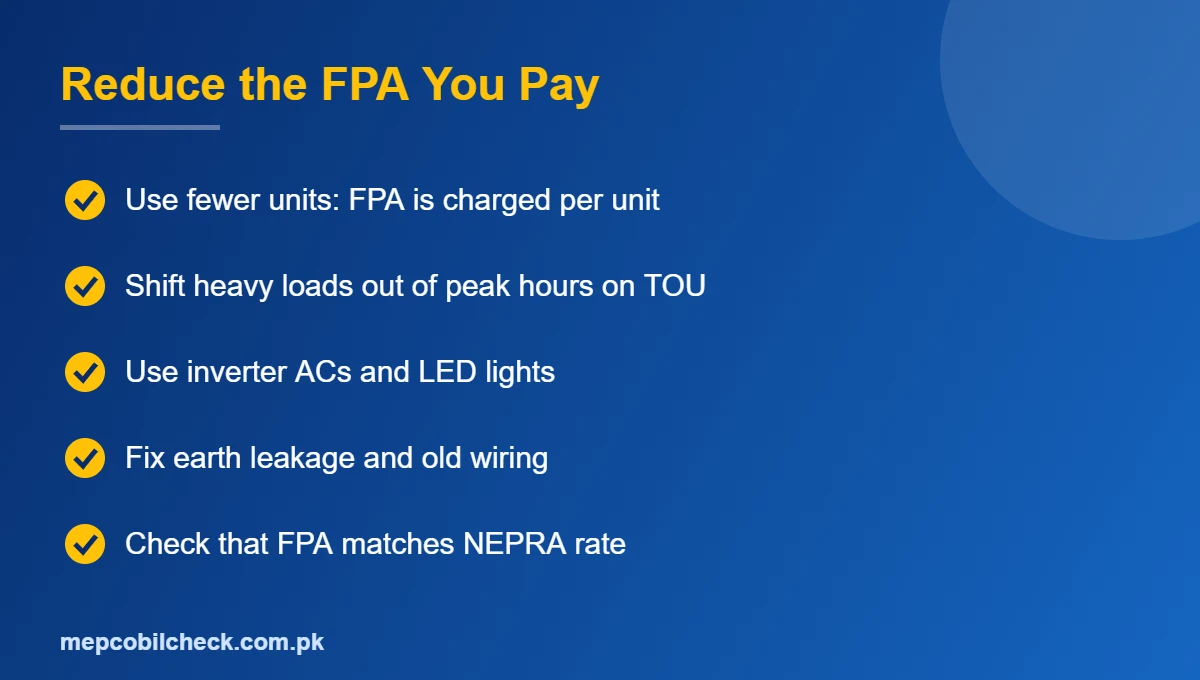
You cannot change the FPA rate, because NEPRA sets it for everyone. But since it is charged per unit, using fewer units directly reduces the FPA you pay:
- Shift heavy appliances to off-peak hours if you have a TOU meter
- Use inverter ACs, LED lights and efficient fans
- Fix earth leakage and old wiring that wastes units
- Read your meter weekly to stay in control
For a full estimate including FPA, try our free MEPCO bill calculator and enter the latest FPA rate.
When Should You Complain About FPA?
The FPA rate itself cannot be disputed at MEPCO, but you can complain if:
- The FPA is charged on more units than you actually used
- The rate on your bill does not match NEPRA’s notified rate for that month
- You are a lifeline consumer and an FPA has been added
- The FPA appears twice for the same month
In these cases, keep a copy of NEPRA’s notification and your bill, and register a complaint through our MEPCO complaint number guide.
FPA in Electricity Bill: Examples for Different Homes
This table shows how much the FPA adds at two recent rates, with and without 18% GST:
| Monthly units | FPA at Rs 1.11 | With GST | FPA at Rs 2.56 | With GST |
|---|---|---|---|---|
| 100 units | Rs 111 | Rs 131 | Rs 256 | Rs 302 |
| 200 units | Rs 222 | Rs 262 | Rs 512 | Rs 604 |
| 300 units | Rs 333 | Rs 393 | Rs 768 | Rs 906 |
| 500 units | Rs 555 | Rs 655 | Rs 1,280 | Rs 1,510 |
A family using 500 units pays five times the FPA of a family using 100 units, which is why the FPA hurts most in summer months when units are high.
How to Find the FPA on Your MEPCO Bill
- Open your bill online with your 14-digit reference number on our MEPCO bill check online tool.
- Go to the charges section where energy cost, fixed charges and taxes are listed.
- Look for a line marked FPA, FCA or fuel price adjustment.
- Divide the FPA amount by your units to see the rate per unit.
- Compare that rate with NEPRA’s notified rate for the relevant fuel month.
If you see two FPA lines, one may be for a different month. Ask your MEPCO office to explain both before you pay.
Negative FPA: When Your Bill Goes Down
The FPA in electricity bill is not always an extra charge. When actual fuel costs fall below the reference fuel cost, for example in months with strong hydropower generation, NEPRA can approve a negative adjustment. In that case, the FPA line shows a minus amount and your bill is reduced by that much per unit. Negative adjustments are usually announced the same way as positive ones, after a NEPRA hearing.
FPA and Protected Consumers
Protected consumers pay lower slab rates, but the FPA is charged on their units too, unless they are lifeline consumers. Because the FPA is a separate per unit line, it does not decide whether you are protected or non-protected. Only your monthly units decide that, which is why keeping consumption within 200 units matters more than the FPA itself.
How to Stay Updated on the Next FPA
You do not need to follow every NEPRA hearing to understand your bill. A simple routine works:
- Check national news around the middle and end of each month, when CPPA-G requests and NEPRA hearings are reported
- Remember that the request is not the final rate; wait for NEPRA’s decision
- Note the final rate and the month of bills it applies to
- When your bill arrives, divide the FPA amount by your units and match it with the notified rate
With this habit, the FPA in electricity bill will never surprise you, and you will spot any wrong charge before the due date.
Quick Summary: FPA in Electricity Bill
- The FPA in electricity bill is a monthly per unit charge or refund for past fuel costs.
- The FPA in MEPCO bill is decided by NEPRA after a CPPA-G request and a public hearing.
- The fuel price adjustment is charged on your units, and GST is added on top.
- The FCA in electricity bill usually relates to fuel costs from about two months earlier.
- Lifeline, EV charging and prepaid tariff consumers are excluded from the fuel price adjustment.
Frequently Asked Questions
What is FPA in electricity bill?
FPA is the fuel price adjustment, a per unit charge or refund that adjusts your bill for the difference between reference and actual fuel costs in an earlier month.
Is FPA the same as FCA?
Yes. NEPRA calls it the fuel charges adjustment (FCA), while bills and news reports often call it FPA.
Why is FPA charged two months later?
CPPA-G needs time to calculate actual fuel costs, file a request and go through NEPRA’s hearing, so the adjustment is applied in a later billing cycle.
Can FPA be negative?
Yes. When actual fuel costs are lower than the reference, NEPRA approves a negative adjustment, which reduces bills.
Is GST charged on FPA?
Yes. GST is charged on the FPA amount along with other electricity charges.


2 Comments