Fixed Charges in Electricity Bill 2026: Slab-Wise Rates, Who Pays and How to Lower Them
Since early 2026, a new line has appeared on almost every home electricity bill in Pakistan: fixed charges. Many families were surprised to pay hundreds of rupees even in months when they used fewer units. This guide explains fixed charges in electricity bill terms simply: what they are, the slab-wise rates, who is exempt, how MEPCO fixed charges are calculated from your sanctioned load and what you can do to lower them.
What Are Fixed Charges in Electricity Bill?
Fixed charges are a monthly amount you pay for staying connected to the grid, separate from the cost of the units you use. They help pay for costs that do not change with your consumption, such as power plant capacity payments, transmission and distribution networks, maintenance and system operation.
Before 2026, most ordinary homes paid no fixed charges, and the cost of the system was recovered through per unit rates. Under NEPRA’s tariff rationalization decision of 11 February 2026, notified by the federal government in S.R.O. 279(I)/2026, fixed charges were extended to most domestic consumers, including protected households. Lifeline consumers remain exempt.
Fixed Charges 2026: Slab-Wise Rates for Homes
According to reports on NEPRA’s decision, domestic fixed charges are set per kW of sanctioned load per month, depending on your slab and status:
| Category | Monthly units | Fixed charges per kW per month |
|---|---|---|
| Lifeline | Up to 100 | Exempt |
| Protected | 1 to 100 | Rs 200 |
| Protected | 101 to 200 | Rs 300 |
| Non-protected | 1 to 100 | Rs 275 |
| Non-protected | 101 to 200 | Rs 300 |
| Non-protected | 201 to 300 | Rs 350 |
| Non-protected | 301 to 400 | Rs 400 |
| Non-protected | 401 to 500 | Rs 500 |
| Non-protected | Above 500 | Rs 675 |
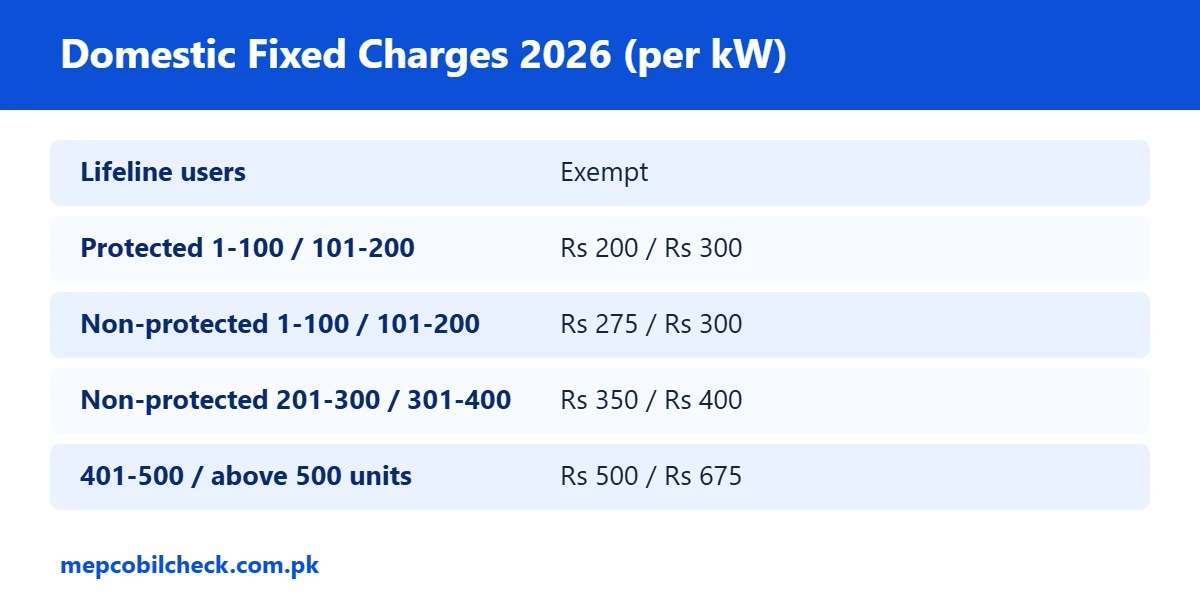
For higher slabs and time-of-use users, NEPRA balanced the change by lowering per unit rates, as reported by The Express Tribune. See the full slab rates in our MEPCO per unit rate guide.
How MEPCO Fixed Charges Are Calculated
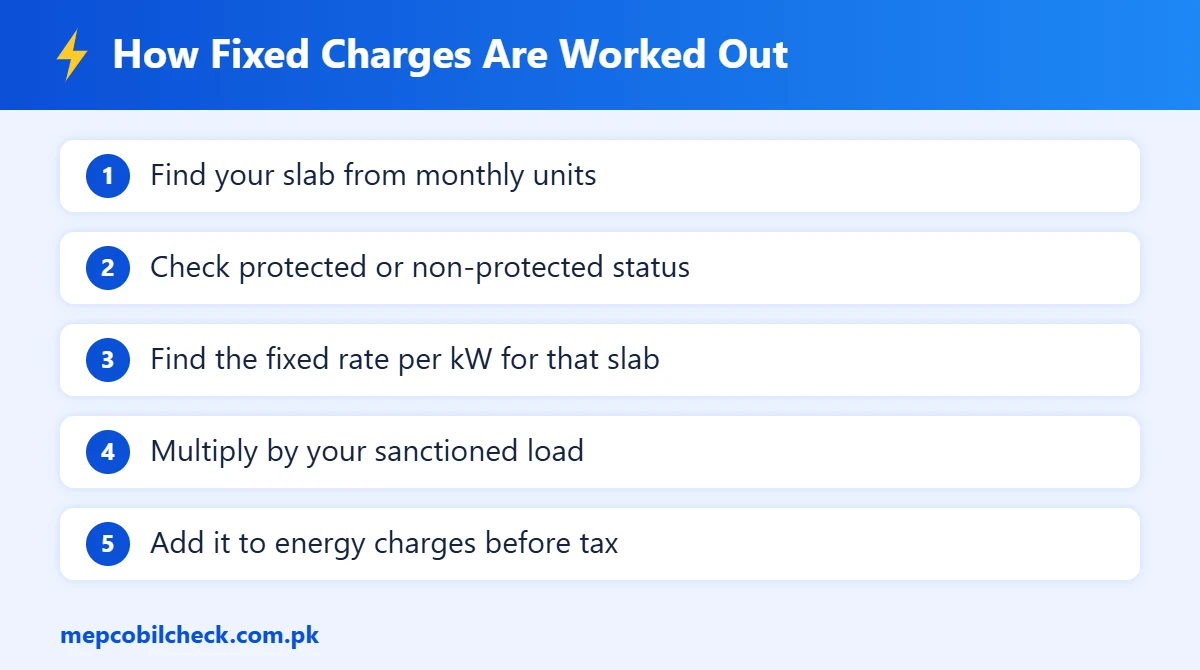
The basic formula is simple:
Fixed charges = fixed rate for your slab x sanctioned load (kW)
- Find your units for the month on the bill.
- Check whether you are protected or non-protected.
- Find the fixed rate for that slab in the table above.
- Multiply it by the sanctioned load printed on your bill.
Example 1: A protected home using 150 units with a 1 kW load pays Rs 300 x 1 = Rs 300 in fixed charges.
Example 2: A non-protected home using 250 units with a 2 kW load pays Rs 350 x 2 = Rs 700.
Example 3: A non-protected home using 450 units with a 3 kW load pays Rs 500 x 3 = Rs 1,500.
Sales tax is then calculated on the bill, so fixed charges also raise the GST amount. Use our MEPCO bill calculator to estimate the full bill.
Fixed Charges 2026 vs 2025: What Changed?
| Point | Before 2026 | Fixed charges 2026 |
|---|---|---|
| Protected homes | No fixed charges | Rs 200 to Rs 300 per kW |
| Non-protected homes | Mostly no fixed charges | Rs 275 to Rs 675 per kW |
| Lifeline homes | No fixed charges | Still exempt |
| Higher slab unit rates | Higher | Slightly reduced |
| Basis | Units only | Units plus sanctioned load |
The biggest change from the fixed charges 2026 decision is that your sanctioned load now matters every single month. Two homes using the same units can get different bills if one has a 1 kW load and the other has 5 kW on record.
Why Did NEPRA Introduce Fixed Charges?
Officials said the sector’s fixed costs, such as capacity payments and grid maintenance, kept rising while electricity sales fell as more people installed solar panels. Recovering part of these costs through fixed monthly charges gives distribution companies more predictable revenue. Reports said the change covers more than 28.5 million residential consumers.
At the same time, the decision cut per unit rates for industry and for higher domestic slabs, shifting part of the cost toward a fixed monthly charge for everyone except lifeline users.
The Challenge Against Fixed Charges
In March 2026, a group of citizens filed a review petition with NEPRA against applying fixed charges to homes based on sanctioned load rather than actual use, according to Business Recorder. They argued the charges hit low and middle-income households and asked for a cost-of-service study. Unless NEPRA changes its decision, the charges continue to apply. Follow official updates on the NEPRA website.
Fixed Charges for Shops, Farms and Industry
Fixed charges are not new for business users:
| Category | Fixed charges |
|---|---|
| Commercial under 5 kW | Rs 1,000 per month |
| Commercial 5 kW and above | Rs 1,250 per kW per month |
| Agricultural tube wells | Rs 400 per kW per month |
| General services (A-3) | Rs 1,000 per month |
Details are in our MEPCO commercial unit price and MEPCO tube well bill guides.
Fixed Charges in Electricity Bill for Tenants
Tenants usually cannot change the sanctioned load because the connection is in the owner’s name. Still, check the load printed on the bill before you rent. A small flat with an unusually high load on record will carry higher MEPCO fixed charges every month. Ask the landlord to apply for a load reduction if the load is clearly higher than needed, or agree on how the fixed part of the bill will be shared.
Questions to Ask at the MEPCO Office
If the fixed charges in electricity bill look wrong, take your latest bill and CNIC to your sub-division office and ask:
- What sanctioned load is recorded for my connection?
- Am I billed as protected or non-protected, and why?
- Which slab was used for this month’s fixed charges?
- Can my load be reduced, and what is the process and fee?
Clear answers help you decide whether to apply for a load change or a MEPCO bill correction.
Where to Find Fixed Charges on Your Bill
Open your bill online with the 14 digit reference number using our MEPCO bill check online tool. In the charges section, look for the fixed charges line next to the cost of electricity. Also check the sanctioned load in the connection details, because it decides how much you pay. Our guide on how to read MEPCO bill sections shows where each item is printed.
How to Lower Fixed Charges in Electricity Bill
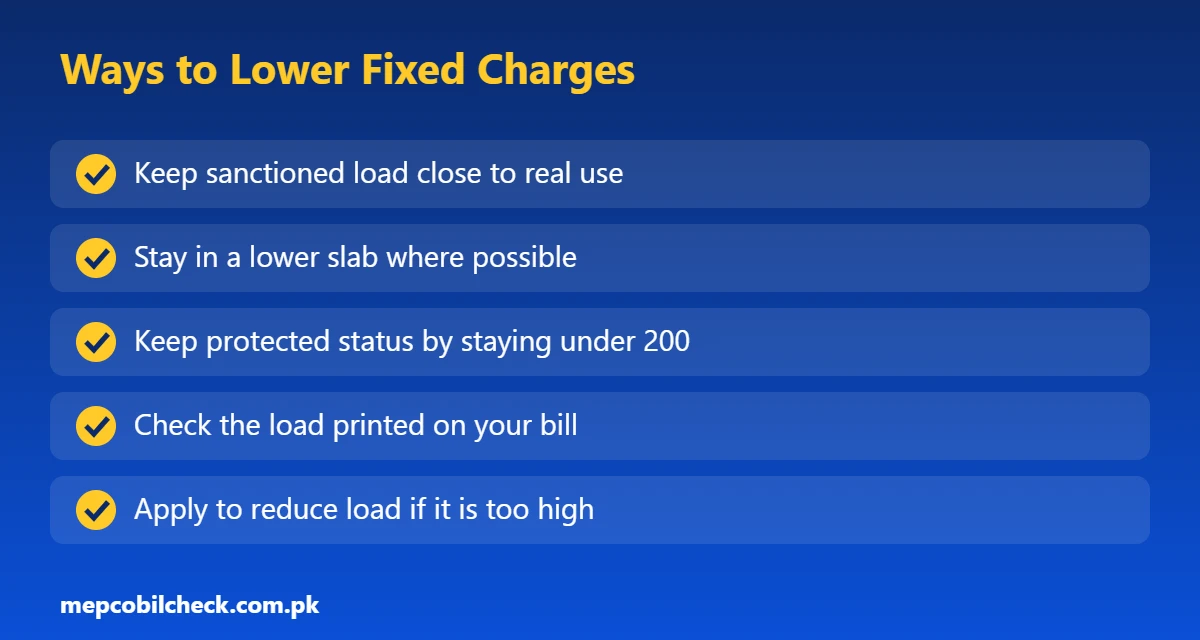
- Right-size your sanctioned load. Many homes have a higher load on record than they actually need. If your bill shows 5 kW but you rarely run more than two kilowatts of appliances at once, ask MEPCO about reducing it. Our MEPCO load extension guide explains load change applications.
- Stay in a lower slab. Fixed rates rise with each slab, so cutting units lowers both energy and fixed charges.
- Keep protected status. Protected rates for fixed and energy charges are lower. Stay at 200 units or less every month if you can.
- Avoid an overloaded connection too. A load that is too low can cause tripping and penalties, so do not cut it below your real need.
For more saving ideas, read our guide on how to reduce electricity bill costs.
Do Fixed Charges Change Every Month?
The fixed rate per kW is set by NEPRA’s tariff decision, but the amount on your bill can still change from month to month. If your units move from one slab to another, a different fixed rate applies, and if you lose or regain protected status, the rate changes too. Your sanctioned load only changes if you apply for a load change. That is why tracking units every month helps you predict MEPCO fixed charges as well as energy charges.
Do Solar Users Pay Fixed Charges?
Yes. Fixed charges depend on your connection and load, not only on the units you import. Solar homes that still use the grid at night pay fixed charges along with their imported units under the 2026 net billing rules. Read our MEPCO green meter guide for details.
Quick Summary: Fixed Charges in Electricity Bill
Here are the main points about MEPCO fixed charges and the fixed charges 2026 rules:
- Since the February 2026 decision, most domestic consumers pay fixed charges per kW of sanctioned load.
- Rates range from Rs 200 to Rs 675 per kW per month depending on slab and status; lifeline users are exempt.
- MEPCO fixed charges = slab rate x sanctioned load, and GST is added on top.
- Right-sizing your load and staying in lower slabs are the best ways to reduce them.
Frequently Asked Questions
What are fixed charges in electricity bill?
They are a monthly amount for staying connected to the grid, charged separately from the units you use.
How much are domestic fixed charges in 2026?
From Rs 200 to Rs 675 per kW per month, depending on your slab and whether you are protected or non-protected. Lifeline consumers are exempt.
Are fixed charges per kW or per house?
Reports on NEPRA’s decision and the review petition describe domestic fixed charges as per kW of sanctioned load, so a higher load means higher charges.
Can I reduce my fixed charges?
Yes, by keeping your sanctioned load close to your real need, staying in lower slabs and keeping protected status.
Do I pay fixed charges if I use zero units?
Yes. Fixed charges apply as long as the connection is active, even in months with very low use.





One Comment