
Electricity Unit Price in Pakistan 2026: Latest Per Unit Rates for Homes, Shops & Farms
What is the electricity unit price in Pakistan right now? The answer depends on who you are: a home using 150 units, a home using 400 units, a shop, a tube well or a factory all pay different rates. Since February 2026, a uniform tariff applies across the former WAPDA companies, including MEPCO, and K-Electric. This guide lists the latest per unit price of electricity for each category, explains what is added on top, and shows how to work out your real electricity rate per unit.
Who Sets the Electricity Unit Price in Pakistan?
The National Electric Power Regulatory Authority (NEPRA) determines the tariff, and the federal government notifies the consumer rates. The current schedule comes from NEPRA’s decision of 11 February 2026, notified in S.R.O. 279(I)/2026 on 12 February 2026. Because the tariff is uniform, a home in Multan pays the same base slab rate as a similar home in Lahore or Islamabad. Monthly fuel adjustments and quarterly adjustments then change the final per unit price of electricity.
Domestic Electricity Unit Price 2026
| Category | Units per month | Rate per unit |
|---|---|---|
| Lifeline | Up to 50 | Rs 3.95 |
| Lifeline | 51 to 100 | Rs 7.74 |
| Protected | 1 to 100 | Rs 10.54 |
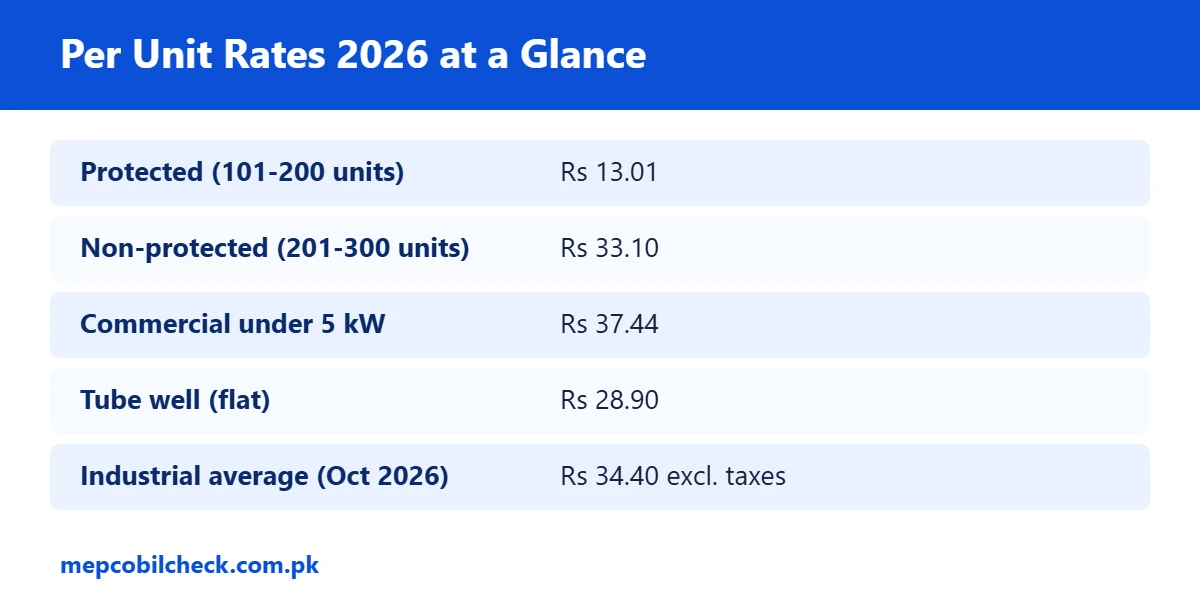
| Protected | 101 to 200 | Rs 13.01 |
| Non-protected | 1 to 100 | Rs 22.44 |
| Non-protected | 101 to 200 | Rs 28.91 |
| Non-protected | 201 to 300 | Rs 33.10 |
| Non-protected | 301 to 400 | Rs 36.46 |
| Non-protected | 401 to 500 | Rs 38.95 |
| Non-protected | 501 to 600 | Rs 40.22 |
| Non-protected | 601 to 700 | Rs 41.85 |
| Non-protected | Above 700 | Rs 47.20 |
Protected consumers are domestic users who stayed at 200 units or less every month for the previous six months. Since February 2026, fixed charges from Rs 200 to Rs 675 also apply to most domestic consumers depending on the slab, while lifeline users are exempt. For MEPCO examples, see our MEPCO per unit rate guide.
Commercial Electricity Rate per Unit
| Commercial category | Rate per unit | Fixed charges |
|---|---|---|
| Under 5 kW | Rs 37.44 | Rs 1,000 per month |
| 5 kW and above, flat | Rs 39.76 | Rs 1,250 per kW per month |
| TOU peak | Rs 43.82 | Rs 1,250 per kW per month |
| TOU off-peak | Rs 35.15 | Included above |
| EV charging station | Rs 23.57 | None |
There are no slabs for commercial users. Our MEPCO commercial unit price guide includes worked shop examples.
Agricultural Electricity Unit Price
Private agricultural tube wells pay Rs 28.90 per unit on the flat rate, or Rs 29.54 peak and Rs 28.69 off-peak on time-of-use meters, with fixed charges of Rs 400 per kW per month, according to published tariff summaries. Eligible farmers also get a package rate on extra units, explained in our MEPCO tube well bill guide.
Industrial Electricity Unit Price
Industrial rates vary by voltage level and time of use. The Power Division said in November 2026 that the average industrial rate in October 2026 was about Rs 34.40 per unit, excluding taxes. Eligible industries also get a lower rate on incremental units under the Incremental Consumption Package, which NEPRA set at a provisional Rs 25.30 per unit from the November 2026 billing month.
What Is Added to the Base Rate?
The base tariff is only part of your electricity rate per unit. These items are added:
- Fuel charges adjustment (FCA): set monthly by NEPRA. About Rs 1.11 per unit was charged in October 2026 bills, and a further request for September fuel costs was under review.
- Quarterly tariff adjustment (QTA): reported at 52 paisa per unit for September to November 2026.
- General sales tax: 18% on the taxable amount.
- Income tax: for non-filers with domestic bills above Rs 25,000, and on commercial bills by bill size.
- Fixed charges: spread over your units, they raise the effective rate for low users.
Electricity duty is no longer collected from domestic bills since July 2025. Read about adjustments in our FPA in electricity bill guide.
How to Work Out Your Real Per Unit Price of Electricity
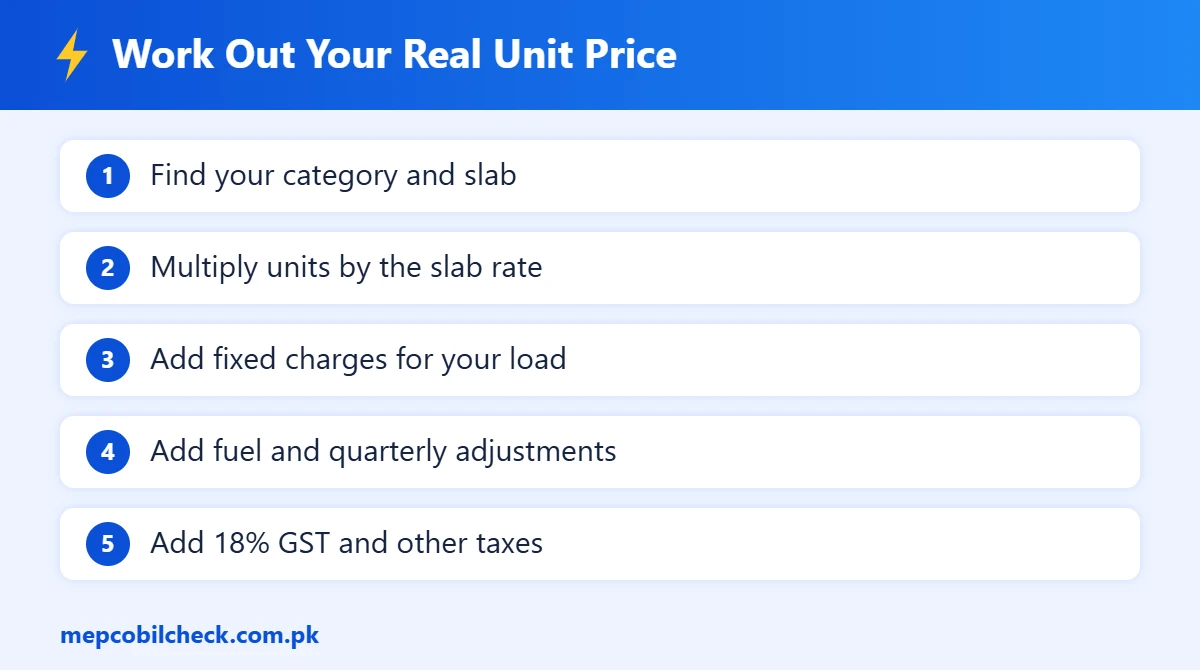
- Find your category and slab on the bill.
- Multiply your units by the slab rate (for non-protected homes the tariff uses one previous slab benefit).
- Add fixed charges for your sanctioned load.
- Add the fuel and quarterly adjustments.
- Add 18% GST and any income tax.
- Divide the total by your units to get your effective rate.
Example: 250 Units for a Non-Protected Home
| Item | Calculation | Amount |
|---|---|---|
| First 200 units | 200 x Rs 28.91 | Rs 5,782 |
| Next 50 units | 50 x Rs 33.10 | Rs 1,655 |
| Fixed charges | Slab charge | Rs 350 |
| Fuel adjustment | 250 x Rs 1.11 | Rs 277.50 |
| Quarterly adjustment | 250 x Rs 0.52 | Rs 130 |
| Subtotal | Rs 8,194.50 | |
| GST at 18% | Rs 1,475.01 | |
| Total | about Rs 9,670 |
That works out to an effective electricity rate per unit of about Rs 38.7, much higher than the Rs 33.10 slab rate. Try your own numbers on our MEPCO bill calculator.
What Changed in the 2026 Tariff?
The February 2026 tariff rationalization changed the structure of the electricity unit price in Pakistan in three important ways. First, rates for industry, agriculture and commerce were reduced to cut the cross-subsidy those users had been paying. Second, fixed charges were extended to most domestic consumers, while some higher-slab energy rates were lowered to balance the change. Third, lifeline consumers stayed protected with very low rates and no fixed charges. The result is that heavy business users pay less per unit than in 2025, while small homes now see a fixed charge on every bill.
Unit Price for Solar Users
Homes and shops with rooftop solar still buy units from the grid at night and on cloudy days. Under NEPRA’s Prosumer Regulations 2026, those imported units are billed at the normal per unit price of electricity for your category, while exported units are credited at the national average energy purchase price, reported at around Rs 10 to 11 per unit when the rules were notified. This gap makes daytime self-use far more valuable than exporting. Our MEPCO green meter guide explains the details.
How to Find Your Slab and Rate on the Bill
Your bill shows your tariff category, units consumed and the charges calculated for them. Check the tariff line first to confirm you are on the right category, then look at the units to see which slab you fall into. Compare the cost of electricity line with the slab table above. If the numbers do not match, read our how to read MEPCO bill guide or ask your sub-division office to explain the calculation.
Why Your Effective Rate Changes Every Month
Your electricity unit price in Pakistan is not fixed for the year. The FCA changes every month, the QTA changes every quarter, and your slab changes with your use. A home that crosses 200 units can lose protected status for six months. That is why two bills with similar units can look very different.
Lifeline and Protected Consumers Explained
Lifeline consumers are the smallest domestic users, using up to 100 units a month, and they pay the lowest electricity rate per unit with no fixed charges. Protected consumers use up to 200 units a month consistently for six months and pay Rs 10.54 or Rs 13.01 per unit. Everyone else is non-protected and pays from Rs 22.44 upward. The jump from protected to non-protected is the single biggest change in the electricity unit price in Pakistan for ordinary families, which is why staying at or under 200 units matters so much. The government has also said it plans to move toward targeted subsidies, so watch our MEPCO subsidy guide for updates.
Tips to Pay a Lower Unit Price

- Stay in the protected slab if your use is close to 200 units.
- Avoid crossing slab limits by tracking your meter weekly.
- Shift motors and irons to off-peak hours if you have a TOU meter.
- Keep your sanctioned load close to your real need.
- Become an active taxpayer if your bills are large.
Small changes in daily habits often matter more than the headline tariff, because they decide which slab you land in each month. Our guide on how to reduce electricity bill costs has 15 more tips.
Quick Summary: Electricity Unit Price in Pakistan 2026
- Domestic rates range from Rs 3.95 (lifeline) to Rs 47.20 (above 700 units).
- Commercial rates range from Rs 35.15 to Rs 43.82 per unit with no slabs.
- Tube wells pay about Rs 28.90 per unit on the flat rate.
- FCA, QTA, fixed charges and 18% GST push the effective rate well above the base rate.
Frequently Asked Questions
What is the electricity unit price in Pakistan in 2026?
It depends on your category and slab. Domestic non-protected rates range from Rs 22.44 to Rs 47.20 per unit, before adjustments and taxes.
Is the per unit price of electricity the same for MEPCO and LESCO?
Yes. The base tariff is uniform across the former WAPDA companies and K-Electric. Only adjustments and your own slab change the final bill.
What is the commercial electricity rate per unit?
Shops under 5 kW pay Rs 37.44 per unit plus Rs 1,000 per month fixed charges.
Why is my effective rate higher than the slab rate?
Fixed charges, fuel and quarterly adjustments, and 18% GST are added to the base rate.
Who decides electricity prices in Pakistan?
NEPRA determines the tariff and the federal government notifies it.




2 Comments