Appliance Electricity Consumption Chart 2026: Units Used by Fan, Fridge, Iron, Motor, Heater & More
Your electricity bill is the sum of what every appliance in your home uses. Knowing the appliance electricity consumption of each device shows you exactly where your units go and where to save. This guide gives a simple chart of units used by common appliances in Pakistani homes, explains fan electricity consumption and refrigerator electricity consumption in detail, and shows how to cut the biggest loads on your MEPCO bill.
How Appliance Units Are Calculated
Units = Watts x Hours / 1,000
One unit is one kilowatt hour (kWh). A 100W device used for 10 hours uses 1 unit. Our guide on how to calculate electricity units explains the formula with more examples.
Appliance Electricity Consumption Chart
| Appliance | Typical watts | Units per hour | Example monthly units |
|---|---|---|---|
| Ceiling fan (AC motor) | 70 to 80 | About 0.075 | 12 hrs/day: about 27 |
| DC inverter fan | 30 to 40 | About 0.035 | 12 hrs/day: about 13 |
| LED bulb | 10 to 15 | About 0.012 | 6 hrs/day: about 2 |
| Old tube light | 40 to 50 | About 0.045 | 6 hrs/day: about 8 |
| Refrigerator (average) | 100 to 200 | About 0.1 to 0.2 | 24 hrs/day: 70 to 140 |
| Deep freezer | 150 to 250 | About 0.15 to 0.25 | 24 hrs/day: 100 to 180 |
| LED TV (43 inch) | 60 to 100 | About 0.08 | 5 hrs/day: about 12 |
| Wi-Fi router | 10 to 20 | About 0.015 | 24 hrs/day: about 11 |
| Electric iron | 1,000 to 1,200 | About 1 | 30 min/day: about 15 |
| Washing machine | 400 to 500 | About 0.45 | 1 hr every other day: about 7 |
| Water motor (1 HP) | About 750 | About 0.75 | 1 hr/day: about 22 |
| Microwave oven | 1,000 to 1,200 | About 1.1 | 15 min/day: about 8 |
| Room heater | 1,000 to 2,000 | About 1 to 2 | 4 hrs/day: 120 to 240 |
| Electric geyser | 1,500 to 3,000 | About 1.5 to 3 | 2 hrs/day: 90 to 180 |
| 1.5 ton inverter AC | 800 to 1,300 | About 0.8 to 1.3 | 8 hrs/day: 190 to 310 |
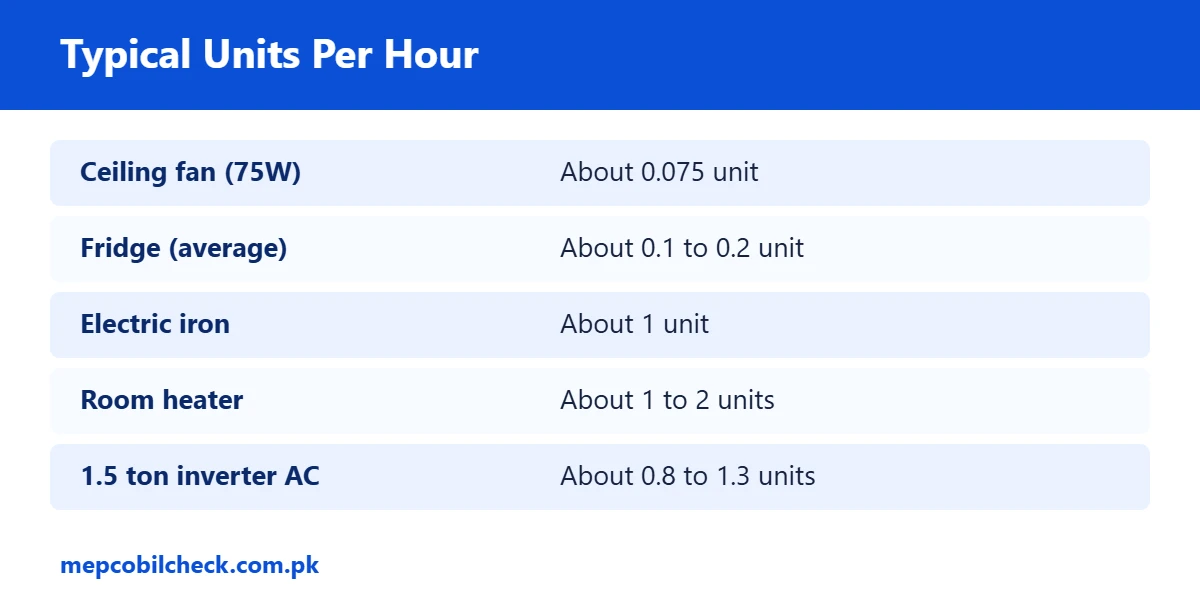
These are typical values for planning. Actual appliance electricity consumption depends on the model, age, settings and how long the appliance really runs.
Fan Electricity Consumption
Fans run longer than almost anything else in South Punjab homes. A standard AC-motor ceiling fan draws about 70 to 80 watts at full speed. Running four fans for 12 hours a day uses about 108 units a month. Modern DC inverter fans use roughly half the power, about 30 to 40 watts, cutting fan electricity consumption to around 50 units a month for the same use. Running fans at lower speed also saves power. Because fans run so many hours, replacing old fans is one of the best long-term savings, especially for homes near the 200-unit protected limit.
Refrigerator Electricity Consumption
A fridge runs all day and night, but its compressor switches on and off. That is why refrigerator electricity consumption is usually measured as an average: about 100 to 200 watts for a typical home fridge, or roughly 70 to 140 units a month. Older fridges, fridges in hot kitchens and fridges with worn door seals use much more. Inverter fridges use noticeably less. To cut refrigerator electricity consumption:
- Keep the fridge away from the stove and direct sun.
- Leave space behind it for air to flow.
- Check door seals and close the door quickly.
- Let hot food cool before putting it inside.
- Defrost older models regularly.
Heavy Hitters: AC, Heater, Geyser and Motor
The biggest units come from appliances that use high power for long hours:
- Air conditioners: a 1.5 ton inverter AC can add 200 to 300 units a month in summer. See our inverter AC electricity consumption guide.
- Room heaters: 1 to 2 units per hour; a few hours every winter evening can add 120 to 240 units.
- Electric geysers: 1.5 to 3 units per hour while heating; timers and insulation help.
- Water motors: short daily use, but large motors and leaking tanks raise units.
Example: A Typical South Punjab Home in Summer
| Appliance | Monthly units |
|---|---|
| 4 ceiling fans | 108 |
| 8 LED bulbs | 17 |
| Fridge | 110 |
| TV and router | 25 |
| Water motor | 22 |
| Iron and washing machine | 22 |
| 1.5 ton inverter AC (8 hrs/day) | 240 |
| Total | About 544 |
Without the AC, this home would use about 304 units. With it, the home jumps into the 501 to 600 non-protected slab. That is why the AC decides most summer bills. Check slab rates in our MEPCO per unit rate guide.
Example: The Same Home in Winter
In winter the AC is off and fans run far less, but a heater and geyser may be added:
| Appliance | Monthly units |
|---|---|
| 2 fans (occasional) | 15 |
| Lights, TV, router | 42 |
| Fridge | 80 |
| Water motor, iron, washing | 44 |
| Room heater (3 hrs/day) | 135 |
| Total | About 316 |
A single heater can push a home above 200 units even in winter. Heat one room, keep doors closed and consider an inverter AC in heat mode, which often uses fewer units than a heater.
Kitchen Appliances
Electric kettles, toasters, blenders and air fryers draw high power, often 1,000 to 2,000 watts, but only for short periods. An air fryer used for 20 minutes a day at 1,500W uses about 0.5 units a day, or around 15 units a month. These appliances rarely decide a bill on their own, but several of them together can add 30 to 50 units. Electric cooking plates and ovens used daily can add much more.
Washing Machines and Dryers
Semi-automatic and automatic washing machines use about 400 to 500 watts while washing, and more if they heat water. A spin dryer adds a little. Drying clothes in the sun instead of using an electric dryer is one of the easiest ways to keep appliance electricity consumption low.
Computers, Laptops and Phones
A laptop uses about 40 to 70 watts, a desktop computer with monitor 150 to 300 watts, and a phone charger just a few watts. Families working or studying from home may add 15 to 40 units a month for computers. Laptops are far more efficient than desktops for long daily use.
Standby Power Adds Up
TVs, set-top boxes, chargers, microwaves and computers use small amounts of power even when switched off with a remote. Each may use only a few watts, but together they can add 10 to 20 units a month. Switching them off at the wall is an easy saving.
Why Track Appliance Electricity Consumption?
Tracking appliance electricity consumption helps you decide what to replace first. If fan electricity consumption and refrigerator electricity consumption together make up a third of your bill, upgrading them may save more than any other change. Writing down monthly units for each major appliance also helps you explain a high bill to your family and plan better for the next summer.
Old vs New Appliances
Older appliances often use far more power than modern efficient ones. A 15-year-old fridge can use nearly double the units of a new inverter fridge, and old AC-motor fans use about twice as much as DC inverter fans. When replacing an appliance, compare the wattage or energy label. A slightly higher price for an efficient model usually pays back through lower bills within a few years.
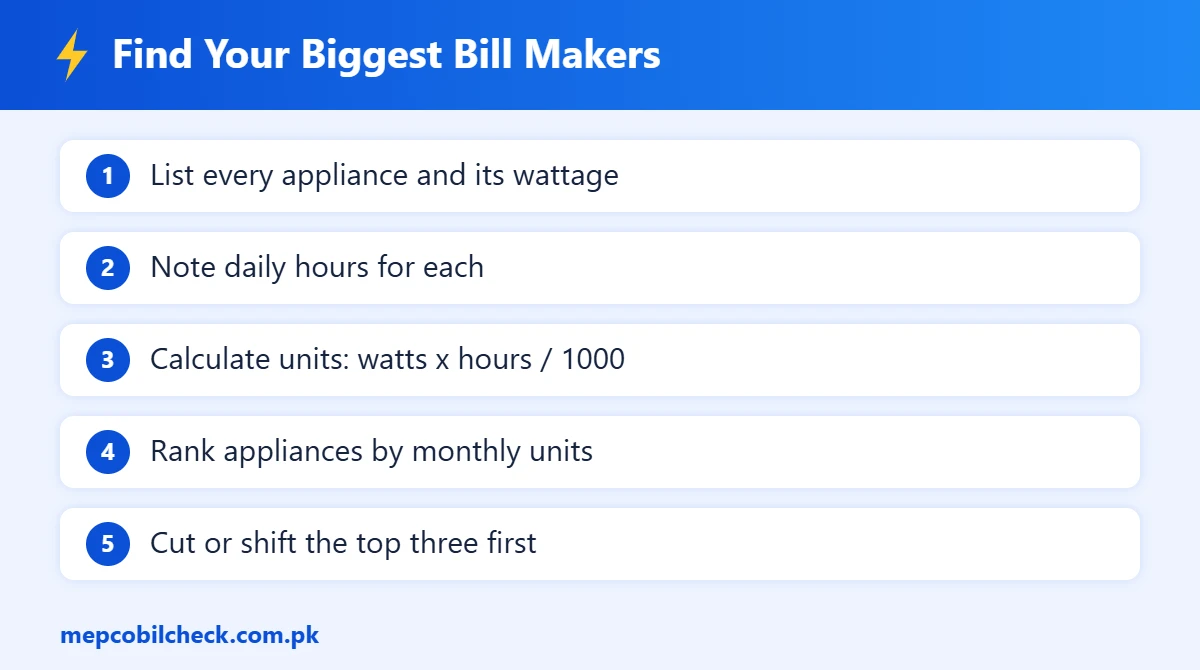
How to Find Your Biggest Bill Makers
- List every appliance and its wattage from the label.
- Note how many hours a day each runs.
- Calculate monthly units for each.
- Rank them from highest to lowest.
- Cut or shift the top three first.
Compare your total with the units on your bill using our MEPCO bill check online tool. If the bill is much higher than your estimate, check for hidden loads or a meter problem.
Peak Hours and Appliances
If you have a time-of-use meter, units used during peak hours cost more. Run water motors, irons and washing machines outside peak hours. See current timings in our MEPCO peak hours guide.
Tips to Reduce Appliance Units
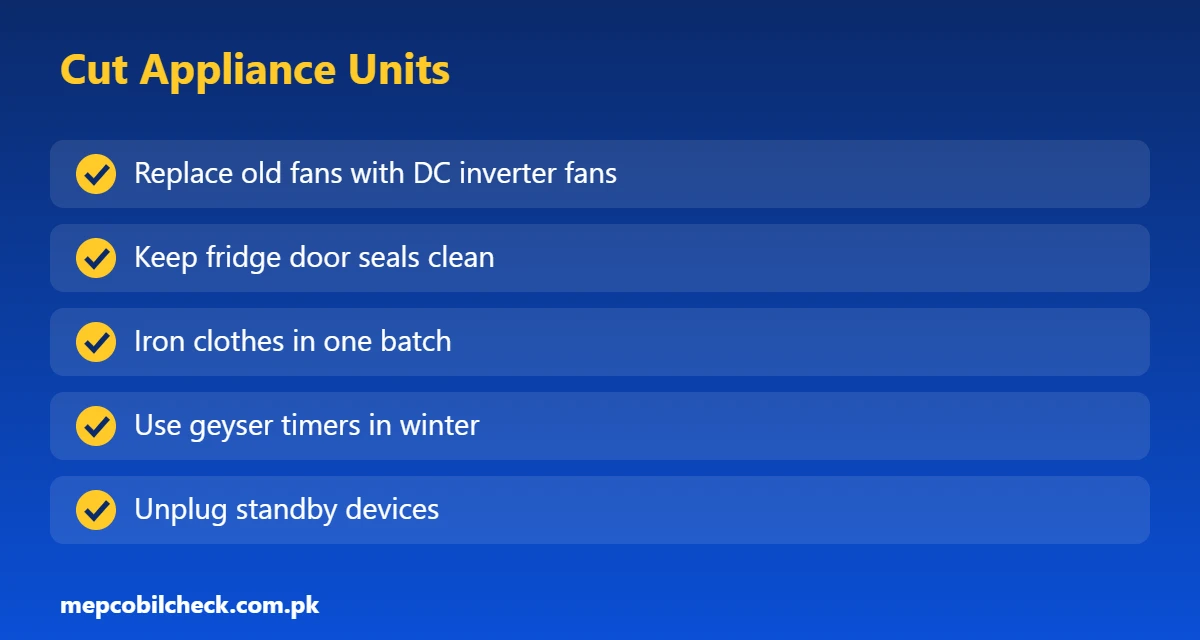
- Replace old fans with DC inverter fans and old bulbs with LEDs.
- Keep fridge seals clean and the fridge away from heat.
- Iron clothes in one batch and run washing machines with full loads.
- Use timers on geysers and limit heater hours.
- Unplug standby devices at night.
More ideas are in our how to reduce electricity bill guide, and our UPS price in Pakistan guide covers backup for fans and lights during load shedding. For official tariff decisions, follow NEPRA.
Quick Summary: Appliance Electricity Consumption
- Units = watts x hours / 1,000.
- ACs, heaters and geysers use the most units; fans and fridges add up because they run for long hours.
- Fan electricity consumption can be halved with DC inverter fans.
- Refrigerator electricity consumption drops with good seals, ventilation and inverter models.
Frequently Asked Questions
How many units does a ceiling fan use per day?
A 75W fan running 12 hours uses about 0.9 units a day, or about 27 units a month.
How many units does a fridge use per month?
A typical home fridge uses about 70 to 140 units a month, depending on size, age and kitchen heat.
Which appliance uses the most electricity?
Air conditioners, room heaters and electric geysers use the most units in most homes.
Does an iron use a lot of electricity?
It uses about 1 unit per hour while heating, so 30 minutes a day adds about 15 units a month.
How can I check my appliance electricity consumption?
Read the wattage on the label, multiply by hours used and divide by 1,000, or measure with your meter by running one appliance at a time.



One Comment