Incremental Consumption Package 2026: New Rs 25.30 Rate for Industry and Farmers Explained
If you run a factory, workshop or farm tube well in South Punjab, the incremental consumption package can lower the cost of every extra unit you use. On 6 November 2026, NEPRA raised the incremental package rate from Rs 22.98 to Rs 25.30 per unit, effective from the November 2026 billing month. This guide explains what the ICP electricity package is, who qualifies, how extra units are counted, what the new rate means for your MEPCO bill and why the rate changed.
What Is the Incremental Consumption Package?
The incremental consumption package (ICP) is a government incentive scheme for industrial and agricultural consumers. It charges a lower rate on electricity used above a consumer’s past consumption. The goal is to use spare generation capacity, encourage more production on the grid and discourage factories from switching to their own captive power.
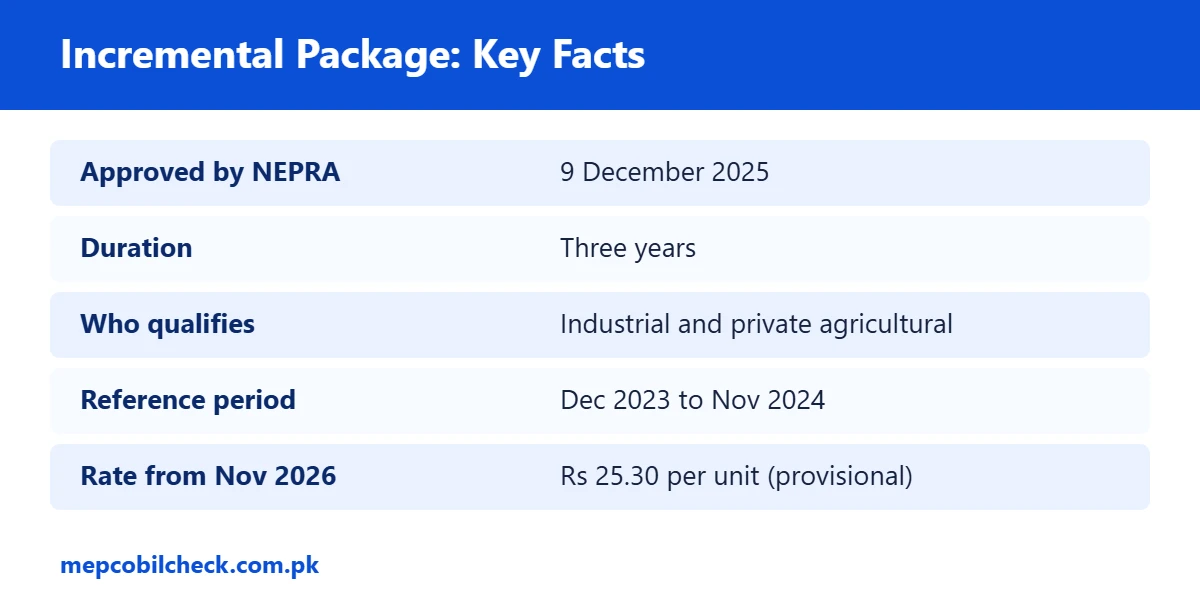
NEPRA approved the package on 9 December 2025, and it was notified on 10 December 2025 for a period of three years, according to Business Recorder.
Who Qualifies for the ICP Electricity Package?
- Industrial consumers of the former WAPDA distribution companies, including MEPCO, and of K-Electric
- Private agricultural consumers, such as farm tube wells
- Both time-of-use and non-time-of-use connections
Domestic and commercial consumers are not covered by this package. Their bills follow the normal tariff, explained in our electricity unit price in Pakistan guide.
How Are Incremental Units Counted?
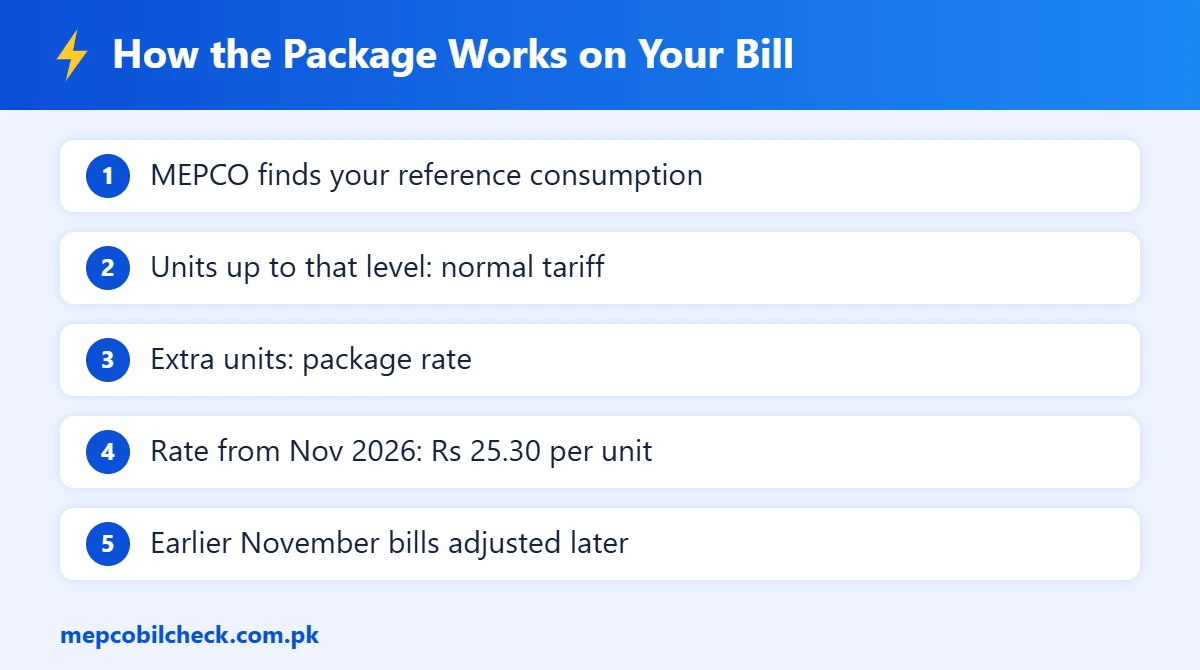
Your extra units are measured against your reference consumption for the same month in the period December 2023 to November 2024.
- Units up to your reference level are billed at the normal tariff.
- Units above your reference level are billed at the incremental package rate.
- If you use less than your reference level, there are no incremental units that month.
Example: A flour mill used 20,000 units in November 2024. In November 2026 it uses 26,000 units. About 6,000 units count as incremental and are billed at the package rate, while the first 20,000 units are billed at the normal industrial tariff.
The New Incremental Package Rate: Rs 25.30
On 6 November 2026, NEPRA approved a provisional increase in the incremental package rate:
| Item | Detail |
|---|---|
| Old rate | Rs 22.98 per unit |
| New rate | Rs 25.30 per unit |
| Increase | Rs 2.32 per unit (about 10%) |
| Effective from | November 2026 billing month |
| Status | Provisional, until a further review decision |
NEPRA rejected applying the new rate retrospectively from October 2026. November 2026 bills issued before the decision was notified will be adjusted in later billing months.
Why Did the Rate Go Up?
The package rate is linked to the marginal cost of generating extra electricity. According to Dawn, the Power Division said marginal generation costs rose because of higher international fuel prices linked to the ongoing conflict in the region. It added that revising the package keeps the cost of the relief from being passed on to consumers who do not benefit from it.
NEPRA has also asked the Power Division to submit a comprehensive review covering the period from June to November 2026. Two NEPRA members dissented, saying the required marginal price data had not been provided properly. The final rate may change after that review.
Is This a Rise in the Normal Industrial Tariff?
No. The Power Division said Rs 25.30 is only the marginal rate for incremental units under the package, not the normal industrial or agricultural tariff. It said the average industrial rate in October 2026 was about Rs 34.40 per unit excluding taxes, and that the industrial tariff is about Rs 18.94 per unit lower than in March 2024, including taxes.
How Many Consumers Benefit?
According to the Power Division’s figures reported in November 2026:
- 6,940 GWh of incremental consumption was covered from December 2025 to September 2026.
- About Rs 43.5 billion in relief was passed to consumers.
- Industrial users saved Rs 5 to Rs 10 per unit on incremental units, lowering their overall bills by an average of Rs 1.5 to Rs 2.5 per unit.
- 209,335 of 518,316 eligible consumers, about 40%, benefited.
What It Means for MEPCO Farmers
South Punjab has thousands of agricultural tube well connections. Under the 2026 tariff, a flat-rate tube well pays about Rs 28.90 per unit. Extra units above last season’s level under the incremental consumption package now cost Rs 25.30, so the saving is smaller than before but still useful during heavy irrigation months. See our MEPCO tube well bill guide for full agricultural rates.
What It Means for MEPCO Industries
Industrial connections in South Punjab range from small workshops to large textile and food processing units. For all of them, the package only helps when production grows, so it rewards expansion rather than steady use. Keep monthly records of units for at least two years so you can verify the reference figures MEPCO uses.
Growing Businesses Benefit Most
Factories, cotton ginneries, rice mills and flour mills across Multan, Bahawalpur, Rahim Yar Khan and Vehari can still lower their average cost by expanding production on the grid. Because only units above the reference level get the package rate, the benefit is largest for businesses that are growing.
Example: How Much Does the Package Save?
These simple examples use rounded figures to show how the incremental package rate works. Your real bill depends on your exact tariff, adjustments and taxes.
| Case | Incremental units | Normal rate used | Saving per unit | Approx. saving |
|---|---|---|---|---|
| Flour mill (old package rate Rs 22.98) | 6,000 | Rs 34.40 average | Rs 11.42 | Rs 68,520 |
| Flour mill (new rate Rs 25.30) | 6,000 | Rs 34.40 average | Rs 9.10 | Rs 54,600 |
| Tube well (new rate Rs 25.30) | 300 | Rs 28.90 flat | Rs 3.60 | Rs 1,080 |
The saving is still meaningful for growing industries, but the increase cuts it by roughly a fifth for the mill in this example. For tube wells, the gap between the agricultural tariff and the incremental package rate is now small, so the benefit is modest.
What Happens Next?
NEPRA has asked the Power Division to submit a full review of the incremental consumption package covering the outstanding first review period and the second review period from June to November 2026. According to The Express Tribune, NEPRA warned that missed deadlines could lead to suspension or termination of the package. The industrial package has not been suspended and continues at the provisional rate for now. Consumers should watch for the final decision, because the rate could move again in either direction.
Who Is Not Covered?
- Domestic consumers, including protected and lifeline users
- Commercial consumers such as shops and offices
- SCARP and other public sector tube wells, unless included by a specific decision
- Consumers whose current use is below their reference consumption
If you are unsure whether your connection qualifies for the ICP electricity rate, ask your MEPCO sub-division office with your reference number and tariff details.
Planning Growth Under the Package
If you plan to add machines, a second shift or a bigger tube well motor, check whether your sanctioned load can carry the extra demand. An overloaded connection trips, damages equipment and can attract penalties. Apply for a higher load first using our MEPCO load extension guide. Businesses that use most of their power in daylight can also combine the package with rooftop solar, keeping in mind the 2026 net billing rules explained in our MEPCO green meter guide. Shops and offices on the commercial tariff should read our MEPCO commercial unit price guide instead, because they are not covered by the incremental consumption package.
How to Check the Package on Your Bill
- Open your bill online with the 14 digit reference number. See our MEPCO web bill guide.
- Look for a separate line or adjustment for incremental units.
- Compare total units with the same month in the reference period.
- If incremental units are missing or wrong, ask your sub-division office how your reference consumption was calculated.
Our guide on how to read MEPCO bill lines helps you find each charge.
Tips to Benefit From the Package
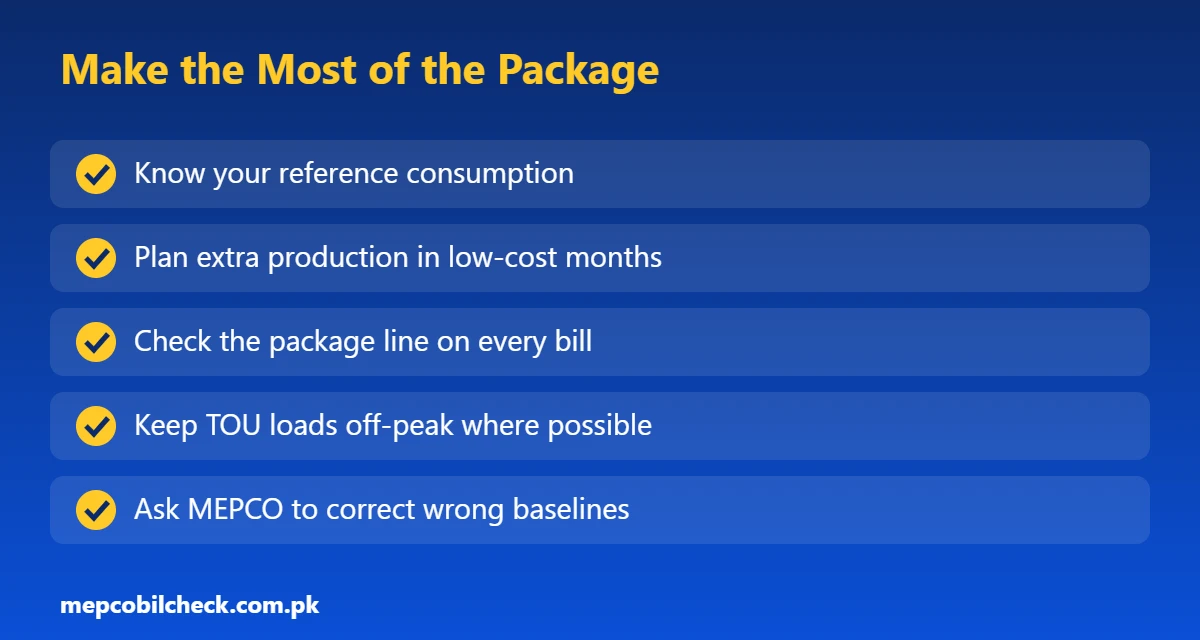
- Find out your reference consumption for each month.
- Schedule extra production where the package gives the biggest saving.
- Check every bill for the incremental line and correct errors early.
- Keep time-of-use loads off-peak where possible.
- Follow NEPRA’s review decision, because the rate is provisional.
Quick Summary: Incremental Consumption Package
- The ICP electricity package gives industrial and private agricultural consumers a lower rate on extra units.
- The incremental package rate rose from Rs 22.98 to Rs 25.30 per unit from the November 2026 billing month, on a provisional basis.
- Extra units are measured against December 2023 to November 2024 consumption.
- Domestic and commercial consumers are not covered.
Frequently Asked Questions
What is the incremental consumption package?
It is a government scheme that charges industrial and private agricultural consumers a lower rate on units used above their past consumption.
What is the new incremental package rate?
NEPRA set a provisional rate of Rs 25.30 per unit from the November 2026 billing month, up from Rs 22.98.
Do domestic consumers get the ICP electricity rate?
No. The package applies only to eligible industrial and private agricultural consumers.
How are incremental units calculated?
Your units are compared with the same month in December 2023 to November 2024. Units above that level are billed at the package rate.
Will my November bill be adjusted?
Yes. November 2026 bills issued before the decision was notified will be adjusted in later billing months.