MEPCO Detection Bill 2026: Rules, Calculation & How to Challenge It
Few things worry an electricity consumer more than a large extra charge called a detection bill. A MEPCO detection bill can add thousands of rupees to your normal bill, and many people do not know why it was charged or whether they can challenge it. This guide explains what a detection bill is, the rules MEPCO must follow under NEPRA’s Consumer Service Manual, how the amount is worked out, and the exact steps to take if you think your detection bill is wrong.
What Is a MEPCO Detection Bill?
A detection bill is a supplementary charge for electricity that MEPCO believes was used but not billed earlier. It is usually raised after a meter inspection finds a problem, for example:
- The meter is running slow or a current transformer (CT) is defective
- The meter is damaged, burnt or stuck
- The meter seal is broken or the meter has been tampered with
- A direct hook or bypass is found
- The connected load is much higher than the sanctioned load
The detection amount is shown on your bill as a separate charge, often with a reference to the checking report.
Types of Detection Bills
| Type | Common reason | What it means for you |
|---|---|---|
| Slow meter / defective CT | Meter records less than actual use | Usually a limited back charge and meter replacement |
| Theft or tampering | Bypass, hook, broken seals, manipulation | Larger back charge, possible legal action |
| Wrong multiplying factor | Error in CT ratio on larger connections | Correction of past units |
| Load-based assessment | Connected load far above sanctioned load | Units assessed on connected load |
Knowing which type applies to you is the first step in deciding whether to accept or challenge the detection bill.
NEPRA Rules on Detection Bills
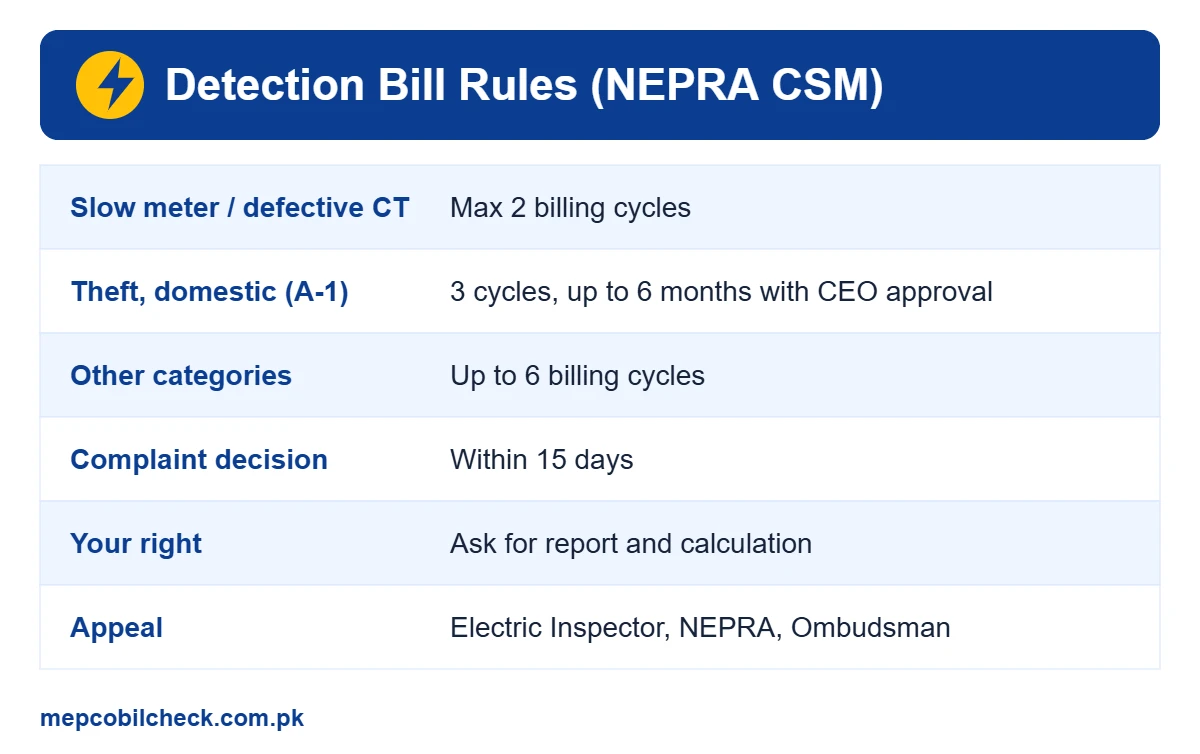
MEPCO cannot charge a detection bill for any period it likes. NEPRA’s Consumer Service Manual (CSM) sets limits:
- Slow meter or defective CT: A supplementary bill can be charged for a maximum of two billing cycles. In 2024, NEPRA rejected a proposal by distribution companies to extend this period, as reported by Business Recorder. NEPRA also said slow meters must be replaced within the set time, and officials can face disciplinary action if they fail to flag slowness.
- Theft cases: For general supply and A-1 to A-3 consumers, the current rules allow detection for up to three billing cycles, which can be extended to six months with the approval of the company’s chief executive. Other categories face up to six billing cycles.
- Complaint deadline for MEPCO: A complaint about a detection bill must be settled within 15 days of the complaint, under the CSM’s billing complaint rules.
In September 2026, NEPRA proposed amendments that would allow longer, load-based detection bills in some theft cases, with domestic consumers capped at six months. These were draft proposals open for comments and not final at the time of writing.
How a MEPCO Detection Bill Is Calculated
The calculation depends on the type of case:
- Slow meter: MEPCO estimates the percentage of slowness from a meter test and adds the missing units for the allowed period.
- Previous consumption method: Units may be assessed by comparing with your consumption in the same months of earlier years, before the fault.
- Connected load method: In some theft cases, units are assessed from the connected load, the hours of use and a load factor.
Whatever the method, you have the right to ask for the calculation sheet, the checking report and the meter test result. A detection bill without clear working is much easier to challenge.
What to Do When You Receive a MEPCO Detection Bill
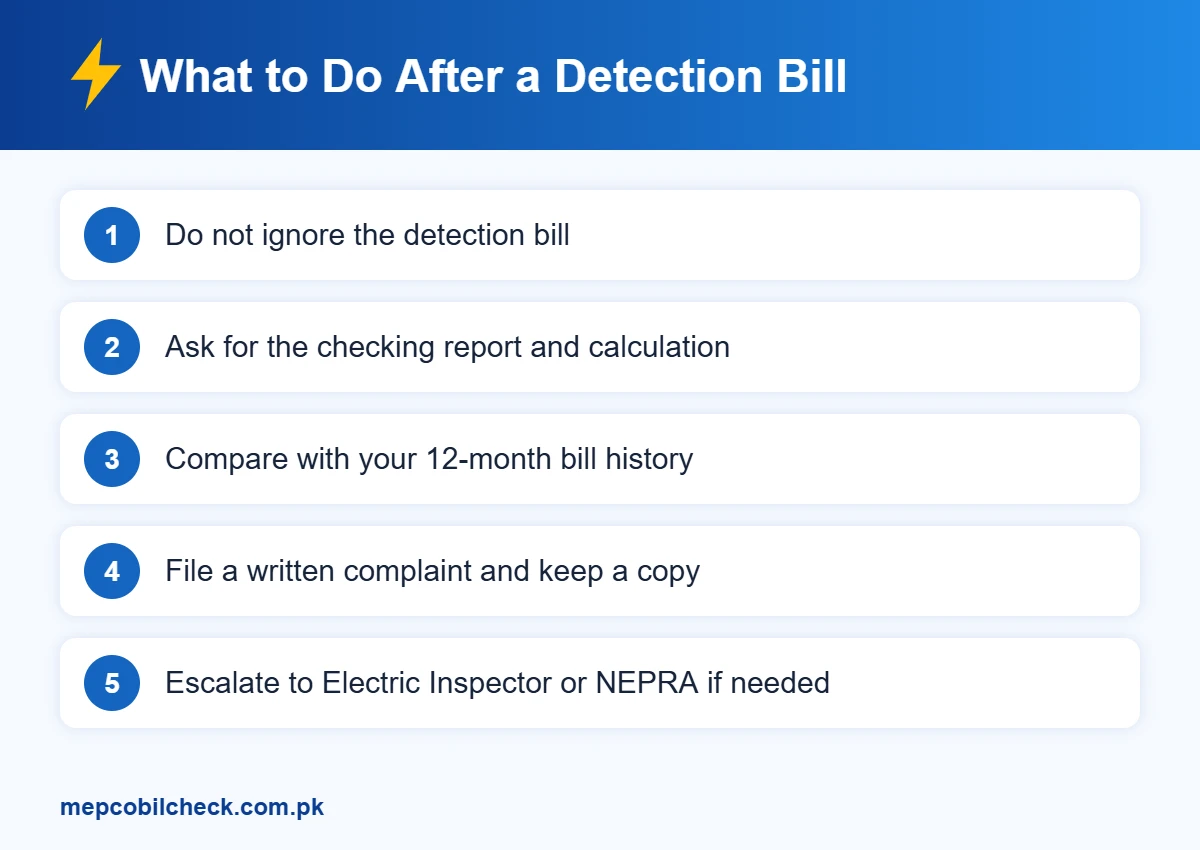
- Do not ignore it. Unpaid detection amounts become arrears and can lead to disconnection.
- Ask for documents. Request the inspection report, photos, the meter test report and the calculation sheet from your sub-division office.
- Compare with your history. Check the 12-month history on your bill using our MEPCO old bill check guide. A sudden drop in units before the inspection supports MEPCO’s case; steady units support yours.
- File a written complaint. Submit it at the SDO or revenue office, keep a stamped copy, and also register it through 118 or the PITC complaint portal.
- Ask about the regular bill. Find out whether you can pay your regular charges while the detection amount is under review, to avoid surcharge on the undisputed part.
- Attend the hearing. In theft cases, the company’s review committee should give you a personal hearing. Bring your documents.
Our MEPCO complaint number guide lists every official contact.
How to Challenge a Wrong Detection Bill
If MEPCO does not resolve your complaint fairly, you can escalate:
- Provincial Office of Inspection (Electric Inspector): In Punjab, consumers can take disputes about meters and detection bills to the Electric Inspector, who can order a meter check and decide the case.
- NEPRA: You can file a complaint with NEPRA through its online complaint system if MEPCO breaks CSM rules or misses deadlines.
- Federal Ombudsman: The Wafaqi Mohtasib also hears complaints of maladministration against government companies, including DISCOs.
Keep copies of everything: the detection notice, bills, complaint receipts and any meter test reports.
How to Avoid a Detection Bill
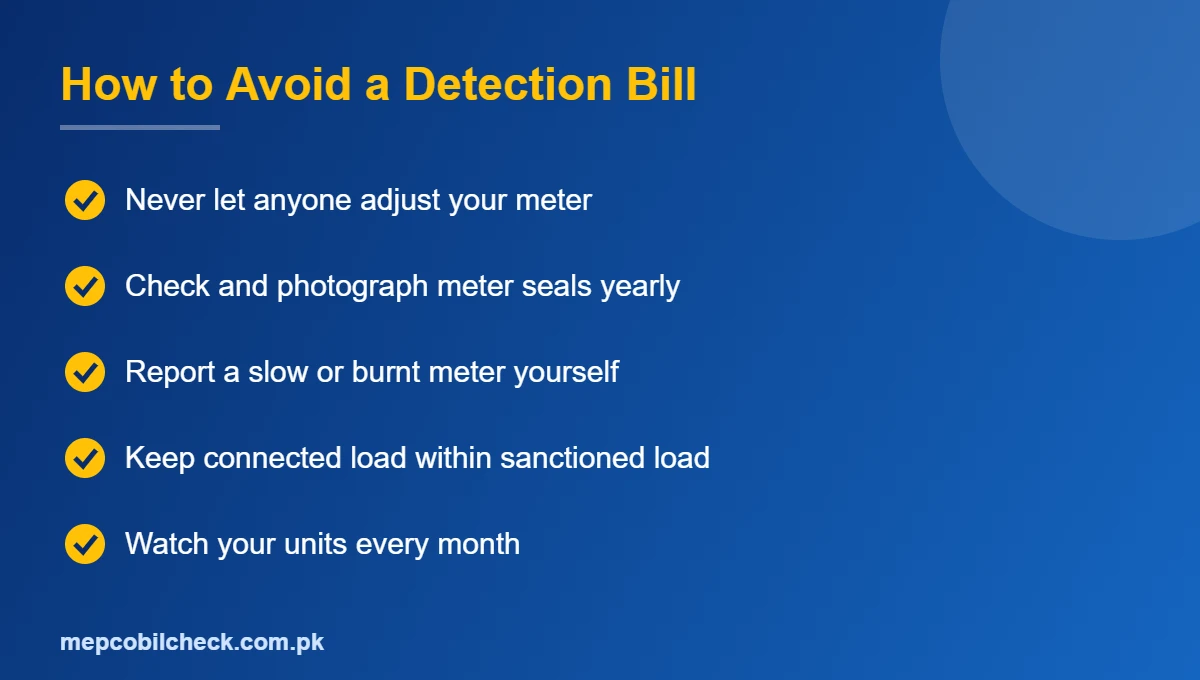
- Never allow anyone to touch or “adjust” your meter, even if they claim to be MEPCO staff, without proper identification
- Check that the meter seals are intact and photograph them once a year
- Report a slow, stuck or burnt meter yourself as soon as you notice it
- Keep your connected load within your sanctioned load, and apply for a load increase when you add ACs
- Watch your units every month; a sudden fall without a reason should be reported
Reporting a faulty meter early protects you, because the CSM limits back charges for slow meters to two billing cycles.
MEPCO Detection Bill vs Bill Correction
A detection bill adds units that MEPCO says were missed. A bill correction removes or adjusts wrong charges, such as a wrong reading or a payment not posted. If your problem is a wrong reading rather than a detection charge, the process and the deadlines are different. In both cases, keep a dated photo of your meter as evidence.
Common Detection Bill Situations (Examples)
These simple examples show how different cases are usually handled. They are illustrations, not legal advice.
Example 1: Slow meter found during routine checking. A meter is tested and found to be recording less than actual use. MEPCO replaces the meter and adds a detection bill for the missing units. Under NEPRA rules, this back charge can cover a maximum of two billing cycles. If MEPCO charges more months than that, you can point to the CSM limit in your complaint.
Example 2: Broken seal but steady units. An inspector finds a damaged seal, but your 12-month history shows steady units with no sudden drop. Ask for the checking report and a meter test. Steady consumption is strong evidence that no electricity was stolen, and you can ask for the detection bill to be reviewed.
Example 3: Connected load far above sanctioned load. A home with three ACs has a 1 kW sanctioned load. MEPCO may assess units using the connected load. In this case, apply for a load extension to bring your sanctioned load in line with your real use, which also prevents future disputes.
Documents to Keep for a Detection Bill Case
- The detection notice and the bill showing the detection amount
- The checking or inspection report, with date and names of officials
- Meter test or laboratory report, if a test was done
- Your last 12 to 24 months of bills or the bill history table
- Dated photos of your meter display and seals
- Copies of every complaint and the receipts or complaint IDs
A well-organised file makes it much easier for MEPCO, the Electric Inspector or NEPRA to review your detection bill fairly.
Quick Summary: MEPCO Detection Bill
- A MEPCO detection bill charges units that were not billed earlier, usually after a meter inspection.
- For a slow meter, the detection bill can cover a maximum of two billing cycles under NEPRA rules.
- For theft, domestic detection is limited to three billing cycles, extendable to six months with CEO approval.
- MEPCO must settle a detection bill complaint within 15 days.
- If a detection bill MEPCO issued looks wrong, ask for documents, file a written complaint and escalate if needed.
Frequently Asked Questions
What is a detection bill?
A detection bill is a supplementary charge for electricity that the company believes was used but not billed, usually because of a slow meter, a fault or theft.
How many months can MEPCO charge in a detection bill?
For a slow meter or defective CT, up to two billing cycles. For theft by general supply consumers, three billing cycles, extendable to six months with CEO approval, under the current Consumer Service Manual.
Can I refuse to pay a MEPCO detection bill?
You should not simply ignore it. File a written complaint, ask for the documents and calculation, and escalate to the Electric Inspector or NEPRA if needed.
How long does MEPCO have to decide my detection complaint?
Under NEPRA’s billing complaint rules, a detection bill complaint should be settled within 15 days.
Will a detection bill affect my protected status?
Detection units can raise your billed consumption. Ask MEPCO how the units were spread across months, and keep your regular use within 200 units.



4 Comments