MEPCO Load Extension 2026: Increase Sanctioned Load, Documents & Cost
Added a new AC, an electric geyser or a water motor and now your breaker keeps tripping? You may need a MEPCO load extension. Your sanctioned load is the amount of power MEPCO has approved for your connection, and in 2026 it matters more than ever, because fixed charges, TOU billing and even solar approvals depend on it. This guide explains when to increase or reduce your load, the documents NEPRA’s rules require, how to apply, the costs involved and the mistakes to avoid.
What Is Sanctioned Load?
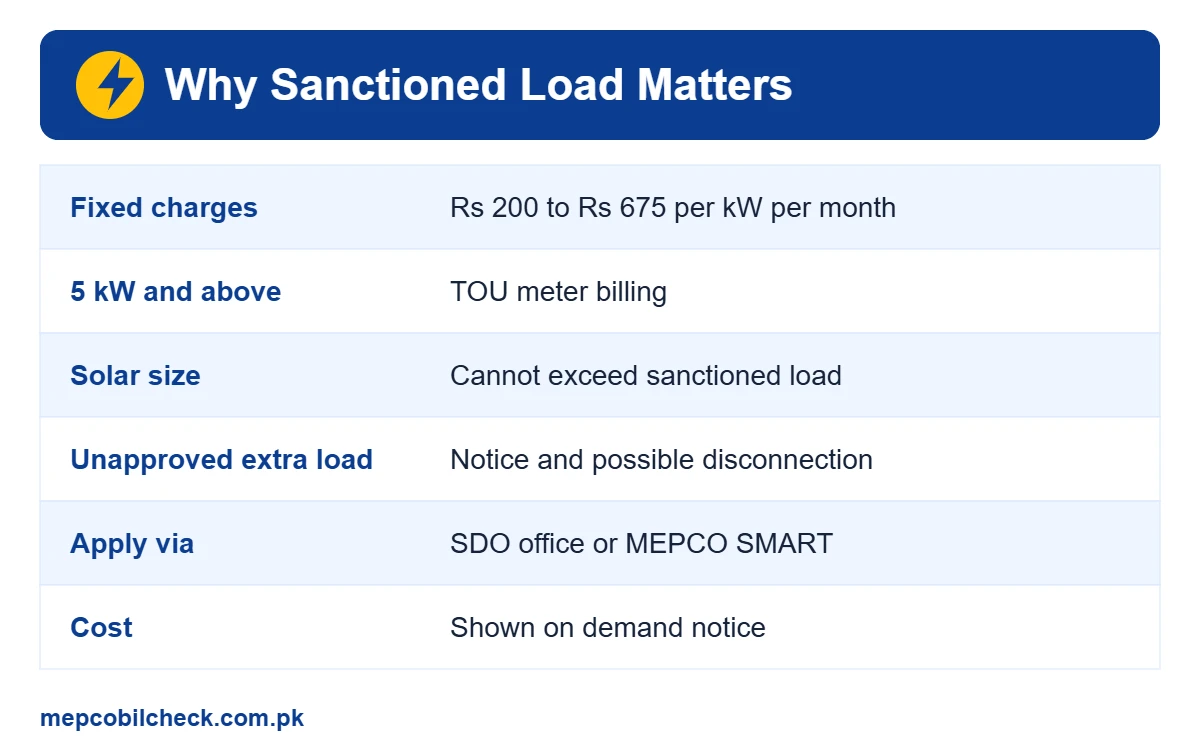
Sanctioned load is the maximum load, in kilowatts (kW), that MEPCO has approved for your connection. It is printed on your bill. It decides:
- Fixed charges: Under the 2026 tariff, domestic consumers pay fixed charges per kW of sanctioned load, from Rs 200 to Rs 675 per kW per month depending on the slab.
- Meter type: Residential connections with a sanctioned load of 5 kW or more are billed on Time of Use (TOU) meters.
- Solar size: Under the 2026 Prosumer Regulations, a solar system’s capacity is limited to your sanctioned load.
- Supply capacity: The service cable and meter are chosen to match your load.
When Do You Need a MEPCO Load Extension?
Apply to increase your sanctioned load when:
- You add air conditioners, an electric geyser, a heater or a large motor
- The main breaker trips often when several appliances run together
- You want to install a larger solar system than your current load allows
- You are converting part of the house into a shop or clinic
- You need a three-phase connection for heavy appliances
Running a load far above your sanctioned load can lead to problems. NEPRA’s disconnection rules allow distribution companies to give notice for an unauthorised load extension, and if the consumer does not apply within one month, supply can be disconnected. In some inspection cases, units may also be assessed on the connected load. Read our MEPCO detection bill guide for more.
How to Calculate the Load You Need
Add up the appliances that may run at the same time:
| Appliance | Approximate load |
|---|---|
| 1.5 ton inverter AC | 1.5 to 2 kW |
| Electric geyser | 1.5 to 3 kW |
| Electric iron | 1 kW |
| Water motor (1 HP) | 0.75 kW |
| Microwave oven | 1 to 1.5 kW |
| Fridge | 0.2 to 0.3 kW |
| Fans and LED lights (whole house) | 0.5 to 1 kW |
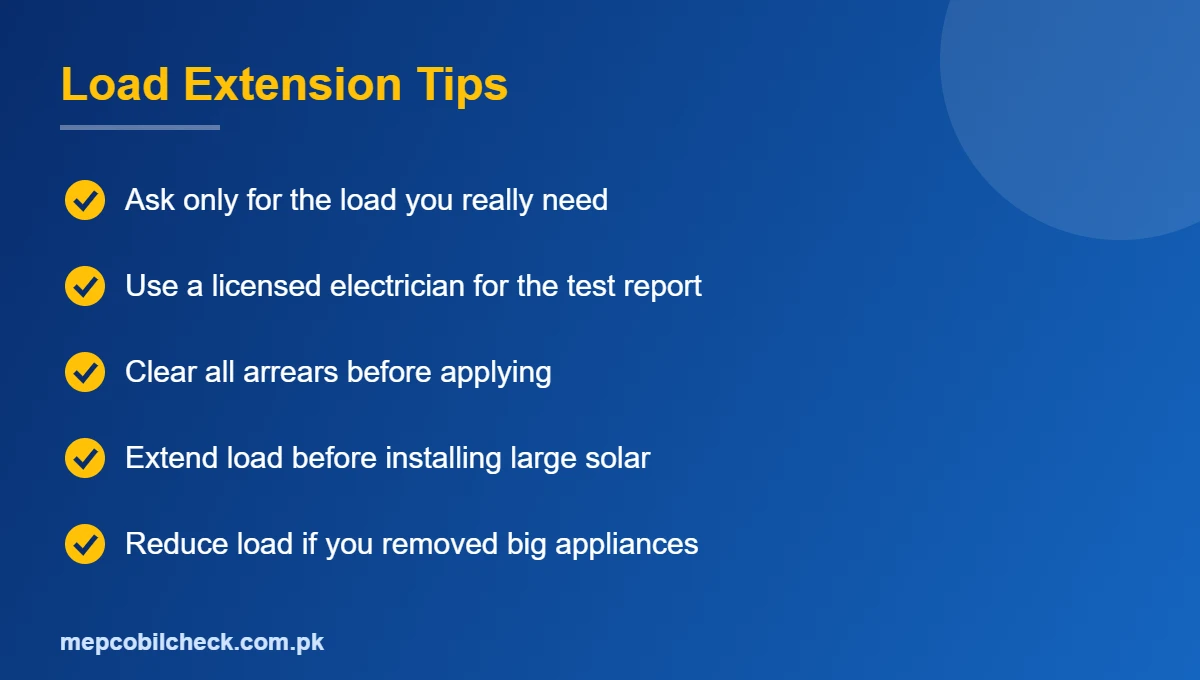
A licensed electrician can help you calculate a realistic figure. Ask for enough load for your real use, but not much more, because extra load raises fixed charges every month.
Documents Required for MEPCO Load Extension
NEPRA’s Consumer Service Manual lists these documents for an extension of load:
- Application form for load change
- Test report from the Electric Inspector or an authorised wiring contractor
- Copy of the last paid bill, with no arrears
- Attested CNIC copy of the consumer
- Power supply contract or agreement
- Payment of any capital cost, if new network work is needed
- Updated security deposit for the entire new load, with credit for the deposit already paid
You can read the manual on NEPRA’s website.
How to Apply for a Load Extension
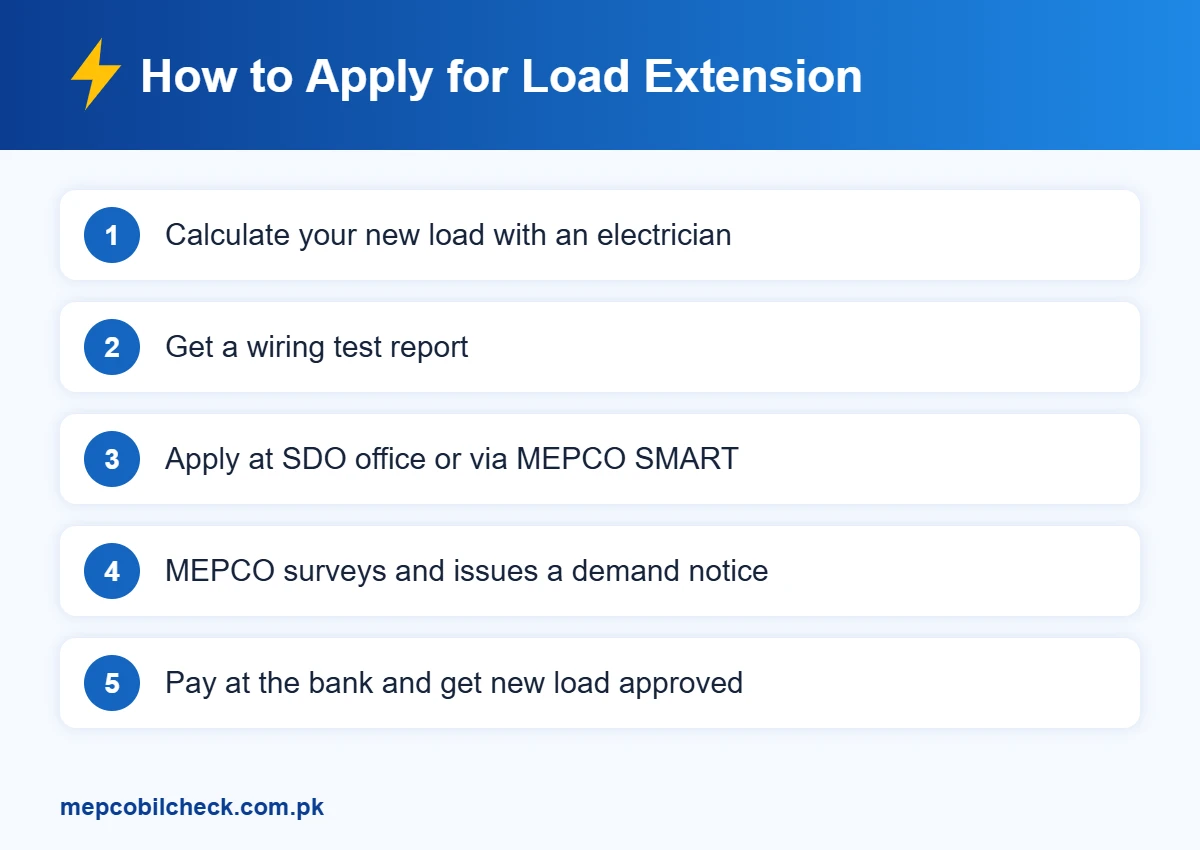
- Calculate your new load with an electrician.
- Get a wiring test report from an authorised contractor.
- Apply at your sub-division office, or start the request through the Change of Attributes option in the official MEPCO SMART app, which covers changes of load, tariff or owner name.
- Site survey: MEPCO checks the service cable, meter and transformer capacity.
- Demand notice: If any cost applies, such as a new meter, cable or security deposit update, MEPCO issues a demand notice.
- Payment and installation: Pay at the bank, after which MEPCO installs any new equipment and updates your sanctioned load.
Our MEPCO demand notice guide explains how to read and pay the notice.
Load Extension Costs
The cost depends on your case and may include:
- Security deposit difference for the new load
- New meter, such as a three-phase or TOU meter
- Thicker service cable, if the existing cable is too small
- Capital cost of network work, if the transformer or line needs an upgrade
There is no single fixed price. Ask for a written breakdown and pay only through the official demand notice. Read our MEPCO meter change guide if your meter type will change.
Can You Reduce Your Sanctioned Load?
Yes. If your sanctioned load is much higher than you need, for example after removing ACs or splitting a property, you can apply for a reduction. The CSM says the security deposit is updated and the difference is refunded or charged. Reducing an unnecessarily high load can lower your monthly fixed charges and, below 5 kW, may move a home off compulsory TOU billing.
Load Extension and Solar
Under the 2026 rules, your solar system cannot be larger than your sanctioned load. If you plan a bigger system, apply for the load extension first, then the solar connection. Our MEPCO net metering guide explains the new net billing rules.
How Sanctioned Load Changes Your Fixed Charges
This example shows fixed charges for a non-protected home using 201 to 300 units a month, where the 2026 fixed charge is Rs 350 per kW per month:
| Sanctioned load | Fixed charges per month | Per year |
|---|---|---|
| 1 kW | Rs 350 | Rs 4,200 |
| 2 kW | Rs 700 | Rs 8,400 |
| 3 kW | Rs 1,050 | Rs 12,600 |
| 5 kW | Rs 1,750 | Rs 21,000 |
A home with 5 kW sanctioned load would also be billed on a TOU meter, with different fixed charge rules. The table shows why asking for far more load than you need is expensive. A careful MEPCO load extension, based on real appliances, keeps fixed charges reasonable.
Single-Phase to Three-Phase Upgrade
Large homes with several ACs, an electric geyser and motors may need a three-phase connection. A three-phase supply spreads the load across three lines, which reduces tripping and voltage drops. The upgrade usually comes with a load extension, a three-phase meter and possibly a new service cable. Ask your sub-division office whether your area’s transformer can take the extra load before you buy expensive appliances.
Common Mistakes With Load Extension
- Installing new ACs first and applying for load later, which risks notices and penalties
- Asking for much more load than needed, which raises fixed charges for years
- Using an unlicensed electrician for the test report
- Applying while arrears are unpaid, which stops the request
- Forgetting that solar capacity is tied to sanctioned load
Who Approves a Load Extension?
Under NEPRA’s Consumer Service Manual, the sanctioning officer depends on the size of the load. For most homes and small shops, the sub-division officer (SDO) handles the request, while larger loads go to higher officers. If your request is delayed, follow up with your application number, and use our MEPCO complaint number guide to escalate.
Load Extension for Shops and Small Businesses
If you run a shop, clinic or small workshop from your premises, your load needs may be higher than a home’s because of freezers, display lights, ACs or machines. A commercial connection also has its own tariff, which is different from the domestic slabs. When you plan a business at home, ask MEPCO about both the load extension and the right tariff category, so your bills are correct from the start and you avoid disputes later.
Checklist Before You Apply
- List every appliance and its wattage.
- Get your electrician to calculate a realistic load.
- Pay any arrears and keep the latest paid bill.
- Get a wiring test report from an authorised contractor.
- Collect CNIC and ownership documents.
- Apply and keep the application number.
Following this checklist makes your MEPCO load extension faster and avoids repeat visits.
Quick Summary: MEPCO Load Extension
- A MEPCO load extension raises the sanctioned load printed on your bill.
- Load extension needs a test report, last paid bill, CNIC, agreement and updated security deposit.
- To increase sanctioned load, apply at the SDO office or through MEPCO SMART’s Change of Attributes.
- Your MEPCO sanctioned load decides fixed charges, TOU billing and maximum solar size.
- Running extra load without approval can lead to notices, disconnection or load-based charges.
Frequently Asked Questions
How do I apply for a MEPCO load extension?
Apply at your sub-division office or start the request through the MEPCO SMART app’s Change of Attributes option, with a wiring test report, last paid bill, CNIC and agreement.
Does a higher sanctioned load increase my bill?
Yes. Fixed charges are charged per kW of sanctioned load under the 2026 tariff, and loads of 5 kW or more put homes on TOU billing.
What is the cost of a MEPCO load extension?
It depends on the security deposit difference, any new meter or cable, and network work. MEPCO issues a demand notice with the exact amount.
Can I reduce my sanctioned load?
Yes. Apply for a reduction; the security deposit is adjusted and your fixed charges may fall.
Do I need a load extension for solar?
If your planned solar system is larger than your current sanctioned load, yes, because capacity is limited to sanctioned load.