How Many Solar Panels Do I Need? Size Your Solar System From Your MEPCO Bill (2026)
Solar is one of the best ways to beat rising bills in South Punjab, but the first question every family asks is: how many solar panels do I need? Buying too few panels leaves you paying high bills, and buying too many wastes money, especially under the 2026 net billing rules. This guide shows how to work out the right solar system size from your MEPCO bill, how many panels that means, how much roof space you need and how to plan a solar system for home use that actually saves money.
Step 1: Find Your Monthly Units
Your MEPCO bill has a history table showing units for the last 12 months. Open your bill with our MEPCO bill check online tool and note the units for each month. Our guide on how to read MEPCO bill sections shows where the history table is.
Calculate two numbers:
- Average monthly units across the year
- Peak monthly units in summer
Most families size the system somewhere between the yearly average and the summer peak.
Step 2: Convert Units to System Size
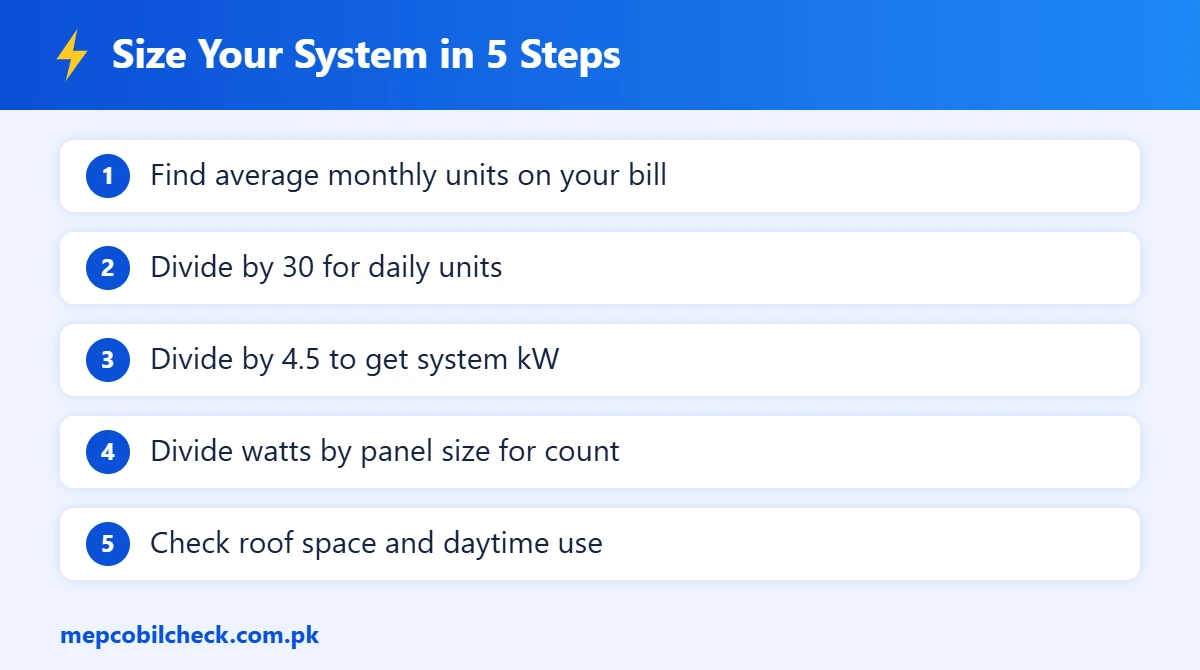
In South Punjab, each kilowatt (kW) of well-installed solar panels produces roughly 4 to 5 units a day on average over the year, more in sunny months and less in foggy winter weeks. Use this formula:
System size (kW) = monthly units / 30 / 4.5
For example, a home using 450 units a month needs about 450 / 30 / 4.5 = 3.3 kW.
Quick Solar System Size Table
| Monthly units | Daily units | Suggested system size |
|---|---|---|
| 150 | 5 | About 1 to 1.5 kW |
| 300 | 10 | About 2 to 2.5 kW |
| 450 | 15 | About 3.5 kW |
| 600 | 20 | About 4.5 to 5 kW |
| 800 | 27 | About 6 kW |
| 1,200 | 40 | About 9 to 10 kW |
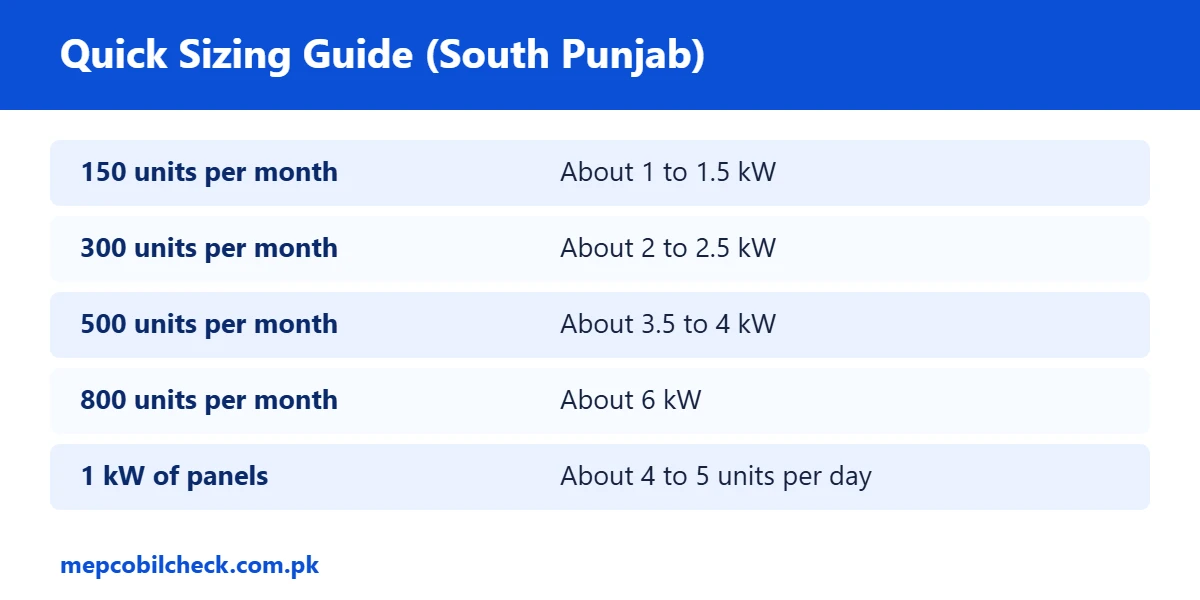
These are rough estimates. Shade, panel direction, tilt, dust and temperature all affect output.
Step 3: Count the Panels
Modern panels sold in Pakistan are usually between 585W and 620W. To find how many solar panels you need:
Number of panels = system size in watts / panel wattage
| System size | 585W panels | 620W panels |
|---|---|---|
| 3 kW | 5 to 6 | 5 |
| 5 kW | 9 | 8 |
| 6 kW | 10 to 11 | 10 |
| 10 kW | 17 | 16 |
For current panel costs, see our solar panel price in Pakistan guide.
Step 4: Check Your Roof Space
A large 600W-class panel measures roughly 2.3 to 2.4 metres long and about 1.1 metres wide, so each needs about 2.6 square metres, or roughly 28 square feet, plus space for walking and cleaning. A 5 kW system with eight panels needs around 250 to 300 square feet of shade-free roof. Avoid areas shaded by water tanks, walls, trees or neighbouring buildings, because even partial shade can cut output significantly.
Step 5: Match the Inverter and System Type
- On-grid system: connects to MEPCO through a bidirectional meter. Cheapest per kW, but switches off during load shedding for safety.
- Hybrid system: works with the grid and batteries, so it can run essential loads during outages. Costs more because of batteries.
- Off-grid system: no grid connection; needs batteries for night use. Common for remote farms and tube wells.
The inverter should match your panel capacity and the maximum load you want to run at once. Ask a certified installer to check both.
Does Battery Storage Change the Answer?
Batteries do not change how many solar panels do I need for daytime use, but they change the total if you want to run loads at night or during load shedding. To charge a battery and run the house in the day, you need extra panel capacity on top of your daytime load. Batteries add significant cost, so many families start with an on-grid or hybrid-ready system and add storage later. For official tariff and net billing decisions, follow NEPRA.
Sizing Under Net Billing in 2026
Since February 2026, new grid-connected systems fall under NEPRA’s net billing rules: imported units are billed at your normal tariff, but exported units earn a lower credit. This changes how you should size a solar system for home use:
- Size the system mainly for daytime use, not to export large surpluses.
- Shift washing, ironing, water pumping and AC use to sunny hours.
- A slightly smaller system with high self-use can give a better return than an oversized one.
Our MEPCO green meter guide explains net billing, bidirectional meters and approval costs.
Example: A Typical Multan Family
A family in Multan uses 250 units in winter and 550 units in summer, an average of about 400 units a month. Using the formula, 400 / 30 / 4.5 is about 3 kW. Because summer AC use is in the afternoon, a 4 to 5 kW on-grid system with eight 620W panels would cover most daytime needs in summer and leave some surplus in winter. If outages are frequent in their area, a hybrid inverter with a small battery could keep fans and lights running.
Example: A Small Protected Home
A home using about 150 units a month is protected and pays low per unit rates. A 1 to 1.5 kW system can cover most daytime fans and lights and help the family stay below 200 units, protecting its low tariff. Very small homes should compare the cost carefully, because savings at protected rates are lower. Learn more in our MEPCO subsidy guide.
How Many Solar Panels Do I Need to Run an AC?
A 1.5 ton inverter AC typically uses about 0.8 to 1.3 units per hour. If you run it for 8 daytime hours, that is roughly 8 to 10 units a day. Since 1 kW of panels makes about 4 to 5 units a day, you would need around 2 to 2.5 kW of panels, about four 620W panels, just for one AC, on top of your other loads. Two ACs push the answer to roughly 4 to 5 kW. Our inverter AC electricity consumption guide explains AC units in detail.
Solar System Size for Shops and Tube Wells
Shops and offices use most of their power during the day, which suits solar perfectly. Work out the solar system size from the shop’s daytime units, not the total, if the shop stays open late. For tube wells, size the system to the motor’s power and pumping hours; a 10 HP motor needs a much larger array than a home system. Many farmers choose off-grid solar pumps that need no bidirectional meter. See our MEPCO tube well bill guide for agricultural tariffs.
Solar System for Home: Cost Overview
Panels are priced per watt, so a larger solar system size costs more in panels in direct proportion. On top of panels, a solar system for home use needs an inverter, mounting structure, cables, protection devices, earthing and installation, and grid-connected systems need a bidirectional meter and approval fees. Get at least three complete written quotes and compare the cost per kW, not just the panel price.
Check Results After Installation
After your system is installed, compare your monthly units with the same month last year using the bill history. If savings are far lower than expected, check for shade, dirty panels or inverter errors. A properly sized system should clearly lower your imported units in sunny months.
Common Sizing Mistakes
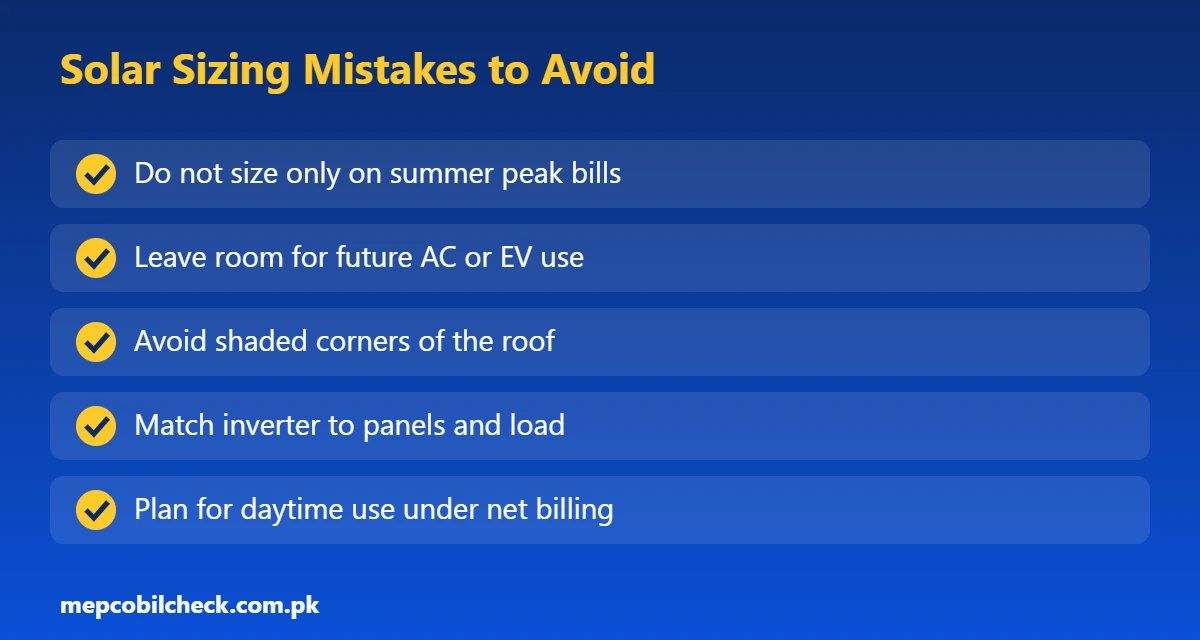
- Sizing only on the hottest month: this can lead to an oversized system that exports cheaply most of the year.
- Ignoring future needs: a new AC, an extra floor or an electric vehicle can raise use later.
- Using shaded roof areas: shade reduces output more than most people expect.
- Mismatched inverter: an undersized inverter limits output; an oversized one costs more for no gain.
- Forgetting fixed charges: your MEPCO bill keeps fixed charges as long as you stay connected. See our fixed charges in electricity bill guide.
Quick Summary: How Many Solar Panels Do I Need?
- Divide your monthly units by 30, then by about 4.5, to estimate system size in kW.
- Divide the system size in watts by panel wattage to get the number of panels.
- A 5 kW system usually needs about eight 620W panels and 250 to 300 square feet of shade-free roof.
- Under net billing, size for daytime self-use rather than export.
Frequently Asked Questions
How many solar panels do I need for 300 units a month?
About 2 to 2.5 kW, which is four 585W to 620W panels in most cases.
How many units does 1 kW of solar produce in Pakistan?
In South Punjab, roughly 4 to 5 units a day on average, depending on weather, shade and panel angle.
What solar system size is best for a home using 500 units?
About 3.5 to 4 kW, or larger if most of your use is during the day in summer.
How much roof space does a 5 kW system need?
Roughly 250 to 300 square feet of shade-free roof for eight large panels.
How do I choose the right solar system size?
Start with your average monthly units, divide by 30 and then by about 4.5 to get kW, then adjust for daytime use, roof space and budget. That simple method answers how many solar panels do I need for most homes.
Should I buy an on-grid or hybrid system?
On-grid systems cost less, while hybrid systems with batteries keep power on during outages. Choose based on your budget and how often load shedding affects your area.




2 Comments