Inverter AC Electricity Consumption 2026: Units Per Hour, Monthly Bill & Winter Heating Cost
Air conditioners are the single biggest reason electricity bills jump in South Punjab. Many people buy an inverter AC to save money, but few know how many units it really uses. This guide explains inverter AC electricity consumption in simple terms: typical inverter AC units per hour, how much a 1.5 ton inverter AC adds to your monthly MEPCO bill, and whether using the AC’s heat mode in winter is cheaper than an electric heater.
How Does an Inverter AC Save Electricity?
A normal (non-inverter) AC runs its compressor at full power until the room reaches the set temperature, then switches off, then switches on again at full power. An inverter AC changes the compressor speed instead. Once the room is cool, it slows down and keeps running gently. Avoiding repeated full-power starts is what lowers inverter AC electricity consumption, often by 30% to 50% compared with an older non-inverter unit, depending on use.
Inverter AC Units Per Hour
One unit on your bill means one kilowatt hour (kWh). Typical ranges are:
| AC type | Typical units per hour |
|---|---|
| 1 ton inverter AC | About 0.5 to 0.9 |
| 1.5 ton inverter AC | About 0.8 to 1.3 |
| 2 ton inverter AC | About 1.2 to 1.8 |
| 1.5 ton non-inverter AC | About 1.5 to 1.8 while the compressor runs |
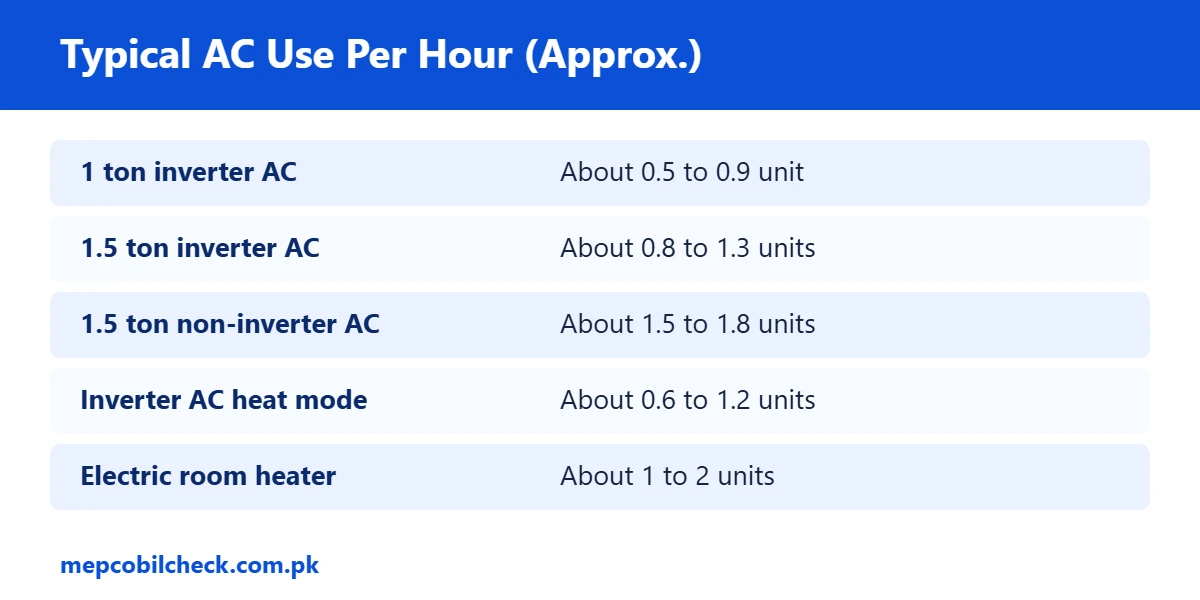
These are averages. Inverter AC units per hour rise on very hot afternoons, in rooms with direct sun or poor insulation, and at low temperature settings. They fall at night, at 26°C settings and in well-shaded rooms. Check the energy label on your AC for its rated power and efficiency.
Monthly Units for a 1.5 Ton Inverter AC
Use this simple formula:
Monthly units = units per hour x hours per day x days
| Daily use | At 1.0 unit per hour | At 1.2 units per hour |
|---|---|---|
| 4 hours | 120 units | 144 units |
| 6 hours | 180 units | 216 units |
| 8 hours | 240 units | 288 units |
| 10 hours | 300 units | 360 units |
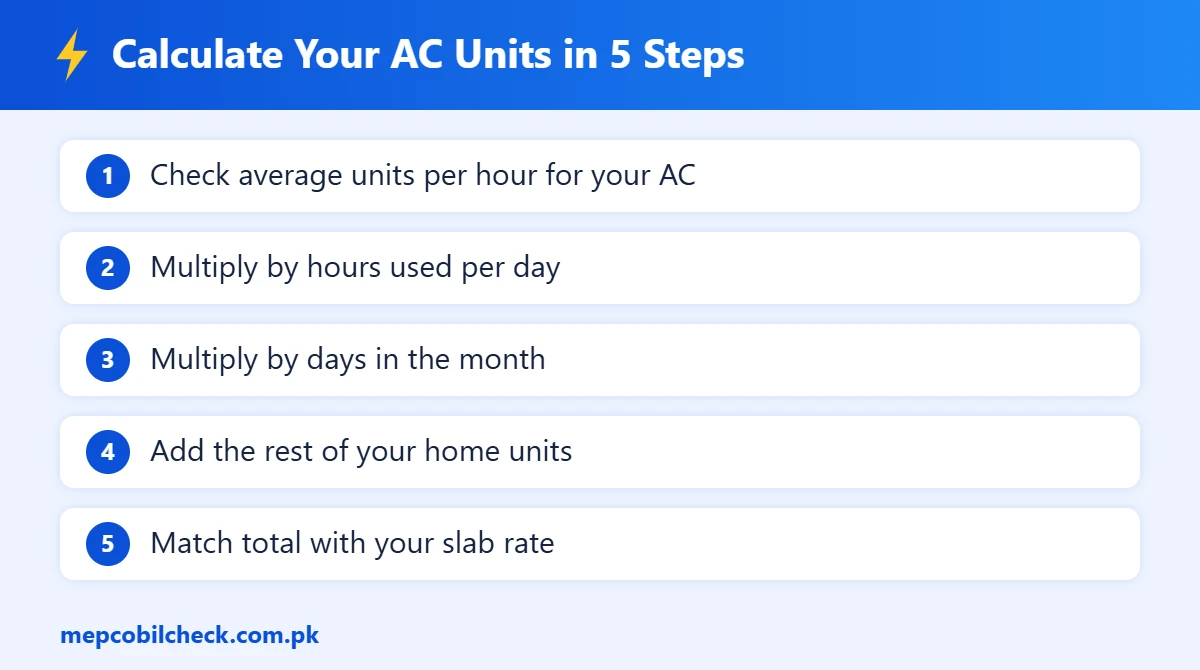
So a 1.5 ton inverter AC used 8 hours a day can add around 240 to 290 units a month. Add fans, fridge, lights and a water motor, and many homes easily cross 300 or 400 units in June and July.
What It Costs on Your MEPCO Bill
Because domestic rates are slab based, the cost of AC units depends on where your total units land. A home that would use 150 units without the AC is protected and pays low rates. Adding 240 AC units pushes it to about 390 units, into the non-protected 301 to 400 slab, where the base rate is Rs 36.46 per unit, plus fixed charges, fuel adjustment and 18% GST. Crossing 200 units also removes protected status for the next six months.
Use our MEPCO bill calculator to test your own numbers, and see current slab rates in our MEPCO per unit rate guide. The new fixed charges in electricity bill also rise with higher slabs.
Remember that the cost of each unit is not fixed for the year. Slab rates are set by NEPRA, and the monthly fuel adjustment changes the final amount. In a month with a large positive fuel adjustment, the same AC hours cost more, so it is worth being extra careful with settings and running time during those months.
Is Heating With an Inverter AC Cheaper in Winter?
Many inverter ACs are heat pumps and can heat a room in winter. A heat pump moves heat from outside air into the room instead of creating heat from electricity directly, so it can deliver more heat per unit than a plain electric heater. Typical use:
- Inverter AC in heat mode: about 0.6 to 1.2 units per hour for a medium room
- Electric room heater: about 1 to 2 units per hour
On cold South Punjab nights, heating one room for six hours with an inverter AC might use around 4 to 7 units, compared with 6 to 12 units for an electric heater. Heat pumps lose some efficiency in very cold weather, but winters in Multan, Bahawalpur and Rahim Yar Khan are mild enough for them to work well.
Inverter vs Non-Inverter: Real Savings
| Point | Inverter AC | Non-inverter AC |
|---|---|---|
| Compressor | Variable speed | On/off at full power |
| Units per hour (1.5 ton) | About 0.8 to 1.3 | About 1.5 to 1.8 when running |
| Temperature control | Steady | Ups and downs |
| Noise | Lower | Higher at start-up |
| Purchase price | Higher | Lower |
| Running cost | Lower | Higher |
For homes that run the AC many hours a day, an inverter model usually pays back its higher price through lower bills within a few summers.
Tips to Reduce Inverter AC Electricity Consumption
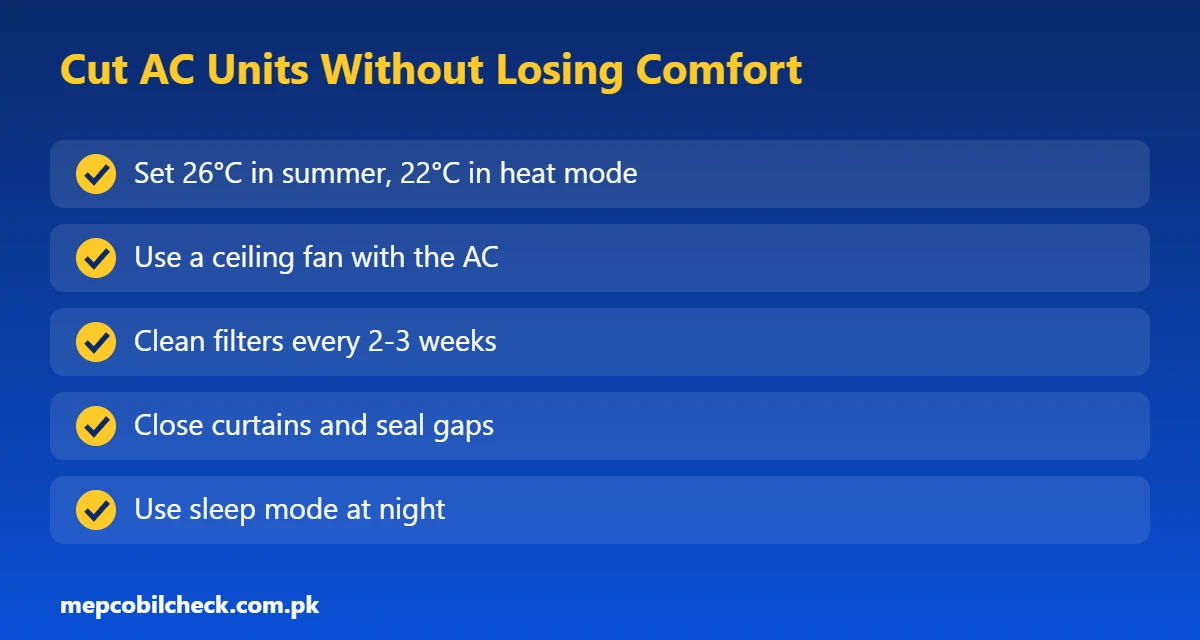
- Set 26°C in summer. Each degree lower adds noticeably to inverter AC electricity consumption.
- Use a ceiling fan with the AC. Moving air feels cooler, so you can keep the setting higher.
- Clean filters every two to three weeks in dusty South Punjab summers.
- Block the sun. Close curtains, use shades and keep doors and windows shut.
- Use sleep mode at night. It gradually raises the temperature as you sleep.
- Service the AC before summer so the gas level and coils are in good condition.
- Install the outdoor unit in shade with free air flow.
- In winter, use heat mode at about 22°C instead of electric heaters.
More ideas are in our guide on how to reduce electricity bill costs.
Choose the Right Size for Your Room
An AC that is too small runs at full power for hours and never reaches the set temperature, which raises inverter AC electricity consumption instead of lowering it. An AC that is too big costs more to buy and cools unevenly. As a rough guide for typical South Punjab rooms:
| Room size | Suggested capacity |
|---|---|
| Up to about 120 sq ft | 1 ton |
| About 120 to 200 sq ft | 1.5 ton |
| About 200 to 300 sq ft | 2 ton |
Top-floor rooms, rooms with west-facing walls or large windows, and kitchens need extra capacity. Ask a qualified technician to assess your room before buying.
Signs Your AC Is Using Too Many Units
- Units jump compared with the same month last year, with no change in use.
- The room takes much longer to cool than before.
- The outdoor unit is very hot, noisy or covered in dust.
- Ice forms on pipes, or water leaks indoors.
- The AC runs all day at a low setting such as 18°C.
Any of these can push inverter AC units per hour well above normal. A service visit, a gas check and cleaning the coils often bring use back down.
Before You Buy an Inverter AC
Check the energy label and the rated input power, choose a true DC inverter model from a brand with local service, compare warranty terms for the compressor, and ask whether the unit supports heat mode for winter. A slightly more efficient model can save hundreds of units over a summer.
Track Your AC Use With the Meter
The best way to know your real inverter AC units per hour is to measure it. Note your meter reading, run only the AC for one hour, and read the meter again. Our guide on how to read electric meter displays shows how. Do this on a hot afternoon and a cool night to see the range.
Peak Hours and AC Use
If you have a time-of-use meter, units used during peak hours cost more. Pre-cool rooms before peak hours start and raise the setting during peak time. See the current timings in our MEPCO peak hours guide.
Solar and Inverter ACs
Inverter ACs pair well with solar panels because they draw steady, moderate power during sunny afternoons when solar output is highest. Under the 2026 net billing rules, using your solar power directly for the AC saves more than exporting it. Read our MEPCO green meter guide for details.
Quick Summary: Inverter AC Electricity Consumption
- A 1.5 ton inverter AC typically uses about 0.8 to 1.3 units per hour.
- At 8 hours a day, that is roughly 240 to 290 units a month.
- AC units can push homes into higher slabs and remove protected status.
- In winter, an inverter AC’s heat mode usually uses fewer units than an electric heater.
Frequently Asked Questions
How many units does a 1.5 ton inverter AC use per hour?
Typically about 0.8 to 1.3 units per hour, depending on outside temperature, room size, insulation and temperature setting.
How many units does an inverter AC use in a month?
At 8 hours a day, a 1.5 ton inverter AC usually uses around 240 to 290 units a month.
Is an inverter AC cheaper than a heater in winter?
Usually yes. In heat mode, an inverter AC often uses about half the units of a plain electric heater for the same comfort.
What temperature saves the most electricity?
26°C in summer with a ceiling fan, and about 22°C in winter heat mode, give a good balance of comfort and savings.
Does a 1 ton inverter AC use less electricity?
Yes, if it is the right size for the room. An undersized AC runs at full power for longer, which can cancel the savings.
2 Comments