MEPCO Net Metering 2026: New Net Billing Rules, Process & Buyback Rate
Thinking of installing rooftop solar in Multan, Bahawalpur or anywhere in South Punjab? Before you buy panels, you need to understand MEPCO net metering in 2026, because the rules changed in a big way this year. New solar connections now come under a net billing system, the buyback rate for exported units is much lower, and existing users have their own protection. This guide explains the new rules, the MEPCO application process, costs, timelines and how to decide if solar is still worth it for your home.
What Is MEPCO Net Metering?
Net metering allowed solar users to send extra electricity from their panels to the MEPCO grid in the daytime and use units from the grid at night. A two-way meter recorded both. For years, exported units were valued at a rate close to what consumers paid, so many homes reduced their bills sharply.
In 2026, this system changed. On 9 February 2026, NEPRA introduced the NEPRA (Prosumer) Regulations, 2026, which replaced the old net metering framework with net billing for new connections, according to The Express Tribune.
Net Metering vs Net Billing: What Changed?
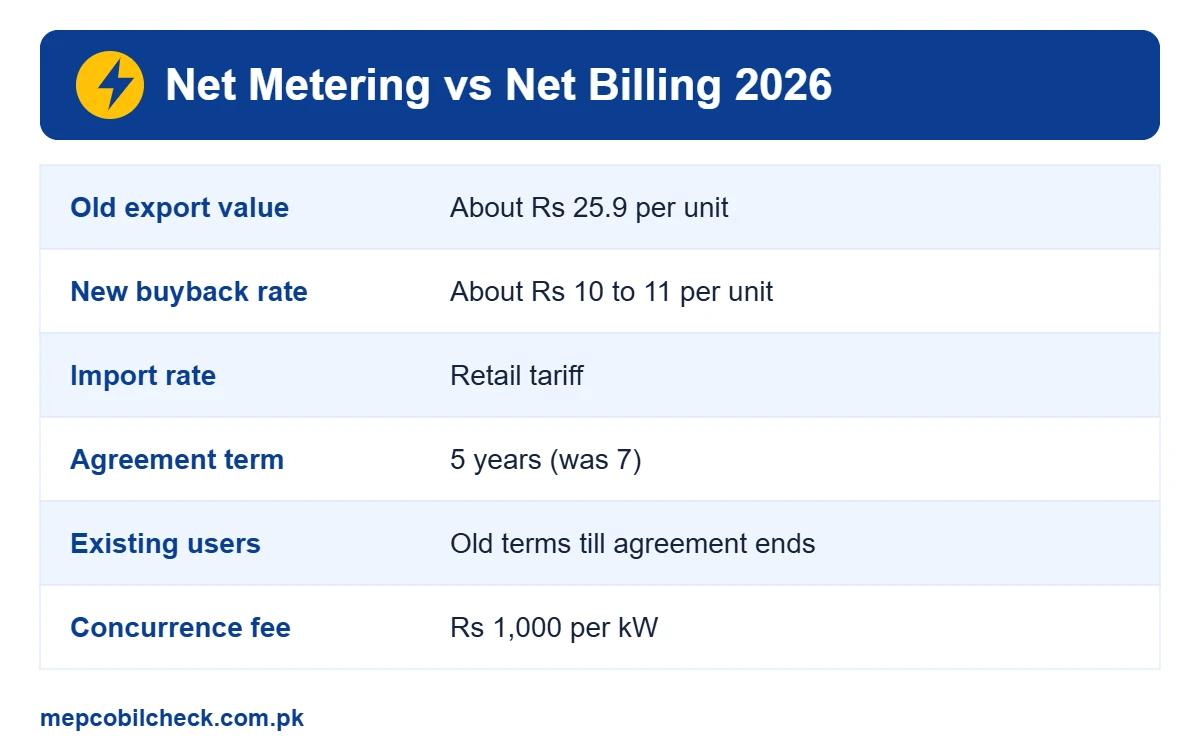
| Point | Old net metering | New net billing (2026) |
|---|---|---|
| How units are valued | Exported units offset imported units | Exported units bought at a set rate; imported units billed at retail tariff |
| Export (buyback) rate | Around Rs 25.9 per unit before the change | National average energy purchase price, reported at about Rs 10 to Rs 11 per unit |
| Import rate | Retail tariff | Retail tariff (reported at about Rs 37 to Rs 55 per unit) |
| Agreement term | 7 years | 5 years, renewable by mutual consent |
| Applies to | Existing agreements until they expire | New installations and renewals |
The big difference is that a unit you export is now worth much less than a unit you buy. That changes how you should size and use a solar system.
What Happens to Existing Net Metering Users?
After strong public reaction and the Prime Minister’s direction to review the rules, NEPRA issued an amendment in February 2026 so that existing net-metering users continue to be billed under the old mechanism until their current agreements expire. Federal Power Minister Awais Leghari said the review was meant to protect 466,506 existing solar users. When an existing agreement ends, the renewal falls under the new net billing rules.
If you already have a MEPCO net metering connection, keep a copy of your agreement and note its expiry date, so you can plan ahead.
Key Rules for New Solar Connections
According to reports on the Prosumer Regulations, 2026:
- The maximum size of one distributed generation facility is 1 MW
- Your system capacity is limited to your sanctioned load
- No new connections are allowed on a transformer once connected generation reaches 80% of its rated capacity
- Systems of 250 kW or more need a load flow study
- A two-way meter, either bidirectional or dual meters, is required
- The prosumer pays the interconnection costs, including meters and any grid upgrades
- A non-refundable concurrence fee of Rs 1,000 per kW applies
MEPCO Net Metering Process Step by Step
MEPCO’s official Ease of Doing Business page describes the process for consumers with solar systems:
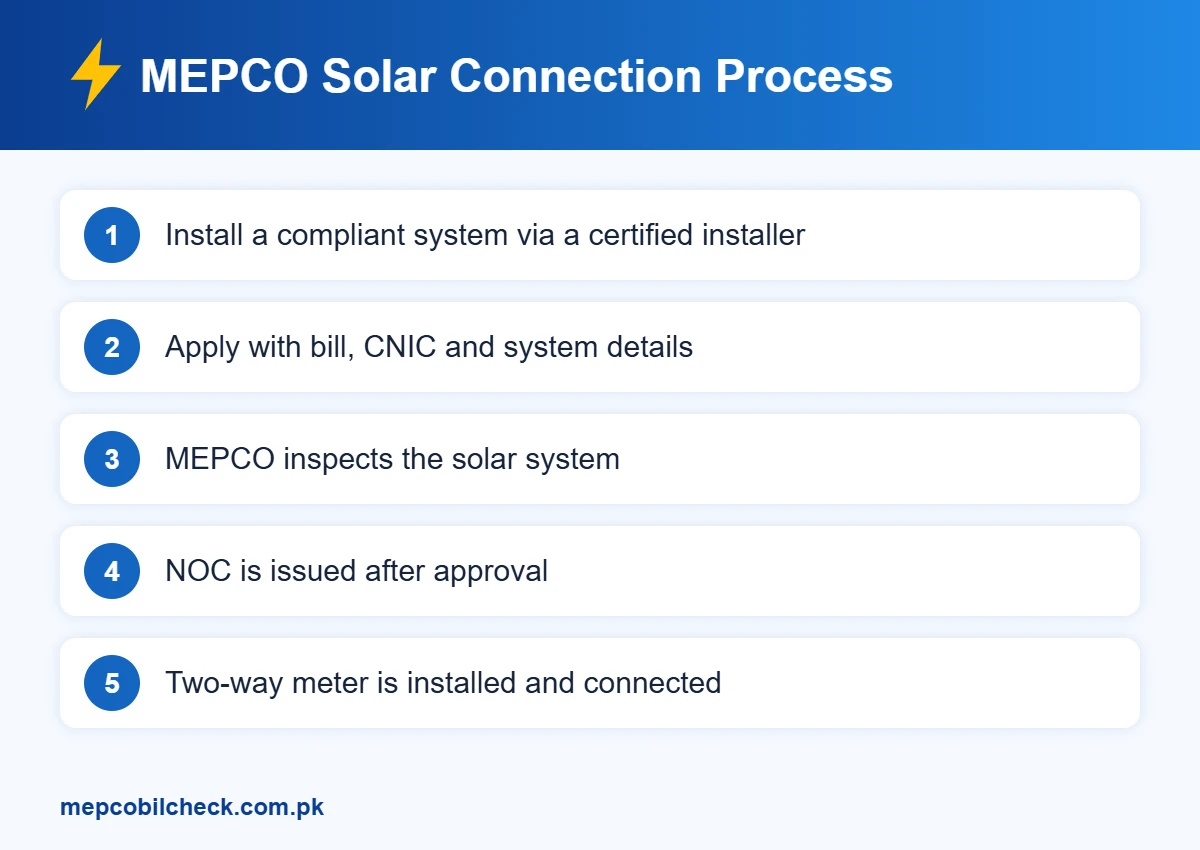
- Install a compliant system through a certified installer.
- Apply to MEPCO with your latest bill, CNIC and the technical data of your solar system.
- Inspection: MEPCO inspects the system.
- NOC: If approved, MEPCO issues a No Objection Certificate.
- Two-way meter: A bidirectional meter is installed and the connection starts working under the applicable regime.
The 2026 regulations also set timelines for the utility: acknowledging applications within 5 working days, completing the technical review within 15 days, and installing the interconnection within 15 days of payment, with NEPRA concurrence expected within 7 working days.
Is Solar Still Worth It in MEPCO Areas?
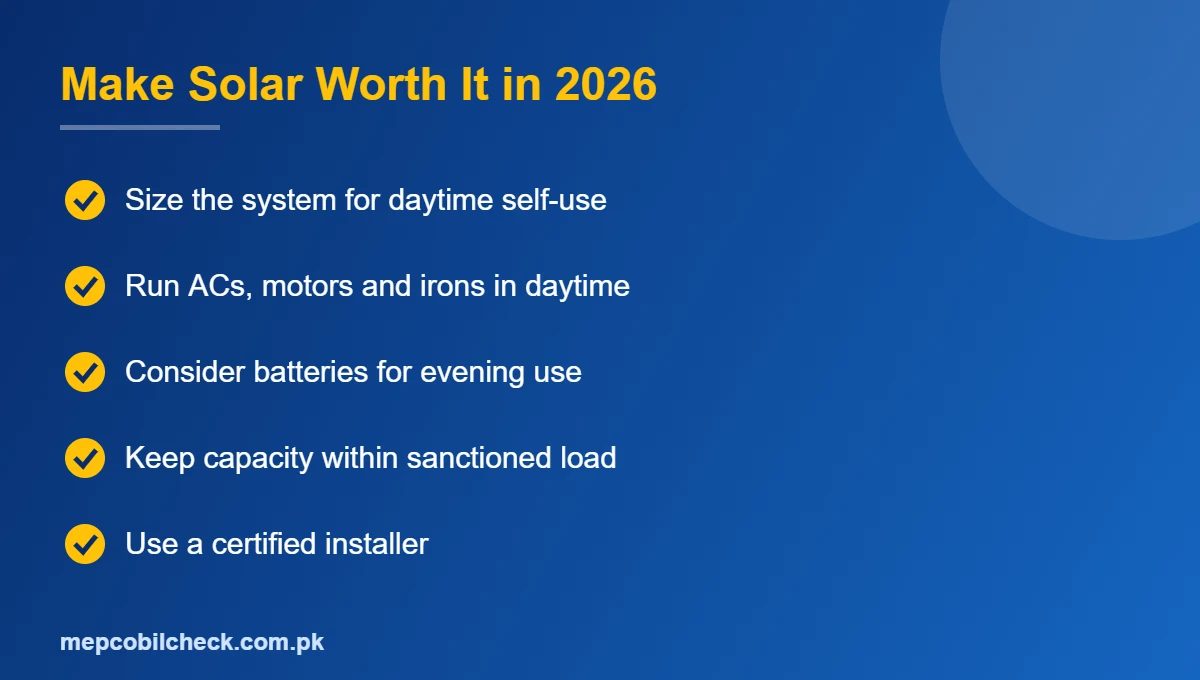
Yes, for many homes, but the strategy has changed. Because a unit you use yourself saves the full retail rate, while a unit you export earns only about Rs 10 to Rs 11, the best approach is to use as much of your own solar power as possible:
- Run ACs, water motors, washing machines and irons in daytime when panels produce power
- Size the system close to your daytime use instead of making it very large for exports
- Consider batteries to store daytime power for the evening peak, when grid rates are highest for TOU users
- Keep your sanctioned load in line with your solar capacity, since capacity is capped at sanctioned load
South Punjab gets strong sunshine for most of the year, so well-sized systems can still cut bills sharply. Use our MEPCO per unit rate guide to see what each saved unit is worth on your tariff.
Example: Value of Self-Use vs Export
Imagine your solar system produces 400 units in a month:
- If you use 300 units yourself and export 100, the 300 self-used units save you the full retail rate, while the 100 exported units earn about Rs 1,000 to Rs 1,100 at the reported buyback rate.
- If you export 300 units and use only 100 yourself, you lose most of the value, because each exported unit earns far less than the rate you pay for grid units at night.
The lesson is simple: under solar net metering rules for new users in 2026, self-consumption is king.
Documents and Costs to Prepare
- Latest MEPCO bill with reference number
- CNIC of the connection owner
- Solar system technical details from your installer (panel and inverter capacity, specifications)
- Proof of property ownership or owner’s consent
- Budget for the two-way meter, interconnection costs and the concurrence fee of Rs 1,000 per kW
Ask MEPCO to issue any meter or interconnection charges through an official demand notice. Our MEPCO meter change guide explains how new meters are installed and checked.
Common Mistakes With Solar in MEPCO Areas
- Buying a large system mainly for exports, when export value is now low
- Installing more capacity than your sanctioned load allows
- Using an installer who is not certified, which can delay or block approval
- Not checking whether your local transformer has space for new solar connections
- Ignoring evening usage, when most grid units are bought
Questions to Ask Your Solar Installer
Before you sign a contract, ask your installer these questions about MEPCO net metering and net billing:
- Are you a certified installer, and have you completed MEPCO solar applications recently?
- What system size do you recommend for my daytime use, not just my total monthly units?
- Will the system stay within my sanctioned load, or do I need a load extension first?
- Who will prepare and submit the application, drawings and technical data to MEPCO?
- What will the two-way meter and interconnection cost, and will MEPCO issue a demand notice?
- How much will I save per month under the new net billing buyback rate?
- Does the price include batteries, and how much evening load can they cover?
A good installer will explain savings using the new rules, not the old net metering Pakistan rates.
MEPCO Solar for Shops, Farms and Businesses
Shops, offices and small factories in South Punjab often use most of their electricity in daytime, which makes solar a strong fit even under net billing, because almost all generation is used on site. Agricultural users also run tube wells in daytime. The same 2026 limits apply: capacity cannot exceed the sanctioned load, and larger systems of 250 kW or more need a load flow study. Business owners should compare their TOU peak and off-peak rates with the expected solar output to find the right size.
How to Track Your MEPCO Solar Application
Keep the application receipt and any reference number from MEPCO. Follow up at your sub-division office if the inspection or NOC is delayed beyond the timelines in the 2026 regulations. If needed, escalate with your dates and receipts through the channels in our MEPCO complaint number guide.
Which Rules Apply to You?
- You already have MEPCO net metering: Your old agreement terms continue until the agreement expires.
- You are installing MEPCO solar now: You come under net billing, so plan for self-use rather than exports.
- You are renewing an expired agreement: Renewals follow the new rules, so review your system size and evening use before renewal.
- You are comparing quotes: Ask installers to calculate savings with today’s solar net metering and net billing rules, not the pre-2026 net metering Pakistan rates.
Quick Summary: MEPCO Net Metering 2026
- MEPCO net metering for new users has been replaced by net billing under NEPRA’s 2026 Prosumer Regulations.
- Existing net metering users keep their old terms until their agreements expire.
- New solar net metering users sell exported units at about Rs 10 to Rs 11 and buy at retail rates.
- Net metering in Pakistan now rewards using solar power at home rather than exporting it.
- Apply through MEPCO with your bill, CNIC and system data after installation by a certified installer.
Frequently Asked Questions
Is MEPCO net metering still available in 2026?
New connections now come under net billing. Existing net metering users continue under their old agreements until they expire.
What is the buyback rate for new solar users?
Exported units are bought at the national average energy purchase price, reported at about Rs 10 to Rs 11 per unit.
How do I apply for solar with MEPCO?
Install a compliant system through a certified installer, then apply to MEPCO with your bill, CNIC and system details. After inspection and approval, a two-way meter is installed.
Can my solar system be larger than my sanctioned load?
No. Under the 2026 regulations, system capacity is limited to the consumer’s sanctioned load.
Is solar still worth it under net billing?
For many homes, yes, if the system is sized for daytime self-use and the household shifts heavy loads to daytime.
One Comment