MEPCO Green Meter 2026: How It Works, Cost, Readings & New Net Billing Rules
Rooftop solar has spread quickly across Multan, Bahawalpur and the rest of South Punjab, and with it a new word on everyone’s lips: the MEPCO green meter. A green meter is the bidirectional meter that records electricity flowing both ways between your home and the grid. In 2026 the rules behind it changed, so this guide explains how a bidirectional meter works, how to read it, what the new net billing rules mean for your bill, what to expect on green meter price and other costs, and how to apply.
What Is a MEPCO Green Meter?
A MEPCO green meter is the common name for a two-way (bidirectional) meter installed for solar users who are connected to the grid. A normal meter only counts the units you take from MEPCO. A bidirectional meter keeps two separate counts:
- Import: units you draw from the MEPCO grid, for example at night or on cloudy days
- Export: surplus solar units your system sends back to the grid, usually around midday
People call it a green meter because it is linked to green, renewable solar energy. It does not make electricity free on its own; it simply measures both directions accurately so MEPCO can bill and credit you correctly.
Net Metering vs Net Billing: What Changed in 2026
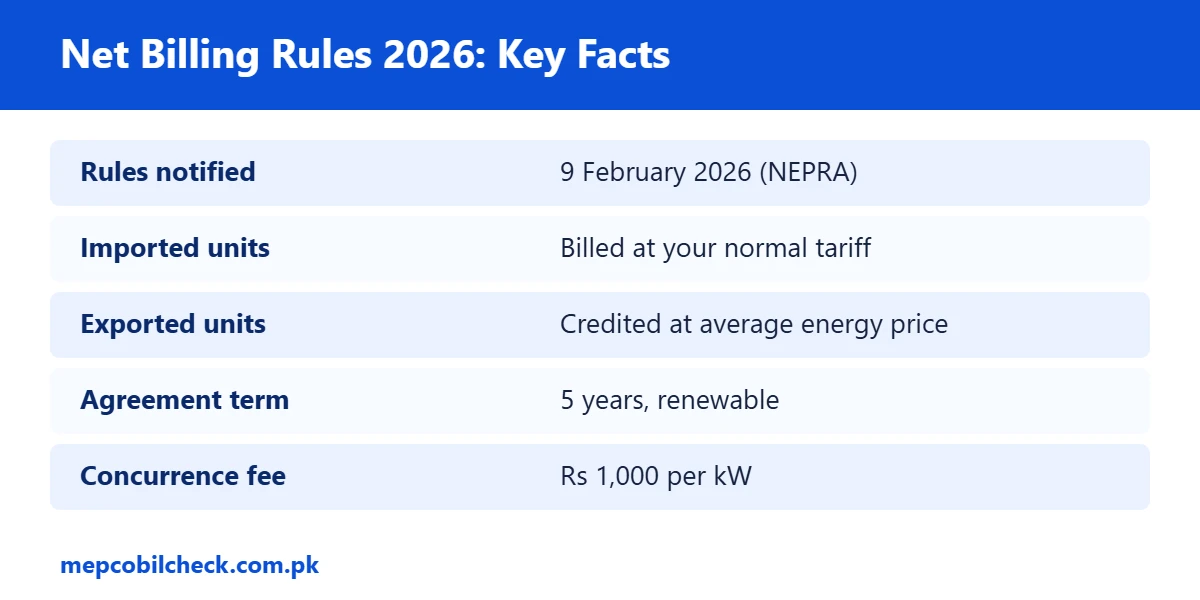
On 9 February 2026, NEPRA notified the Prosumer Regulations 2026, which replaced the 2015 net metering regulations, as reported by The Express Tribune. The key change is the move from unit-for-unit net metering to net billing:
- Old net metering: exported units were adjusted against imported units, so one exported unit roughly cancelled one imported unit.
- New net billing: imported units are billed at your normal applicable tariff, while exported units are credited at the national average energy purchase price, which press reports put at around Rs 10 to 11 per unit when the rules were notified.
- Credits: if your export credit is larger than your import charges, the balance is carried forward or settled under the agreement.
- Agreement term: new agreements run for five years instead of seven and can be renewed.
Existing agreements signed under the old rules remain valid until they expire; renewals then follow the new framework. Always check the latest decisions on the NEPRA website.
How to Read Your MEPCO Green Meter
Most bidirectional meters have a digital display that cycles through several readings, or you press a button to scroll. Labels differ by model, but you will usually see:
| Display item | Common label or code | Meaning |
|---|---|---|
| Total import | Import kWh or 1.8.0 | Units taken from the grid |
| Total export | Export kWh or 2.8.0 | Solar units sent to the grid |
| Peak / off-peak | T1, T2 or similar | Time-of-use import registers |
| Maximum demand | MDI | Highest load recorded in the month |
| Date and time | Clock display | Used for time-of-use billing |
Note both import and export once a month, ideally on your reading date, and compare them with the bill. Our article on MEPCO peak hours explains why time-of-use registers matter.
How Green Meter Units Appear on Your Bill
A solar user’s bill shows imported units, exported units and the resulting charges and credits. Under net billing, the energy cost of imported units is calculated at your tariff, and the export credit is calculated at the lower buy-back rate, so a month with equal import and export can still leave a payable amount. Fixed charges, taxes, the monthly fuel adjustment and the quarterly adjustment can also apply to the import side. Use our MEPCO bill calculator and MEPCO per unit rate guide to estimate the import cost.
Green Meter Price and Other Costs
There is no single fixed green meter price for every home. Under the 2026 rules, the prosumer pays for interconnection equipment, including the meter and any required upgrades, so the final cost depends on the meter type, the connection and the installer. When budgeting, include:
- The bidirectional meter: price varies by single-phase or three-phase model and supplier. For context, the federal government said in December 2025 that the cost of a three-phase smart meter for distribution companies had fallen from about Rs 45,000 to Rs 25,000, excluding taxes.
- Concurrence fee: a non-refundable Rs 1,000 per kW of system capacity, for example Rs 10,000 for a 10 kW system.
- Installation and testing: wiring, protection devices and inspection.
- Paperwork: application documents, agreement and any approval charges.
Ask MEPCO and two or three certified installers for written quotes before paying anyone. Be careful of agents who promise “fast” green meters for extra cash.
Who Can Apply for a Bidirectional Meter?
You can apply if you are a MEPCO consumer with a grid-connected solar system that meets the technical rules. Under the 2026 regulations:
- System capacity can range from 1 kW up to 1 MW and is tied to your sanctioned load.
- New connections are not allowed on a transformer once distributed generation on it reaches 80% of its rated capacity.
- Systems of 250 kW and above need a load flow study.
If your sanctioned load is too low for the system you want, apply for a load increase first. Our MEPCO load extension guide explains how.
How to Apply for a MEPCO Green Meter
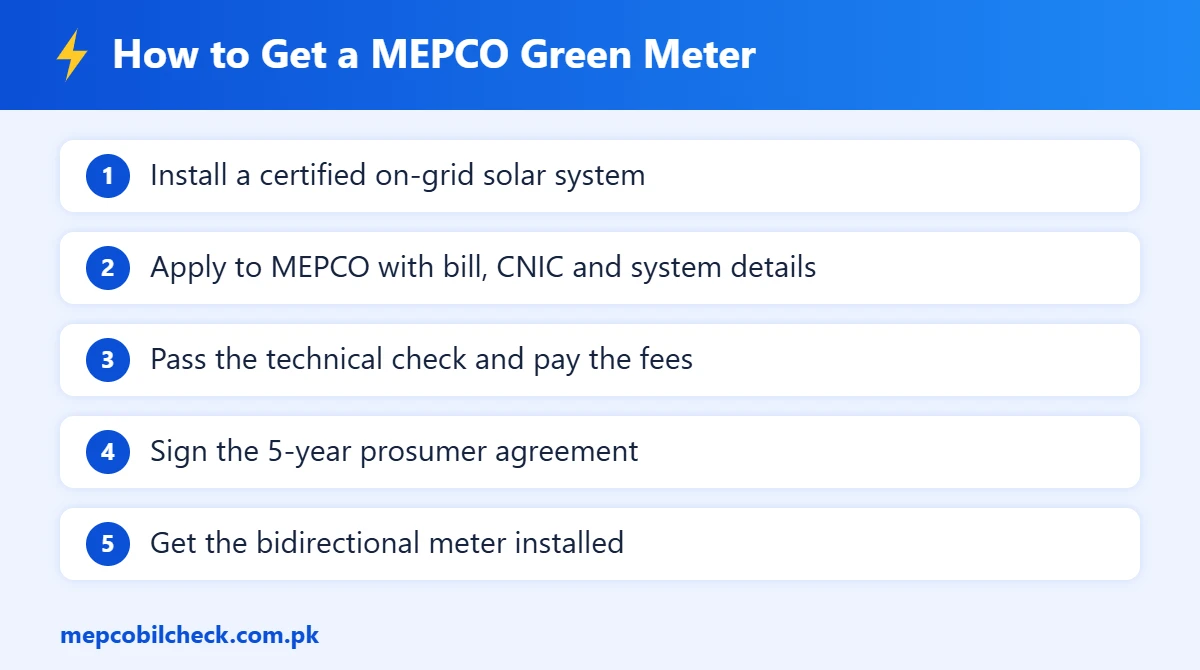
- Install or plan a certified system: use a reputable installer and an on-grid inverter that meets MEPCO’s technical requirements.
- Prepare documents: a copy of your CNIC, the latest paid bill, system and inverter details, and the installer’s certificates.
- Submit the application at your MEPCO office or through the official process explained in our MEPCO net metering guide.
- Technical inspection: MEPCO checks your site, transformer capacity and protection equipment.
- Pay fees and sign the agreement: pay the concurrence fee and other charges, then sign the five-year prosumer agreement.
- Meter installation: MEPCO installs or approves the bidirectional meter and starts billing under net billing.
Is a Green Meter Still Worth It?
Under net billing, every unit you use directly from your panels saves the full retail tariff, while every unit you export earns a much lower credit. That means the best savings come from using solar power during the day, not from exporting as much as possible. Families who run air conditioners, water motors, washing machines and irons in daylight hours still benefit greatly. If most of your use is at night, consider a smaller system or discuss storage options with a certified installer.
Green Meters for Shops, Offices and Farms
The same prosumer rules apply to commercial, industrial and agricultural connections, as long as the system stays within the sanctioned load and the 1 MW limit. Shops and offices are good candidates for solar because most of their use happens in daylight, which means more of the solar output is used directly at full tariff value instead of being exported at the lower credit rate. Farmers in South Punjab with daytime tube well loads can see similar benefits, though many now choose off-grid solar pumps that need no bidirectional meter at all. Compare both options with a certified installer, and check whether a MEPCO new connection or a change of tariff is needed before applying.
Common Green Meter Problems
- Export not showing on the bill: compare your meter’s export register with the bill and file a complaint with photos if they differ.
- High bill despite solar: check import units at night and fixed charges, which net billing does not cancel.
- Faulty or blank display: report it quickly; a faulty meter can lead to estimated billing. See our MEPCO meter change guide.
- Wrong reading: request a correction with dated meter photos, as explained in our MEPCO bill correction guide.
Get More From Your MEPCO Green Meter
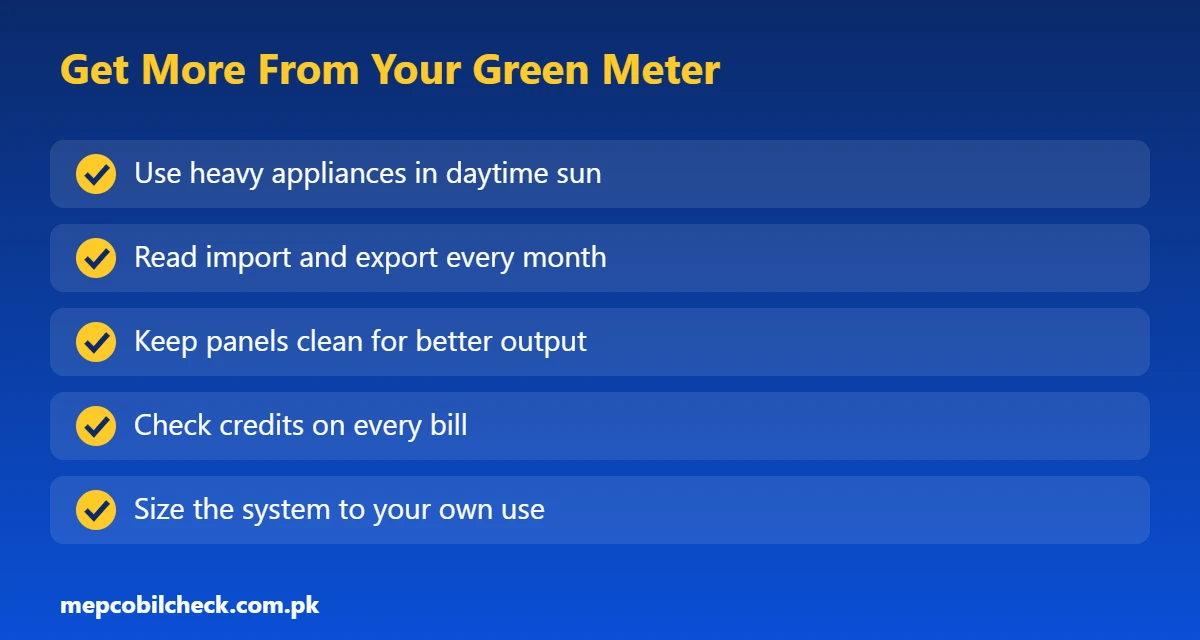
A few habits make a big difference: run heavy appliances when the sun is strongest, keep panels clean, especially after dust storms, read your import and export registers every month and check the credits on each bill. Size any new system to your own daytime use rather than for export.
Quick Summary: MEPCO Green Meter
- A MEPCO green meter is a bidirectional meter that records import and export separately.
- Since February 2026, new solar users are on net billing: imports at the normal tariff, exports at a lower average energy price.
- Costs include the meter, installation and a Rs 1,000 per kW concurrence fee; get written quotes.
- Existing agreements continue until expiry, then move to the new rules.
Frequently Asked Questions
What is a MEPCO green meter?
It is a bidirectional meter for grid-connected solar users. It records the units you import from MEPCO and the units you export to the grid.
What is the green meter price in 2026?
There is no single price. It depends on the meter type, supplier and installation work, and the prosumer pays for the meter and interconnection. Get written quotes from MEPCO and certified installers.
Is net metering still available with MEPCO?
New solar users fall under net billing since February 2026. Consumers with older net metering agreements keep their terms until the agreement expires.
How do I read the export units on a bidirectional meter?
Scroll the display until you see the export register, often labelled Export kWh or 2.8.0. Labels vary by model, so check the meter manual or ask MEPCO.
Can a green meter make my bill zero?
Not usually under net billing. Exported units earn a lower credit than the price of imported units, and fixed charges and taxes still apply.
5 Comments