How to Read MEPCO Bill 2026: Every Section Explained in Simple Words
Your electricity bill is full of numbers, codes and short forms, and most people only look at the amount and the due date. Learning how to read MEPCO bill sections properly can save you money, because it helps you catch wrong readings, missed payments and slab jumps before you pay. This guide gives you the MEPCO bill explained box by box, in the order you will see it, with a simple MEPCO bill sample calculation at the end.
Why Learning How to Read MEPCO Bill Matters
Every month NEPRA adjusts fuel costs, quarterly charges and sometimes slab rates, so two bills with the same units can show different totals. When you know how to read MEPCO bill lines, you can tell whether a higher amount comes from more units, a slab change, an adjustment or a mistake. Billing errors are not rare: wrong readings, estimated units and missed payments all happen, and the only person who checks your bill every month is you. Knowing how to read MEPCO bill details also helps when you talk to the sub-division office, because you can point to the exact line that looks wrong.
The New MEPCO Bill Format
In June 2026 the Power Division said that MEPCO, along with LESCO and GEPCO, had started printing a simpler bill design with key amounts, due dates and consumption shown more clearly and a QR code for extra digital services (Geo News report). The layout may look slightly different from older bills, but the information is the same. Learn more about the code in our MEPCO bill QR code guide.
1. Consumer and Connection Details
The top part of the bill identifies your connection:
- Name and address: the registered consumer, which may be the owner rather than the tenant.
- Reference number: 14 digits followed by U (urban) or R (rural). You need it to check and pay your bill. See our MEPCO online bill enter 14 digit guide.
- Customer ID: a 10 digit number that also works on the web bill page.
- Tariff: your category, for example domestic (A-1) or commercial (A-2).
- Sanctioned load: the load approved for your connection, in kW. It affects fixed charges.
- Meter number, feeder and sub-division: useful for complaints, load shedding schedules and office visits.
If the tariff or load looks wrong, ask your sub-division office to correct it, because both affect your bill every month.
2. Reading Date, Issue Date and Due Date
- Reading date: when the meter reader recorded your meter.
- Issue date: when the bill was generated.
- Due date: the last day to pay without a late payment surcharge.
A reading period much longer than a month can push your units into a higher slab. Compare the reading date with last month’s bill.
3. Meter Readings and Units
This is the most important part of the bill:
| Field | Meaning |
|---|---|
| Previous reading | Meter reading at the last billing date |
| Present reading | Meter reading on this month’s reading date |
| MF | Multiplying factor, usually 1 for homes |
| Units consumed | (Present – Previous) x MF |
| Meter photo | A snap of your meter taken at reading time |
The meter reader takes a photo of the meter showing the reading, and this snap is printed on the bill. Check that the number in the photo matches the present reading. If it does not, or the photo is unclear, you have strong grounds for a correction request.
4. Bill History
A history table shows units, bill amounts and payments for the past 12 months. Use it to compare this month with the same month last year. A sudden jump with no change in appliances is a reason to read your meter and question the bill.
5. Charges: The MEPCO Bill Explained Line by Line
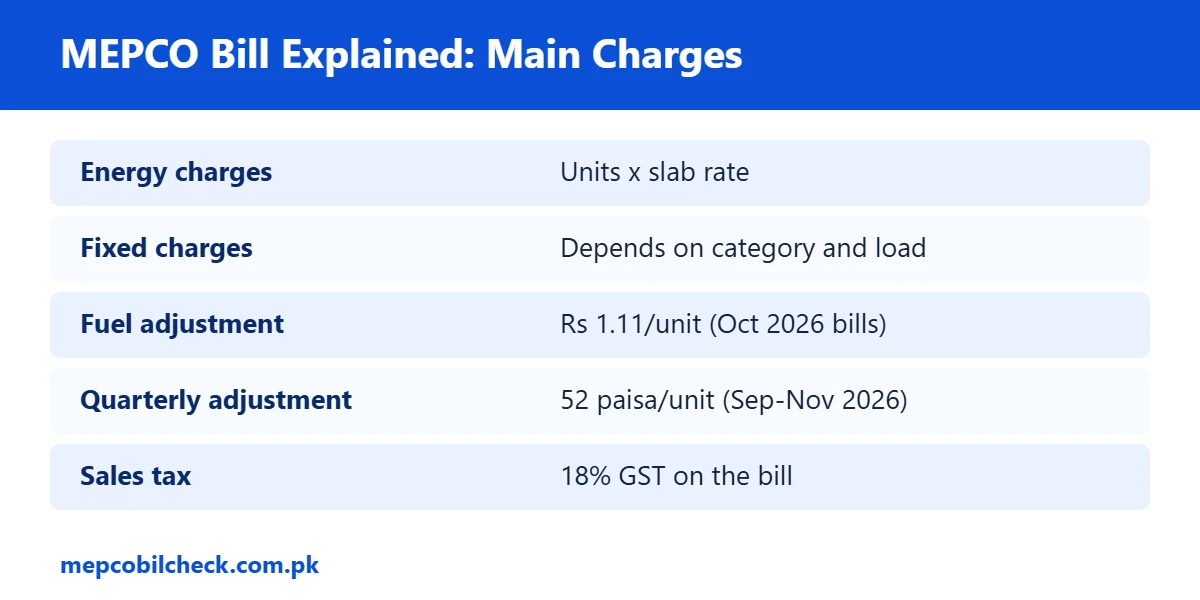
- Cost of electricity (energy charges): units multiplied by the NEPRA slab rate for your category. Rates are listed in our MEPCO per unit rate guide.
- Fixed charges: since NEPRA’s February 2026 decision, fixed charges apply to most domestic consumers too, while lifeline users are exempt.
- Fuel charges adjustment (FCA or FPA): a monthly adjustment for actual fuel costs. For example, about Rs 1.11 per unit was charged in October 2026 bills. See our FPA in electricity bill guide.
- Quarterly tariff adjustment (QTA): a three-month adjustment, reported at 52 paisa per unit for September to November 2026.
- General sales tax: 18% on the taxable bill amount.
- Income tax: advance income tax applies to non-filers whose domestic bills exceed Rs 25,000.
- Electricity duty: no longer charged on domestic bills since July 2025, as explained in our electricity duty on MEPCO bill guide. The PTV fee was also removed in 2025.
6. Protected or Non-Protected Status
Domestic consumers who use 200 units or less every month for the previous six months are treated as protected and pay lower slab rates. Crossing 200 units even once can move you to non-protected rates for months. The bill shows your category, and our MEPCO subsidy guide explains the rules and upcoming changes.
7. Arrears, Installments and Adjustments
- Arrears: unpaid amounts from earlier bills. If you paid on time and still see arrears, keep your receipt and complain.
- Installment: if MEPCO approved an installment, the bill shows the current installment and remaining balance. See our MEPCO bill installment guide.
- Corrections and detection: any correction or detection amount should be listed separately with a reason. Read about MEPCO detection bill rules if you see one.
8. Payable Within and After Due Date
The bill shows two totals: the amount payable within the due date and a higher amount payable after the due date, which includes the late payment surcharge. Always aim to pay the first amount. All payment channels are listed in our MEPCO bill payment guide.
How to Read MEPCO Bill in Five Minutes
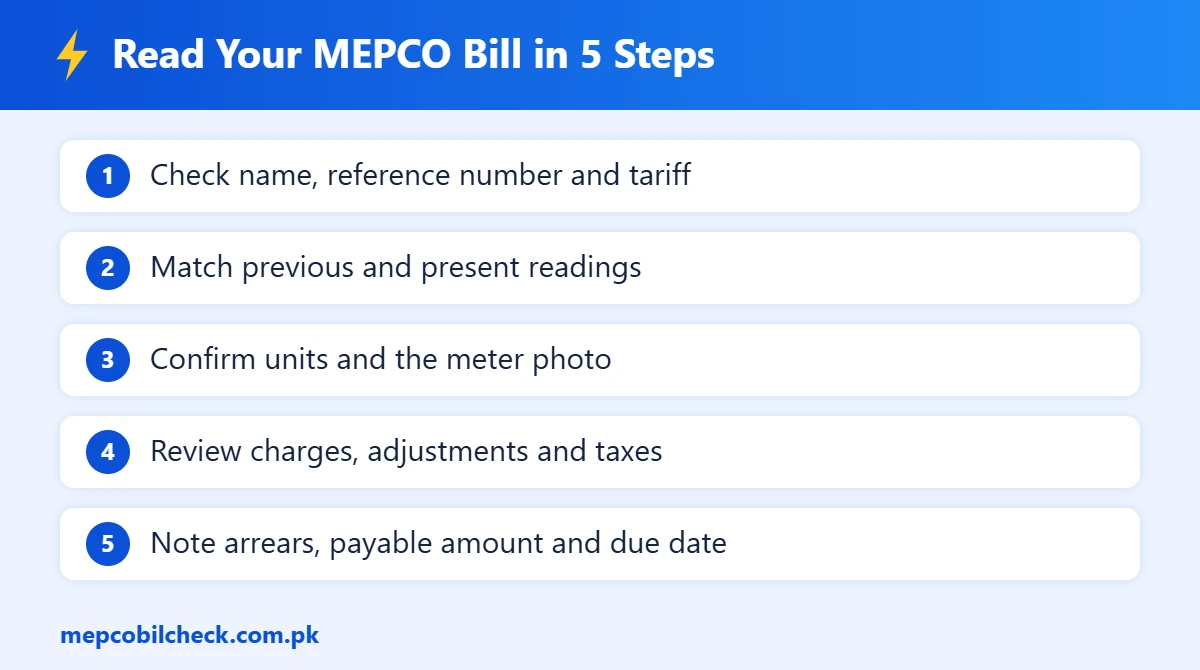
- Confirm the name, reference number, tariff and sanctioned load.
- Subtract the previous reading from the present reading and match the units.
- Check the meter photo against the present reading.
- Look through energy charges, fixed charges, FCA, QTA and taxes.
- Check arrears and note the payable amount and due date.
MEPCO Bill Sample Calculation
This is where knowing how to read MEPCO bill charges pays off. Here is a simple MEPCO bill sample for a non-protected home using 250 units in a month, based on the 2026 domestic slab rates and the one previous slab benefit used in the tariff:
| Item | Calculation | Amount |
|---|---|---|
| First 200 units | 200 x Rs 28.91 | Rs 5,782 |
| Next 50 units | 50 x Rs 33.10 | Rs 1,655 |
| Energy charges | Total | Rs 7,437 |
| Fixed charges | 1 kW x Rs 350 | Rs 350 |
| Base total | Before FCA, QTA and taxes | Rs 7,787 |
Fuel adjustment, quarterly adjustment and 18% sales tax are added on top. To include them for your own units, use our free MEPCO bill calculator.
Common Short Forms: MEPCO Bill Explained
| Short form | Full meaning |
|---|---|
| FPA / FCA | Fuel price or fuel charges adjustment |
| QTA | Quarterly tariff adjustment |
| GST | General sales tax |
| MF | Multiplying factor |
| MDI | Maximum demand indicator (for larger loads) |
| TOU | Time of use (peak and off-peak billing) |
| kWh | Kilowatt hour, one unit of electricity |
| LPS | Late payment surcharge |
With these short forms, the MEPCO bill explained above becomes much easier to follow, even on older bill designs.
Where to See a MEPCO Bill Sample
The best MEPCO bill sample is your own latest bill, because it shows your actual tariff and charges. Open it on the official PITC web bill page with your reference number, as described in our MEPCO web bill guide, and keep it next to this article while you read each section. Avoid copying bill photos from social media, as they may be old formats or another category, and never post your own full bill online because it shows your name, address and reference number.
Red Flags to Look For
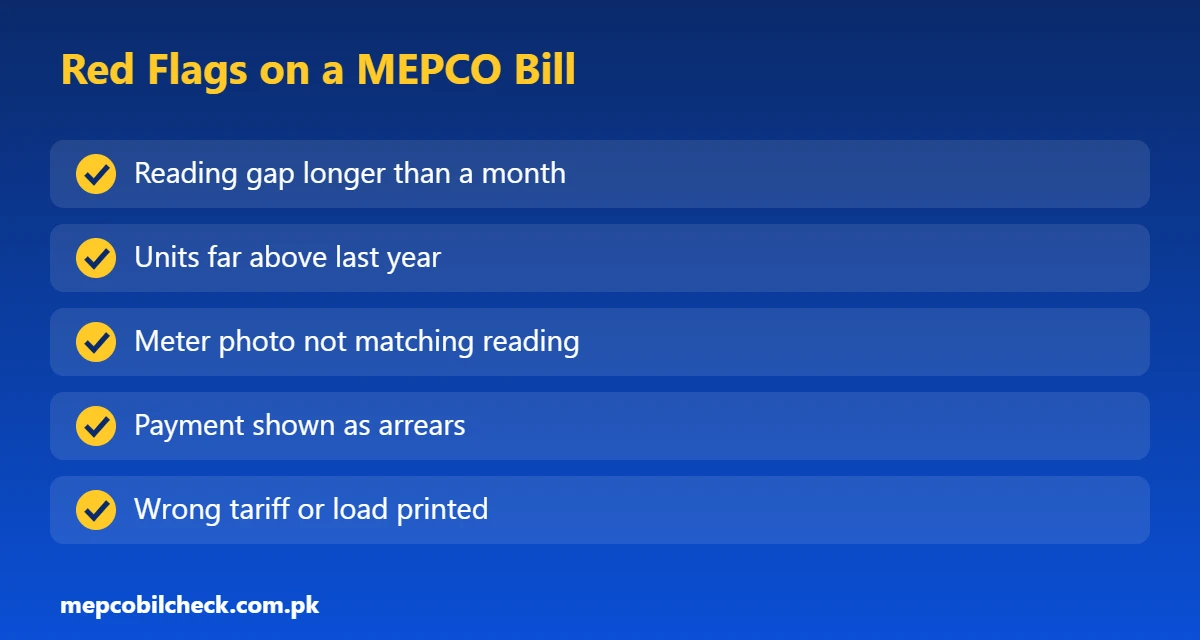
- A reading period much longer than 30 days
- Units far above the same month last year
- A meter photo that does not match the present reading
- A payment you made shown as arrears
- A wrong tariff, load or name
If you spot any of these, apply for a correction before the due date with your bill, CNIC and a dated photo of your meter. Our MEPCO bill correction guide explains the process, and our why is my electricity bill so high article covers common causes.
Quick Summary: How to Read MEPCO Bill
- Start with connection details: reference number, tariff and load.
- Match readings, units and the meter photo.
- Understand each charge: energy, fixed charges, FCA, QTA and taxes.
- Check arrears and pay the within-due-date amount on time.
- Keep this MEPCO bill explained checklist handy and repeat it every month.
Frequently Asked Questions
How do I read my MEPCO bill units?
Subtract the previous reading from the present reading and multiply by the MF printed on the bill. For most homes the MF is 1.
What is FPA or FCA on the MEPCO bill?
It is the monthly fuel charges adjustment decided by NEPRA. It can increase or reduce your bill depending on actual fuel costs.
Why is there a meter photo on my bill?
The meter reader photographs your meter at reading time so you can verify that the billed reading is correct.
What does protected consumer mean on a MEPCO bill?
It means a domestic consumer who used 200 units or less every month for the previous six months and gets lower slab rates.
Where can I see a MEPCO bill sample?
Use your own latest bill from the official PITC web bill page as a MEPCO bill sample. It shows your real tariff and charges, which makes it easier to learn how to read MEPCO bill sections.
Is electricity duty still charged on MEPCO bills?
Electricity duty was removed from domestic bills from July 2025. Check the tax lines on your bill to confirm.
4 Comments