How to Calculate Electricity Units: Watts to Units Formula, Examples & Bill Estimate (2026)
Every electricity bill is built on one number: units. If you know how to calculate electricity units, you can estimate your bill before it arrives, see which appliance costs the most and avoid crossing an expensive slab. This guide explains what one unit means, the simple watt to unit formula, worked examples for common appliances, and how to turn units into an estimated MEPCO bill. You can also use our free MEPCO bill calculator as an electricity unit calculator once you know your units.
Why Learn How to Calculate Electricity Units?
Most families only see the total amount on the bill, not where the units come from. When you know how to calculate electricity units, you can spot which appliance is pushing you into a higher slab, check whether a new AC or heater is worth it, and question a bill that looks wrong. A simple watt to unit calculation takes less than a minute and can save thousands of rupees in summer. It also turns any notebook into an electricity unit calculator you can use before buying appliances.
What Is One Unit of Electricity?
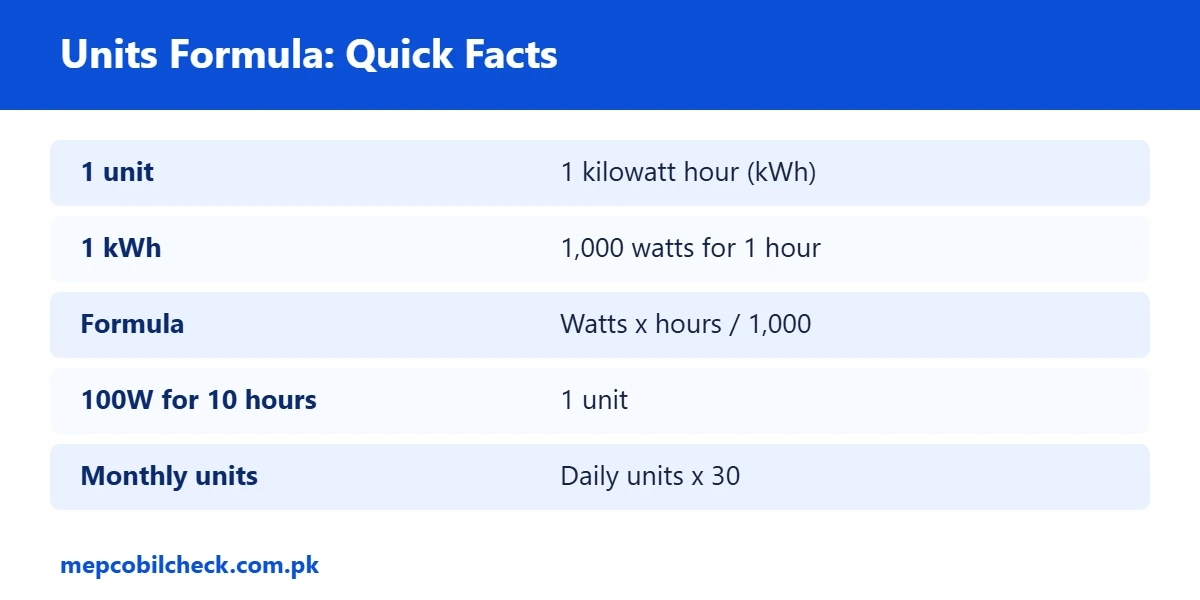
One unit on your bill is one kilowatt hour (kWh). It means using 1,000 watts of power for one hour. For example:
- A 1,000W iron used for 1 hour uses 1 unit.
- A 100W bulb used for 10 hours uses 1 unit.
- A 50W fan used for 20 hours uses 1 unit.
So “units” and “kWh” are the same thing. Your meter counts kWh, and MEPCO bills you for those units.
The Watt to Unit Formula
Units = Watts x Hours / 1,000
That is the whole formula. To get monthly units, multiply daily units by the number of days:
Monthly units = (Watts x Hours per day / 1,000) x 30
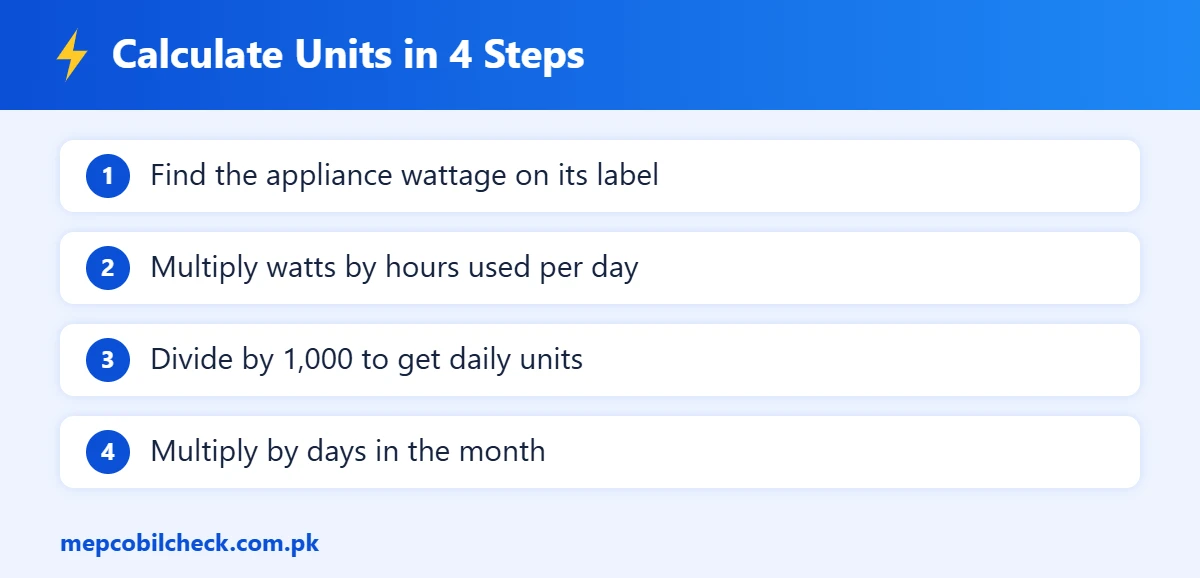
You can find the wattage on the appliance label, the box or the user manual. If the label shows amps instead, multiply amps by 220 volts to get approximate watts.
Watts, Kilowatts, Amps and Units Explained
These terms confuse many people, so here is a simple breakdown:
- Watt (W): how much power an appliance draws at a moment.
- Kilowatt (kW): 1,000 watts. Your sanctioned load on the bill is in kW.
- Amp (A): electric current. At about 220 volts, 1 amp is roughly 220 watts.
- Unit or kWh: energy used over time, which is what you pay for.
Knowing the difference is the first step in learning how to calculate electricity units correctly. A powerful appliance used for a short time can use fewer units than a small appliance running all day.
Worked Examples
Ceiling Fan
A 75W ceiling fan running 12 hours a day: 75 x 12 / 1,000 = 0.9 units per day, or about 27 units a month.
LED Bulb
A 12W LED bulb running 8 hours a day: 12 x 8 / 1,000 = 0.096 units per day, or about 3 units a month.
Water Motor
A 1 HP motor (about 746W) running 1 hour a day: 746 x 1 / 1,000 = about 0.75 units per day, or about 22 units a month.
Electric Iron
A 1,000W iron used 30 minutes a day: 1,000 x 0.5 / 1,000 = 0.5 units per day, or about 15 units a month.
Inverter AC
A 1.5 ton inverter AC averaging about 1,000W for 8 hours: 1,000 x 8 / 1,000 = 8 units per day, or about 240 units a month.
These examples show why air conditioners, heaters and motors decide most bills. Our inverter AC electricity consumption guide explains AC units in more detail.
Room Heater
A 1,500W room heater running 4 hours a winter evening: 1,500 x 4 / 1,000 = 6 units per day, or about 180 units a month, enough to push many homes past the 200-unit protected limit on its own.
Add Up Your Whole House
To estimate your total, list every appliance with its watts and daily hours, calculate units for each, and add them up.
| Appliance | Watts | Hours/day | Units/month |
|---|---|---|---|
| 4 ceiling fans | 4 x 75 | 12 | 108 |
| 8 LED bulbs | 8 x 12 | 6 | 17 |
| Fridge (average draw) | 150 | 24 | 108 |
| TV | 100 | 5 | 15 |
| Water motor | 746 | 1 | 22 |
| Iron | 1,000 | 0.5 | 15 |
| Total | About 285 |
A fridge’s compressor switches on and off, so its average draw is much lower than its starting power; check the energy label for yearly kWh if available.
Why Your Estimate May Differ From the Meter
Even a careful watt to unit calculation will not match the meter exactly. Appliances rarely draw their full rated power all the time, voltage changes affect consumption, and old wiring or faulty earthing can add losses. Billing periods also vary between 28 and 35 days. If your meter shows far more units than your estimate, check for hidden loads, a faulty appliance or leakage using the pulse light test explained in our meter guide, and compare with your bill history.
Check Your Answer With the Meter
The most accurate electricity unit calculator is your own meter. Note today’s reading, then subtract the present reading printed on your last bill. The difference is the units you have used since the reading date. Our guide on how to read electric meter displays explains each screen.
From Units to Your MEPCO Bill
Units are only the first step. Your bill also depends on:
- Slab rate: protected or non-protected, and the slab your units fall in. See our MEPCO per unit rate guide.
- Fixed charges: a monthly charge per kW of sanctioned load. See our fixed charges in electricity bill guide.
- Fuel charges adjustment: set monthly by NEPRA. November 2026 bills carry Rs 2.3673 per unit for September fuel costs.
- Quarterly adjustment and 18% GST.
For example, 285 units for a non-protected home falls in the 201 to 300 slab, where the base rate is Rs 33.10 per unit. Use our MEPCO bill calculator to include all charges.
Calculating Units for a Shop or Office
The same formula works for businesses. List lights, fans, ACs, computers, fridges and display chillers with their watts and opening hours. Commercial tariffs have no slabs, so every unit costs the same within your category, and the total is easier to estimate. Our MEPCO commercial unit price guide shows how to turn shop units into a bill.
Calculating Solar Units
Solar panels produce units too. In South Punjab, each kilowatt of well-installed panels produces roughly 4 to 5 units a day on average. A 5 kW system can therefore produce about 600 to 750 units a month. Comparing this with your monthly use tells you how much of your bill solar could cover. See our guide on how many solar panels do I need for sizing.
Plan With an Electricity Unit Calculator
Before summer, list the appliances you plan to use and estimate units for June and July. If the total crosses 200 or 300 units, decide in advance which loads to cut or shift. An electricity unit calculator, whether on paper or our online tool, makes these decisions easy and helps you avoid bill shocks. For official tariff decisions behind each rate, you can also follow NEPRA.
Common Mistakes When Calculating Units
- Using starting power instead of running power for fridges and ACs.
- Forgetting standby devices such as routers, set-top boxes and chargers.
- Ignoring seasons: summer and winter use differ hugely in South Punjab.
- Mixing watts and kilowatts: 1.5 kW is 1,500 watts.
- Forgetting the number of days in a billing period, which can be 28 to 35 days.
Use Units to Cut Your Bill
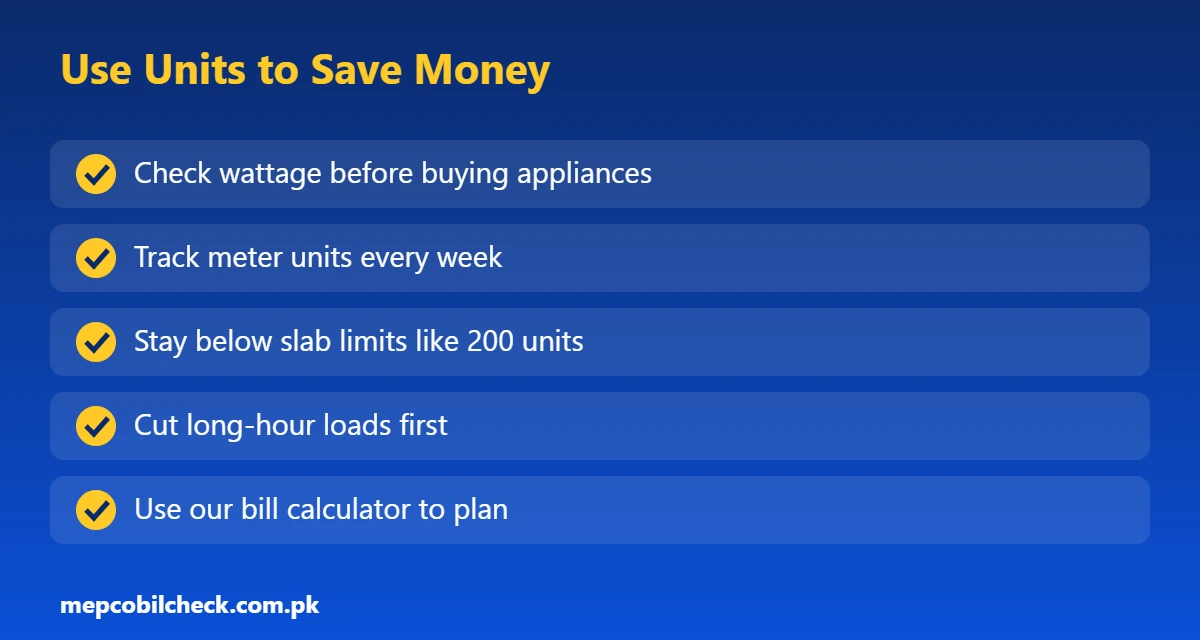
Once you know how to calculate electricity units, you can make smarter choices:
- Check wattage before buying a new appliance.
- Cut the longest-running high-watt loads first.
- Stay below slab limits such as 200 units to keep protected rates.
- Shift motors and irons out of peak hours if you have a time-of-use meter.
More ideas are in our guide on how to reduce electricity bill costs.
Quick Summary: How to Calculate Electricity Units
- 1 unit = 1 kWh = 1,000 watts for one hour.
- Units = Watts x Hours / 1,000; multiply by days for monthly units.
- ACs, heaters and motors use the most units.
- Use your meter and our bill calculator to check and estimate your bill.
- Knowing how to calculate electricity units helps you stay below slab limits and avoid surprises.
Frequently Asked Questions
How do I calculate electricity units from watts?
Multiply the appliance’s watts by the hours used, then divide by 1,000. The answer is units (kWh).
How many units does a 100 watt bulb use in 10 hours?
Exactly 1 unit, because 100 x 10 / 1,000 = 1.
Is 1 unit equal to 1 kWh?
Yes. One unit on your electricity bill is one kilowatt hour.
How many units does a fan use in a month?
A 75W fan running 12 hours a day uses about 27 units a month.
Is there a watt to unit calculator I can use?
Yes. Use the formula above, or our free MEPCO bill calculator to turn units into an estimated bill.






2 Comments