200 Units Electricity Subsidy to End? BISP Targeted Subsidy Plan & 250-Unit Proposal Explained (2026)
Millions of families in Pakistan pay lower electricity rates because they are protected consumers using 200 units or less a month. In 2026, news reports said this 200 units subsidy may be replaced by a targeted scheme paid through the Benazir Income Support Programme (BISP). This guide explains the electricity subsidy BISP plan, what has actually been decided, the separate 250-unit proposal, and what MEPCO consumers should do now.
How the Current 200 Units Subsidy Works
Before looking at the new plan, it helps to understand the current system and why so many families care about it. In South Punjab, where summers are long and incomes are often modest, staying in the protected slab can make the difference between an affordable bill and a heavy one.
Today, a domestic consumer who uses 200 units or less every month for the previous six months is treated as a protected consumer. Protected homes pay much lower slab rates than other homes:
| Category | Units | Rate per unit (2026) |
|---|---|---|
| Lifeline | Up to 50 | Rs 3.95 |
| Lifeline | 51 to 100 | Rs 7.74 |
| Protected | 1 to 100 | Rs 10.54 |
| Protected | 101 to 200 | Rs 13.01 |
| Non-protected | 1 to 100 | Rs 22.44 |
| Non-protected | 101 to 200 | Rs 28.91 |
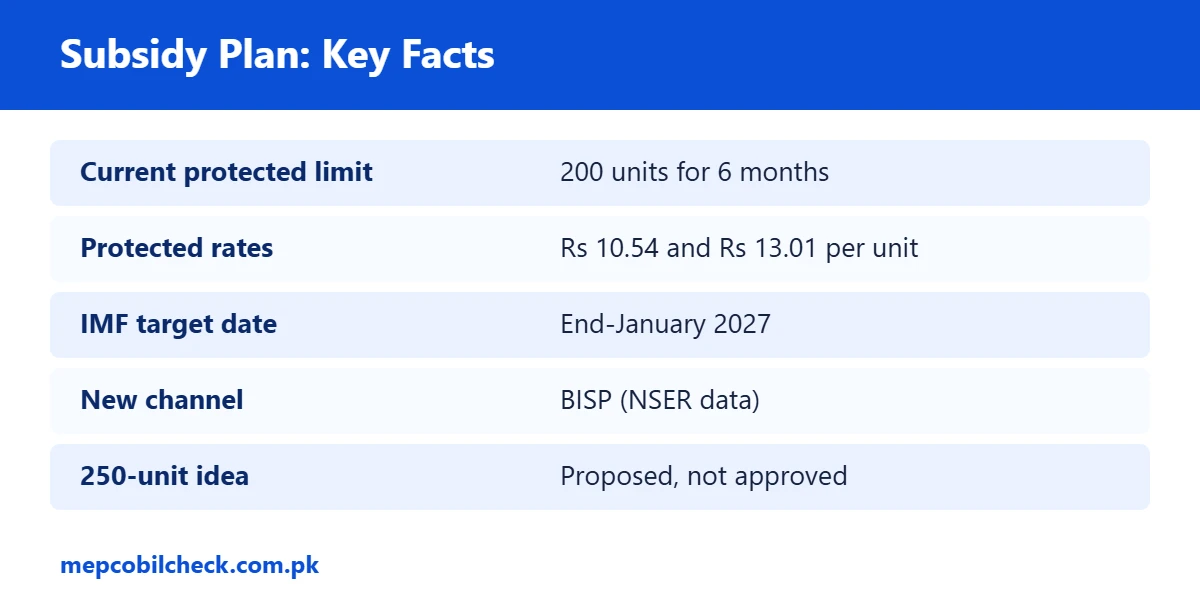
The difference between protected and non-protected rates is the subsidy built into the tariff. It goes to anyone under the limit, whether rich or poor, which is why the government and the IMF want to change it. See the full slab table in our MEPCO per unit rate guide.
What Is the Electricity Subsidy BISP Plan?
Pakistan has committed to the IMF to move from a blanket subsidy inside tariffs to a targeted subsidy for low-income households through BISP. The commitment appears in the government’s Memorandum of Economic and Financial Policies published with the IMF’s December 2025 staff report, as a reform measure under the Resilience and Sustainability Facility.
The reported timeline is:
| Step | Target |
|---|---|
| Link electricity consumers to BISP’s NSER data | End-December 2025 |
| Analyse who should be eligible | End-July 2026 |
| Register eligible consumers | Reported for November 2026 |
| Switch to BISP-based support | End-January 2027 |
Under this approach, low-income households identified through BISP’s National Socio-Economic Registry (NSER) would get support, while other homes using under 200 units might lose the cheap protected rate. Reports such as Geo News describe this as ending the 200 units subsidy for everyone and replacing it with targeted relief.
Why the IMF Wants a Targeted Subsidy
The current 200 units subsidy is given to every home under the limit, including small flats owned by well-off families and rented rooms in large cities. At the same time, some poor families with bigger households cross 200 units in summer and lose the benefit. Economists argue that this blanket approach costs a lot and does not reach the people who need it most. Moving the electricity subsidy BISP route is meant to target support using household income data rather than units alone, and to reduce the cross-subsidy that pushes up rates for other consumers and industry.
How Targeted Support Might Work
The final design has not been announced, but possible options discussed in reports include:
- A discount on the electricity bill for consumers matched with BISP records
- A cash transfer through BISP to help eligible families pay their bills
- A combination of a basic low rate for very small users and targeted cash support
Each option depends on correctly matching electricity connections with families. That is why linking the right CNIC to every meter has become important.
What Has Actually Been Decided?
This is important: nothing has changed on your bill yet. As of November 2026:
- No new tariff for protected consumers has been notified.
- Eligibility rules for BISP-based electricity support have not been published.
- The amount and method of support (bill discount or cash transfer) have not been announced.
- Any change needs a NEPRA decision and a federal government notification before it applies to bills.
Until then, protected consumer rates continue under the current tariff.
The 250-Unit Proposal
On 27 October 2026, Power Minister Sardar Awais Leghari told the Senate, in reply to a calling attention notice, that the government plans to raise the protected threshold from 200 to 250 units. This is a plan, not a decision. No start date was given, and it has not been approved by NEPRA or notified. It is also unclear how it fits with the IMF commitment on targeted subsidies. For now, the limit on your MEPCO bill is still 200 units.
Recent Changes for Protected Consumers
| Date | Change |
|---|---|
| February 2026 | Fixed charges extended to protected homes (Rs 200 to Rs 300 per kW per month) |
| 2026 | Consumer data linking and eligibility work reported under the IMF programme |
| 27 October 2026 | Power minister says a 250-unit limit is planned |
| End-January 2027 | Target date for BISP-based targeted support |
Read our fixed charges in electricity bill guide to see how the February 2026 change already affects protected consumer bills.
Who Could Be Affected?
- Protected consumers not registered with BISP could lose the low protected rates if the plan goes ahead.
- BISP families are expected to keep some form of support.
- Lifeline consumers using very few units may also be affected, depending on the final design.
- Non-protected consumers already pay higher rates and would see little direct change, though fixed charges and adjustments still apply.
What MEPCO Consumers Should Do Now
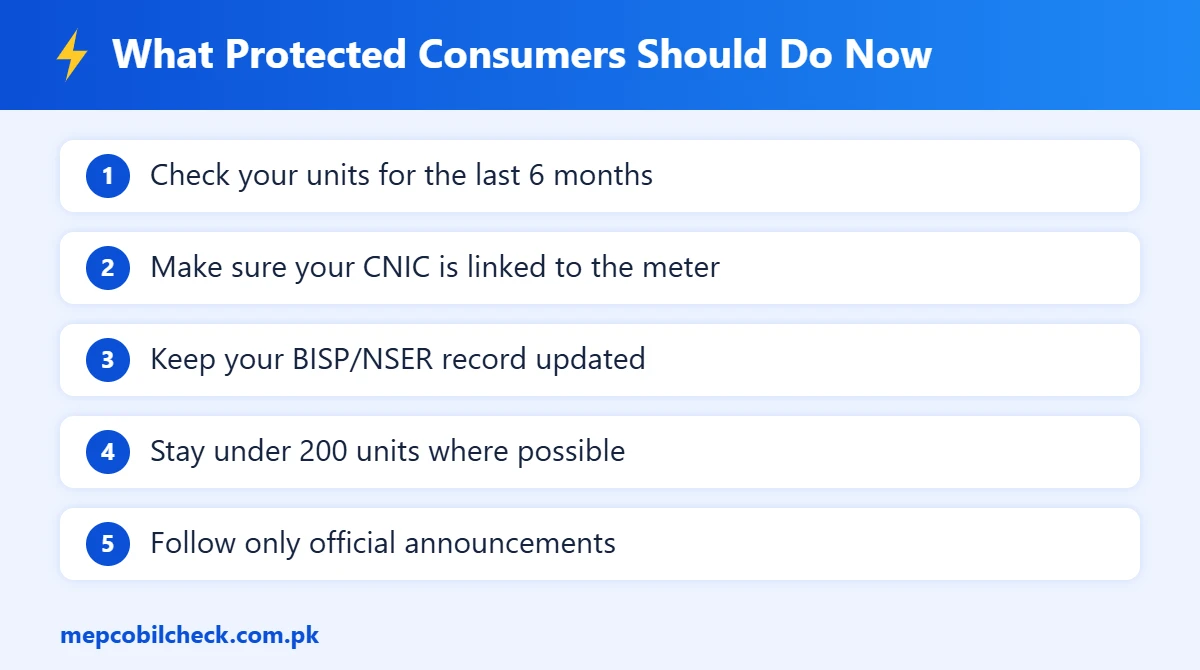
- Check your last six months of units on the bill history using our MEPCO bill check online tool.
- Link the correct CNIC to your connection. Targeted support depends on matching consumers with BISP data. If the bill is in a landlord’s or late parent’s name, ask about updating details through the MEPCO app or your sub-division office. Our MEPCO name change guide explains the process.
- Keep your BISP/NSER information up to date through official BISP channels if your family is registered.
- Stay under 200 units where possible to keep protected rates while they last. Our how to reduce electricity bill guide has 15 practical tips.
- Ignore unofficial messages promising subsidy registration for a fee.
How Much Could Bills Rise?
If a home using 150 units moved from protected to non-protected rates, the energy charge would change roughly as follows (base rates, before fixed charges, adjustments and taxes):
| Status | Calculation | Energy charge |
|---|---|---|
| Protected | 100 x Rs 10.54 + 50 x Rs 13.01 | Rs 1,704.50 |
| Non-protected | 100 x Rs 22.44 + 50 x Rs 28.91 | Rs 3,689.50 |
That is roughly double the energy charge, which is why the final design matters so much for low-income families. Our MEPCO subsidy guide explains the existing subsidy rules in more detail.
Tenants and Shared Houses
Many families live in rented homes where the meter is in the landlord’s name. If targeted support is matched through CNIC records, the person named on the connection may matter. Tenants who receive BISP support should talk to their landlord about how the bill is recorded, and keep copies of paid bills as proof that they use and pay for the connection. Joint families sharing one meter may also find it harder to stay under 200 units, so tracking units each week becomes even more useful.
Where to Follow Official Updates
Policy news changes quickly, and social media often spreads rumours about the 200 units subsidy. For reliable updates, follow tariff decisions on the NEPRA website, official statements from the Power Division and BISP’s official channels. When a final decision is notified, the new rates will also appear on your bill under the tariff and charges section. Our guide on how to read MEPCO bill sections shows where to look. We will update this page when an official notification is issued.
Beware of Subsidy Scams
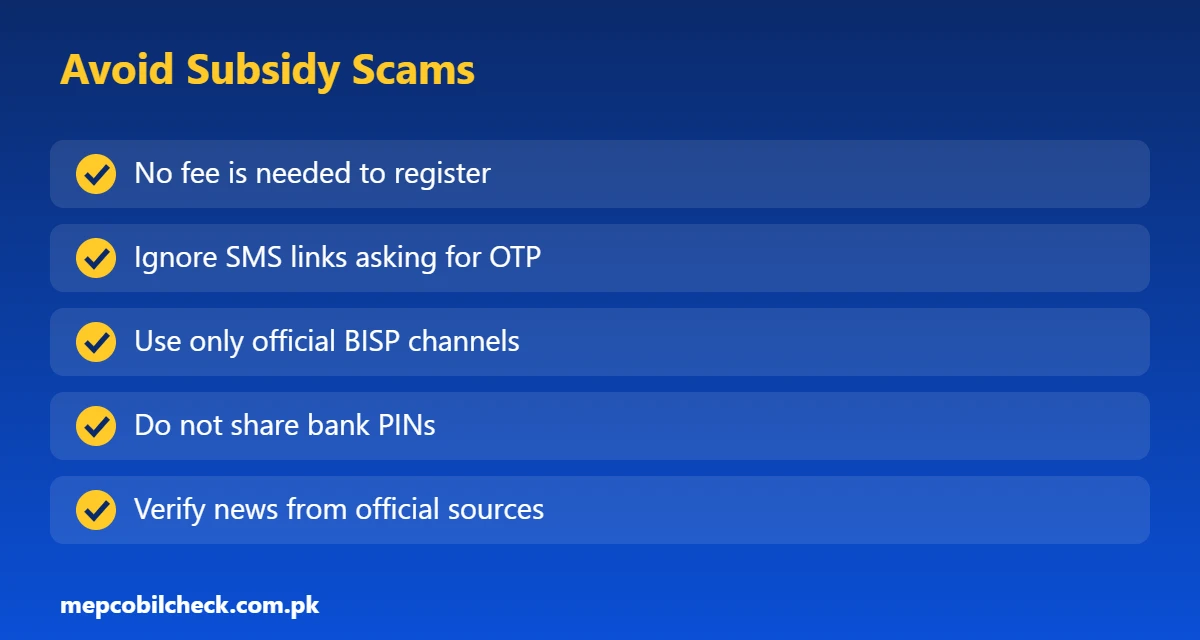
Big policy news brings scammers. Remember:
- Government subsidy registration never requires a fee.
- Do not click SMS links asking for your CNIC, OTP or bank PIN.
- Use only official BISP channels and official government announcements.
- MEPCO staff will not ask for money to “keep your subsidy”.
Quick Summary: Electricity Subsidy BISP Plan
- Protected consumers using up to 200 units for six months pay much lower rates today.
- Pakistan has told the IMF it will move to targeted support through BISP by end-January 2027.
- Nothing is in force yet; NEPRA and the federal government must approve any tariff change.
- A 250-unit protected limit has been proposed but not approved.
Frequently Asked Questions
Is the 200 units subsidy ending?
The government has committed to replace the blanket 200 units subsidy with targeted support through BISP, with a target of end-January 2027. As of November 2026, no new tariff had been notified.
Who will get the electricity subsidy through BISP?
Low-income households identified through BISP’s NSER data are expected to qualify. Detailed eligibility rules have not been published.
Has the protected limit been raised to 250 units?
No. The power minister said in October 2026 that the government plans to raise it to 250 units, but it has not been approved or notified.
Will my bill change in December 2026?
Not because of this plan, unless NEPRA and the government notify a change. Monthly fuel adjustments and other existing charges still apply.
What is a protected consumer?
A domestic consumer who used 200 units or less every month for the previous six months.