EV Charging Rate in Pakistan 2026: Station Tariff, Home Charging Cost & Electric Bike Units
Electric bikes, rickshaws and cars are becoming common in Pakistan, including in Multan and other South Punjab cities. The big question for owners is the EV charging rate in Pakistan: how much does a unit cost at a charging station, and what does charging at home add to a MEPCO bill? This guide explains the official EV charging station tariff, the real electric vehicle charging cost at home, example calculations for e-bikes and cars, and tips to charge cheaper.
Why EV Charging Costs Matter in South Punjab
Fuel prices are a major monthly expense for families who commute to work, school and markets. Electric bikes and rickshaws can cut that cost sharply, but only if charging does not push the household electricity bill too high. Knowing the EV charging rate in Pakistan and how home charging affects your slab helps you decide whether an electric vehicle really saves money.
The Official EV Charging Station Tariff
Under the uniform tariff notified in February 2026, electric vehicle charging stations (EVCS) have their own category with a rate of Rs 23.57 per unit, and no fixed charges listed for this category. This is much lower than commercial rates of Rs 35 to Rs 44 per unit and most non-protected domestic slabs.
In addition, NEPRA’s decision on the September 2026 fuel charges adjustment, charged in November 2026 bills, exempted EV charging stations from the Rs 2.3673 per unit increase, as reported by Business Recorder.
Important: Rs 23.57 is the rate a charging station pays the power company. The price drivers pay at a public charger is set by the operator, who adds equipment, rent and service costs. So the EV charging rate in Pakistan at a public station will usually be higher than Rs 23.57.
Charging at Home: What Rate Do You Pay?
If you charge an e-bike or car at home on a normal domestic connection, those units are added to your household units and billed at your domestic slab rate:
| Status and slab | Base rate per unit |
|---|---|
| Protected 101 to 200 | Rs 13.01 |
| Non-protected 101 to 200 | Rs 28.91 |
| Non-protected 201 to 300 | Rs 33.10 |
| Non-protected 301 to 400 | Rs 36.46 |
| Non-protected above 700 | Rs 47.20 |
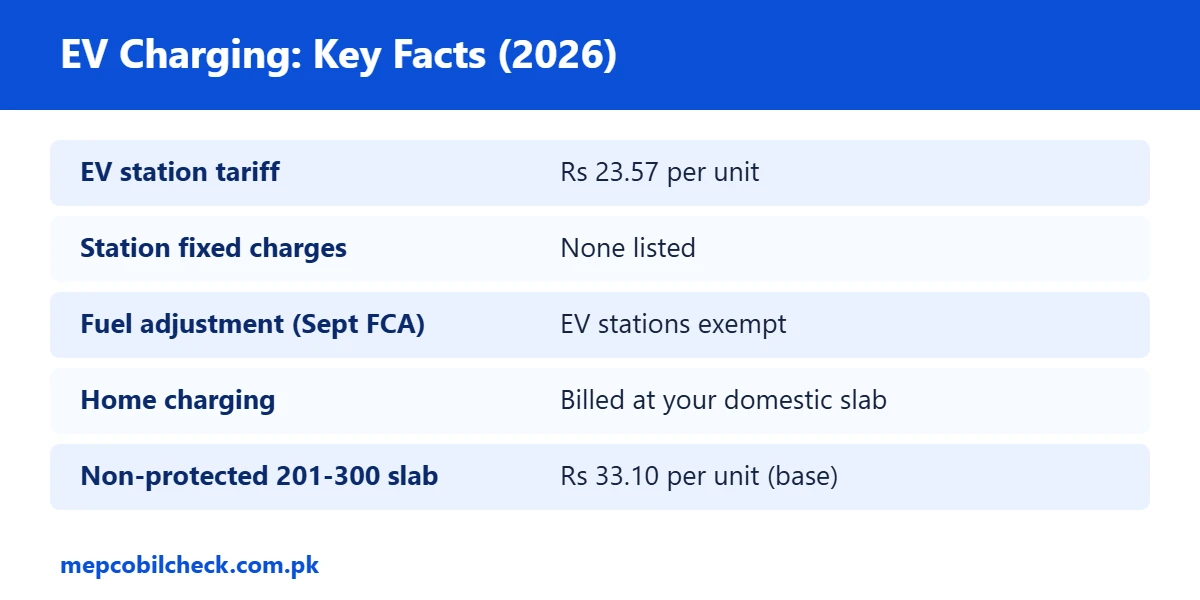
Fixed charges, the monthly fuel adjustment, the quarterly adjustment and 18% GST are added on top. Charging at home can also push a protected home above 200 units, which removes protected rates for six months. See our MEPCO per unit rate guide for all slabs.
Electric Vehicle Charging Cost: Worked Examples
Units to charge = battery kWh x about 1.1 (to allow for charging losses)
Electric Bike
A typical electric bike battery might hold about 2 kWh. A full charge needs about 2.2 units.
- At Rs 33.10 per unit: about Rs 73 per full charge (base rate only)
- Charging 20 times a month adds about 44 units
Electric Rickshaw
A larger battery of about 7 kWh needs roughly 7.7 units per full charge.
- At Rs 33.10: about Rs 255 per charge
- Daily charging adds about 230 units a month, which can move a home into a higher slab
Electric Car
A car with a 50 kWh battery needs about 55 units for a full charge.
- At the EVCS tariff of Rs 23.57: about Rs 1,296 in electricity cost before the operator’s margin
- At a home rate of Rs 36.46: about Rs 2,005 before adjustments and taxes
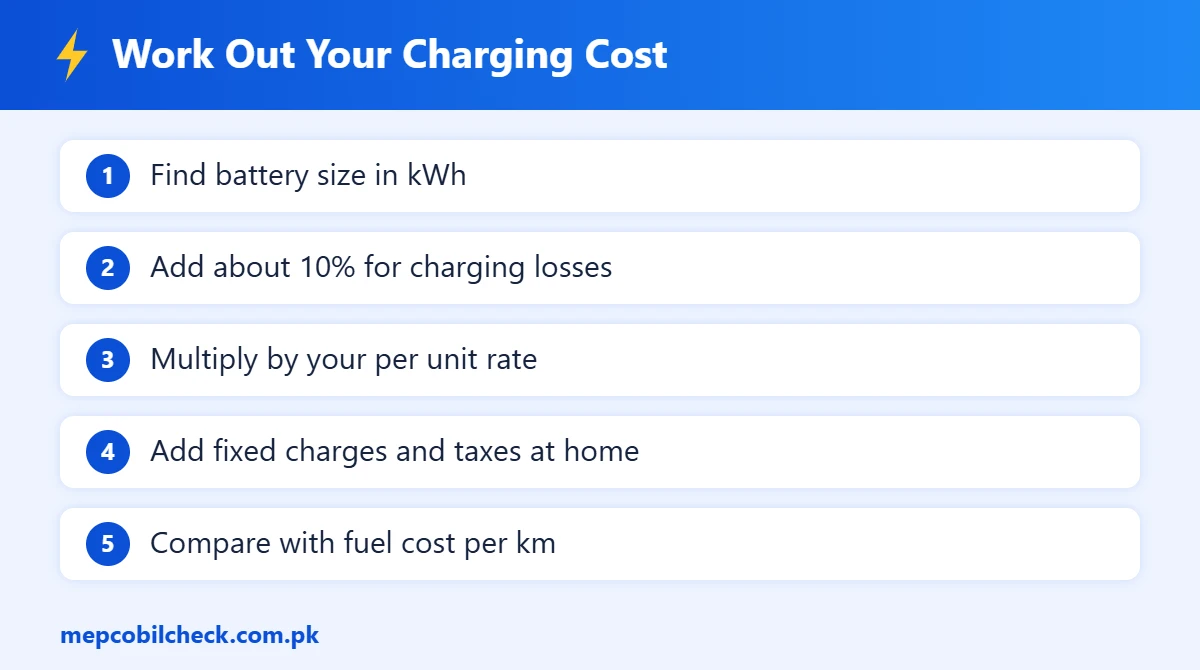
These are simple estimates. Battery sizes differ by model, so check your vehicle’s specifications. Our guide on how to calculate electricity units explains the unit formula.
Cost Per Kilometre: EV vs Petrol
The real question for most riders is cost per kilometre. Many electric bikes travel roughly 60 to 100 km on a full charge, depending on battery size, speed, weight and road conditions. If a full charge costs around Rs 73 at a Rs 33.10 slab rate, the electric vehicle charging cost works out to only about Re 1 per km in electricity, before fixed charges and taxes. Even with all charges added, this is usually far below petrol costs for a similar bike. For cars, efficiency varies widely by model, so check your vehicle’s rated consumption and multiply by your per unit rate.
Charging at Night vs Day
At home, the time of charging does not change the domestic slab rate unless you have a time-of-use meter. With a TOU meter, charging during peak hours costs more, so overnight charging after peak hours is cheaper. With solar, daytime charging is cheapest. Choose the time based on your meter type and solar setup.
Home Charging vs Public Station
| Point | Home charging | Public station |
|---|---|---|
| Rate | Your domestic slab | Operator price (based on Rs 23.57 tariff plus costs) |
| Convenience | Overnight, at home | Fast charging on the road |
| Effect on MEPCO bill | Adds units, may change slab | No effect on home bill |
| Best for | Daily commuting | Long trips, quick top-ups |
Charging From Solar
Charging an EV from rooftop solar during the day is the cheapest option, because each unit comes from your own panels instead of the grid. Under the 2026 net billing rules, using solar power directly is worth more than exporting it at the lower credit rate. If you plan an EV, size your solar system with our guide on how many solar panels do I need and read our MEPCO green meter guide.
EV Charging and Protected Consumers
Families who are protected consumers, using 200 units or less every month for six months, should be careful when adding an electric bike or rickshaw. Charging an e-bike 20 times a month adds about 44 units; an electric rickshaw can add over 200. Crossing 200 units even once moves the home to non-protected rates for the next six months, which can raise the whole bill, not just the charging units. Track your meter weekly and plan charging so the electric vehicle charging cost does not push the household into a higher slab. Our electricity subsidy BISP guide explains possible changes to protected status in 2027.
Batteries: Lead-Acid vs Lithium in E-Bikes
Cheaper electric bikes often use lead-acid batteries, which are heavier, charge more slowly and last fewer cycles. Lithium batteries cost more but are lighter, last longer and usually waste less energy during charging. When comparing bikes, look at battery type and capacity in kWh or amp-hours, because they decide both range and charging units. Our lithium battery price in Pakistan guide explains lithium battery basics.
Safety Tips for Home Charging
- Use the charger supplied by the manufacturer.
- Plug into a dedicated, properly rated socket with earthing; avoid extension boards.
- Do not charge in rain or wet areas.
- Ask an electrician to check whether your wiring and sanctioned load can handle the charger, especially for cars.
- Never leave a damaged battery charging unattended.
If your sanctioned load is too low for car charging, apply for a load increase through our MEPCO load extension guide.
Why the EV Charging Station Tariff Is Lower
The government set a separate, lower EV charging station tariff to encourage electric vehicles, reduce fuel imports and use spare grid capacity, especially at night. The exemption of EV stations from the September 2026 fuel adjustment follows the same goal. Policies can change in future tariff decisions, so check the latest EV charging rate in Pakistan on official NEPRA decisions before investing in a station.
Starting an EV Charging Business
Businesses that set up public charging stations can apply for the EVCS tariff category through MEPCO. The connection, load, equipment and approvals depend on the station size. Commercial operators should compare this with the normal MEPCO commercial unit price to understand the advantage of the EV category.
Tips to Lower Your EV Charging Cost
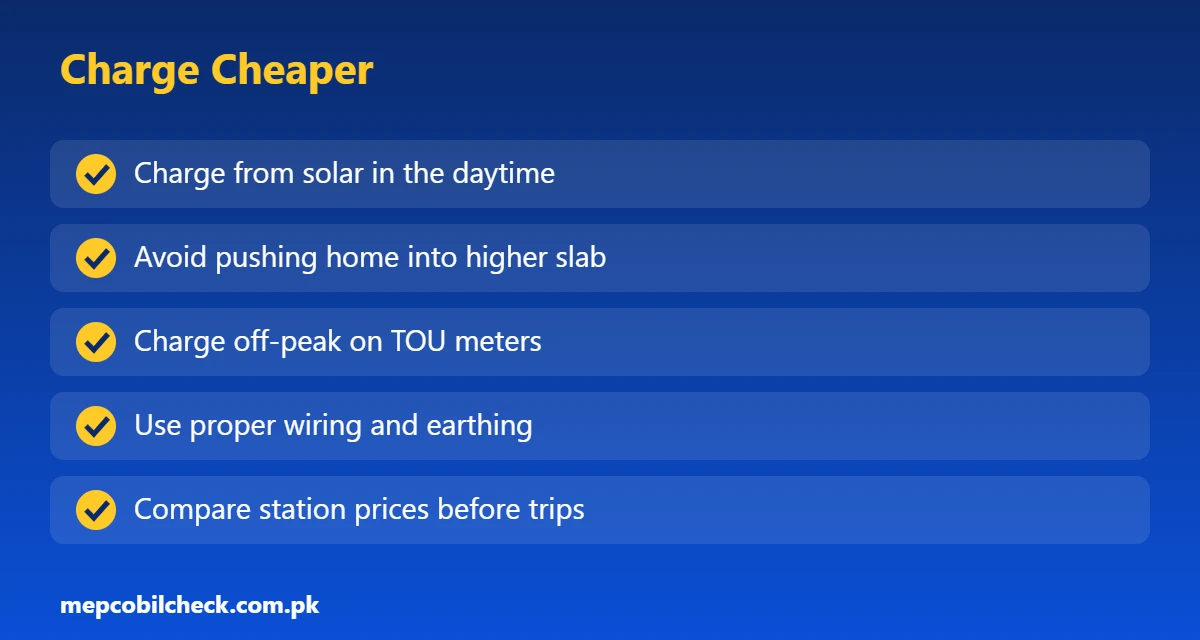
- Charge from solar in the daytime where possible.
- Track monthly units so EV charging does not push your home into a higher slab.
- Charge outside peak hours if you have a time-of-use meter; see our MEPCO peak hours guide.
- Keep tyres inflated and drive smoothly to use fewer units per kilometre.
- Compare public station prices before long trips.
Quick Summary: EV Charging Rate in Pakistan
- The EV charging station tariff is Rs 23.57 per unit, with no fixed charges listed.
- EV stations were exempt from the September 2026 fuel adjustment in November bills.
- Home charging is billed at your domestic slab rate plus adjustments and taxes.
- Public station prices are set by operators and are higher than the base tariff.
Frequently Asked Questions
What is the EV charging rate in Pakistan?
The official EV charging station tariff is Rs 23.57 per unit. Drivers pay the operator’s price, which includes the station’s costs.
How much does it cost to charge an electric bike at home?
A 2 kWh battery needs about 2.2 units, roughly Rs 73 at a Rs 33.10 slab rate before fixed charges, adjustments and taxes.
Does EV charging increase my MEPCO bill?
Yes. Home charging adds units to your household total and can push you into a higher slab.
Are EV stations charged fuel adjustment?
NEPRA exempted EV charging stations from the September 2026 fuel adjustment charged in November 2026 bills.
Can I get the EV tariff at home?
The EVCS category is for charging stations. Normal home charging is billed at domestic rates.